

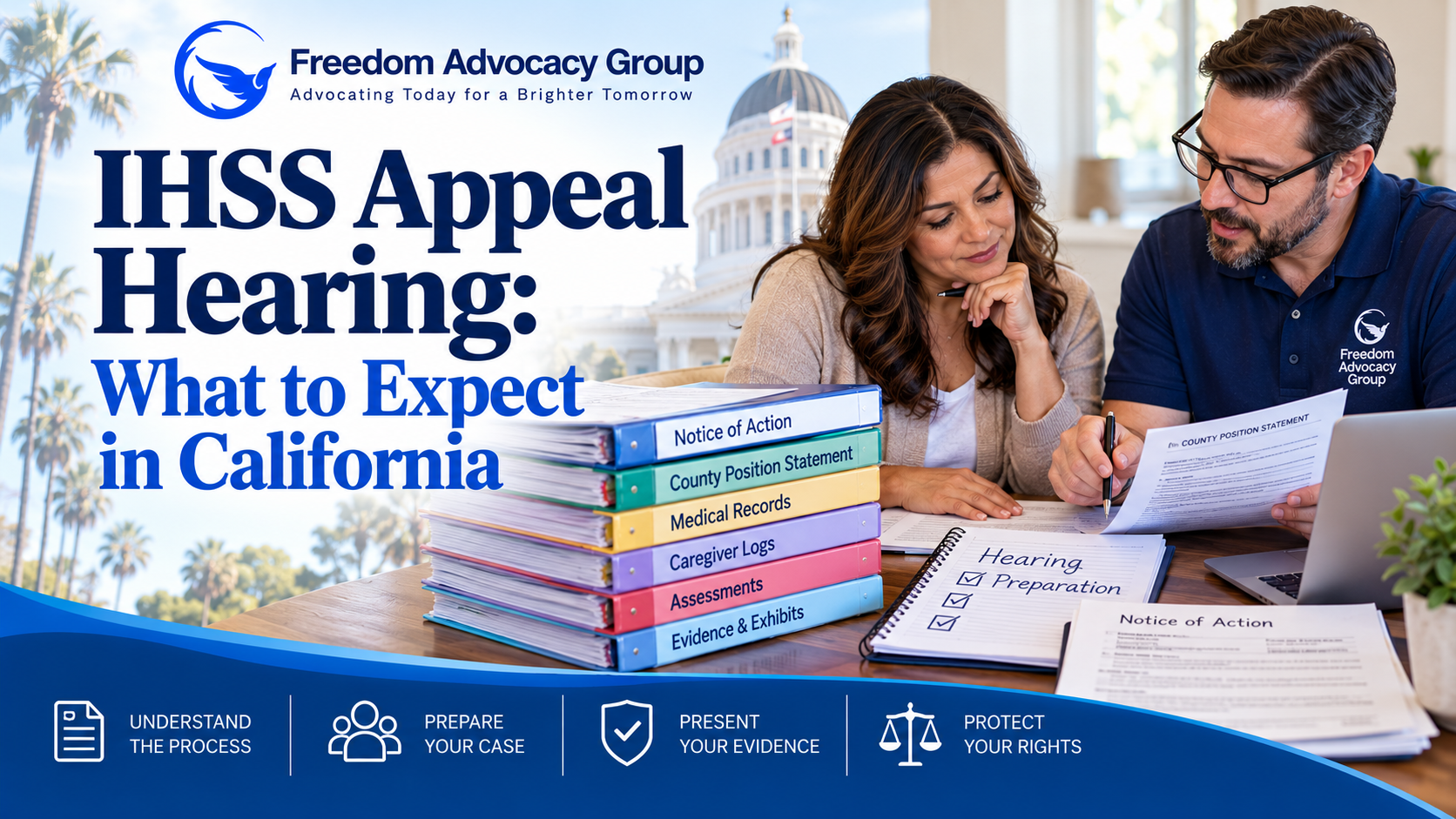
Receiving an IHSS denial, reduction in hours, or denial of Protective Supervision can be frustrating—especially when you believe the county doesn’t fully understand the amount of care or supervision your loved one actually needs.
Requesting an appeal may be the next step.
But then another question often comes up:
What actually happens at an IHSS appeal hearing?
Many California families imagine a courtroom, attorneys arguing, complicated legal terminology, and an intimidating judge.
A California IHSS State Hearing is different from a traditional civil or criminal court trial.
It is an administrative hearing where an Administrative Law Judge (ALJ) reviews the dispute between you and the county. You have an opportunity to explain why you believe the county’s decision was incorrect, present relevant documents, provide testimony, question the county’s position, and have witnesses testify when appropriate.
The county also has an opportunity to explain and support its decision.
The Administrative Law Judge then evaluates the evidence and applicable program rules.
Preparation matters.
Knowing what to expect before your IHSS appeal hearing can help you walk into the process organized, focused, and ready to explain your case.
This guide explains the California IHSS hearing process, the county’s position statement, what evidence to prepare, what questions you may be asked, what happens during the hearing, common mistakes to avoid, and what happens after the hearing.
Table Of Contents
Table of Contents
What Is an IHSS Appeal Hearing?
An IHSS appeal hearing is a California State Hearing used to resolve disputes involving actions or inaction by a county administering In-Home Supportive Services.
You might request a hearing because the county:
- Denied your IHSS application
- Reduced existing IHSS hours
- Denied a particular IHSS service
- Denied Protective Supervision
- Reduced Protective Supervision or other services
- Determined that fewer hours were necessary than you believe are required
- Made a decision after a reassessment that you disagree with
- Failed to act on information or a request in circumstances that may be appealable
The purpose of the hearing is to give you an opportunity to challenge the county’s decision through an independent administrative process.
The California Department of Social Services State Hearings Division conducts these hearings.
The person deciding the dispute is an Administrative Law Judge.
The judge is not your IHSS social worker. The judge is also not there simply to accept whatever the county says.
The State Hearings Division’s role is to provide an impartial review of the disputed agency action.
Who Will Be at an IHSS State Hearing?
Every case is different, but an IHSS hearing commonly involves:
- The claimant — the IHSS applicant or recipient whose services are disputed.
- The claimant’s representative — if the claimant has authorized another person to assist or represent them.
- A county representative — someone responsible for presenting and explaining the county’s position.
- The Administrative Law Judge — the person conducting the hearing and evaluating the dispute.
- Witnesses — when either side has relevant witnesses.
- An interpreter — when language assistance is needed and arranged.
Depending on the circumstances, a social worker or other county employee involved with the assessment may also participate.
A claimant does not necessarily need to hire an attorney simply to participate in a State Hearing.
California allows claimants to represent themselves or use an authorized representative.
The important issue is making sure whoever presents the case understands the facts, the disputed county decision, and the evidence.
Is an IHSS Hearing Like Going to Court?
Not exactly.
A State Hearing is an administrative proceeding rather than a traditional courtroom trial.
It is still serious.
Testimony and evidence matter.
But families should not assume they will walk into a dramatic courtroom scene with a jury and opposing attorneys making television-style arguments.
The process is designed to give both sides an opportunity to explain their positions.
The Administrative Law Judge may ask questions.
The county explains why it took the disputed action.
You or your representative explain why you believe that decision was incorrect.
Relevant documents can be considered as evidence.
Witnesses may testify.
The goal isn’t to create the most emotional argument.
The goal is to show, as clearly as possible, why the evidence and applicable IHSS rules support your position.

Start With Your IHSS Notice of Action
One of the most important documents in an appeal is the Notice of Action, commonly called the NOA.
The Notice of Action should identify the action the county has taken.
For example, it might say that:
- Protective Supervision was denied
- Certain IHSS hours were reduced
- An application was denied
- A particular service was not authorized
- Previously authorized services will change
Read the Notice of Action carefully.
Don’t prepare an appeal around what you think the county decided.
Identify exactly what was decided and why.
Then ask:
What do I need to prove to show that this decision should be changed?
That question should guide much of your hearing preparation.
If you have only recently received an unfavorable Notice of Action and have not yet requested your hearing, review Freedom Advocacy Group’s guide to the IHSS appeal deadline immediately.
California generally gives claimants 90 days to request a State Hearing regarding a county action, but waiting until the end of that period can create other problems.
If existing services are being reduced or stopped, the effective date on the Notice of Action may be especially important because requesting the hearing before that effective date may affect whether existing services continue pending the hearing under applicable aid-pending rules.
What Is the County’s Position Statement?
The county position statement is one of the most important documents you should understand before the hearing.
The county prepares a written explanation of its position.
The statement generally describes:
- The facts as the county understands them
- The disputed action
- Why the county believes its action was correct
- The regulations or program rules supporting its position
- Documentary evidence the county intends to rely upon
Think of the position statement as the county explaining:
“Here is what we decided, here is why we decided it, and here is the evidence and authority supporting our decision.”
That makes it extremely valuable when preparing your response.
Get the County’s Position Statement Before the Hearing
Don’t wait until the hearing begins to learn what the county plans to argue.
California CDSS guidance explains that a claimant can contact the appropriate county office about obtaining the position statement before the hearing.
If you don’t receive or pick it up beforehand, you should generally be given an opportunity to review it before the hearing begins.
But reviewing it in advance gives you much more time to prepare.
Read it carefully.
Mark statements that you believe are:
- Incorrect
- Incomplete
- Unsupported
- Based on misunderstanding
- Inconsistent with your documentation
Then identify evidence that addresses each disputed point.
For example:
County position:
“The recipient demonstrates adequate safety judgment.”
Your response might include:
Specific behavior logs, medical documentation, developmental records, testimony, and examples demonstrating impaired judgment and repeated caregiver intervention.
The objective isn’t simply to say:
“The county is wrong.”
Explain why it is wrong.
Build Your IHSS Appeal Around the Actual Dispute
A common mistake is trying to tell the judge everything that has happened to the family.
Some background can be important.
But an effective hearing presentation should remain focused on the disputed IHSS issue.
Imagine the appeal concerns a denial of Protective Supervision.
The key question is not simply:
“How difficult is caregiving?”
The case may turn on issues such as whether the recipient is non-self-directing because of a mental impairment and requires appropriate observation and intervention to safeguard against injury, hazard, or accident.
In that situation, your evidence should directly address those requirements.
Families appealing a Protective Supervision decision should review Freedom Advocacy Group’s IHSS Protective Supervision information before organizing their appeal.
What Evidence Should You Bring to an IHSS Hearing?
The best evidence depends on the issue being appealed.
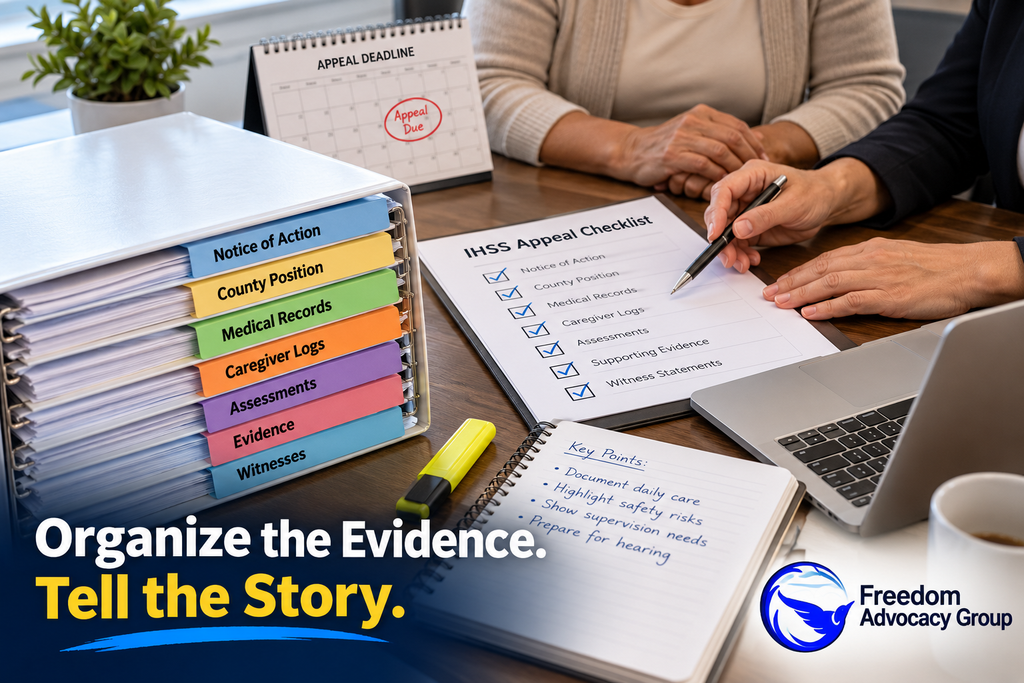
Potential evidence can include:
- Notice of Action
- County position statement
- IHSS assessments
- Medical records
- Physician statements
- SOC forms
- Caregiver logs
- Behavior and hazard logs
- Daily care records
- Developmental assessments
- Psychological evaluations
- Regional Center documentation
- School or IEP records when relevant
- Therapy records
- Photographs when genuinely relevant
- Prior IHSS documentation
- Written statements from knowledgeable professionals
- Relevant correspondence with the county
- Other documents directly supporting the disputed service or hours
Don’t assume that having hundreds of pages automatically creates a stronger case.
Relevant evidence is more important than sheer volume.
If you hand someone 600 pages and cannot explain what matters within them, important evidence can become buried.
Organize your documents so you can quickly locate what you need.
Create a Simple Hearing Timeline
A timeline can make a complicated case much easier to understand.
For example:
January 10: IHSS reassessment completed.
January 24: County issues Notice of Action reducing hours.
February 2: Family requests State Hearing.
February–March: Family continues documenting care needs.
March 18: Physician provides updated documentation.
April 5: County position statement received.
April 12: State Hearing.
A timeline helps keep dates and events organized.
It can also help you recognize gaps or inconsistencies before the hearing.
Prepare a Short Explanation of Why You’re Appealing
You should be able to explain your dispute clearly.
For example:
“We are appealing the county’s denial of Protective Supervision because the recipient’s cognitive impairment causes significant limitations in safety judgment and repeated non-self-directing behavior requiring caregiver intervention to prevent accidental injury.”
Or:
“We are appealing the reduction in IHSS hours because the county’s assessment does not accurately reflect the amount of time reasonably necessary to perform the authorized tasks.”
That is much more effective than beginning with:
“Everything the county did is wrong.”
Identify the decision.
Identify the disagreement.
Identify the evidence.
What Happens When the IHSS Hearing Begins?
Although individual hearings can vary, the Administrative Law Judge generally controls the proceeding and explains how the hearing will work.
The hearing is recorded.
Testimony is given under oath or affirmation, and relevant documents used in the proceeding can be marked as exhibits.
The judge may identify:
- Who is present
- The issue being appealed
- The county action
- Documents being considered
- Whether the claimant received and reviewed the county’s position statement
- Whether there are preliminary issues that need to be resolved
Don’t worry if you don’t understand every procedural term.
If you don’t understand something important, respectfully ask the judge to explain.
Who Speaks First?
The county is responsible for explaining and supporting its action.
The county representative may summarize the position statement and explain:
- What the county decided
- How the county reached the decision
- What evidence was considered
- What regulations or policies the county believes apply
Listen carefully.
Take notes.
Don’t interrupt simply because you disagree.
Write down the points you want to address when you have the opportunity.
You or your representative can then present your side and respond to the county’s position.
The judge may ask questions throughout the hearing.
What Questions Might the Judge Ask?
The questions depend heavily on the type of IHSS dispute.
For an hours dispute, questions might concern:
- What tasks are performed?
- How often are they performed?
- How long do they reasonably take?
- What can the recipient do independently?
- What assistance is actually required?
- What changed since a prior assessment?
For Protective Supervision, questions might concern:
- What mental impairment does the recipient have?
- Is the recipient non-self-directing?
- What potentially dangerous behaviors occur?
- How frequently do they occur?
- What happens if nobody intervenes?
- Can the recipient recognize danger?
- Can the recipient safely remain alone?
- What does the caregiver do to prevent injury?
- Are the behaviors accidental or deliberate?
- How is supervision provided throughout the day?
For an application denial, the questions will depend on the reason the county denied eligibility or services.
Don’t memorize artificial answers.
Know your facts.
Answer the Question the Judge Actually Asked
This sounds simple, but it can make a major difference.
If the judge asks:
“How often does your father attempt to leave the house without supervision?”
Don’t spend ten minutes explaining his entire medical history.
Answer:
“Usually three to five times per week. I documented eight incidents during the last two weeks, and those entries are in Exhibit 4.”
Then provide necessary context.
Specific answers make your testimony easier to follow.
Don’t Exaggerate Your Case
Credibility matters.
If a behavior occurs three times per week, don’t say:
“It happens constantly.”
If the recipient can independently perform part of a task, don’t say:
“They can’t do anything themselves.”
If there are good days and difficult days, explain that.
A strong IHSS case doesn’t require making the recipient appear more disabled than they actually are.
It requires accurately showing what assistance or supervision is reasonably necessary.
Exaggeration can create inconsistencies.
Inconsistencies can damage credibility.
What If the County Says Something That’s Wrong?
Stay calm and write it down.
When you have the opportunity to respond, identify the statement and explain why you disagree.
For example:
County:
“The recipient has not demonstrated a pattern of unsafe wandering.”
Response:
“I disagree. Our behavior log documents 17 elopement attempts between May and July. The incidents are listed in Exhibit 5. Three involved the recipient reaching the driveway before intervention.”
That is much stronger than:
“That’s a lie.”
Focus on the evidence.
Can You Ask Questions at the Hearing?
The hearing process allows the parties to address testimony and evidence, and the Administrative Law Judge controls how questioning occurs.
If a county witness provides information that you believe is incomplete or incorrect, be prepared to identify the issue and ask relevant questions when permitted.
For example:
“How long did the home assessment last?”
“Did you review the behavior log before making the Protective Supervision determination?”
“Where in your assessment did you document the incidents we reported involving elopement?”
The goal isn’t to attack the social worker.
The goal is to clarify the evidence.
Can Someone Represent You at an IHSS Hearing?
Yes.
A claimant may represent themselves or authorize another person to assist or represent them in the hearing process.
Depending on the circumstances, that could include an attorney or another authorized representative.
Having assistance can be valuable when a case involves:
- Extensive medical records
- Protective Supervision
- Major reductions in hours
- Complicated functional limitations
- Conflicting assessments
- Difficult evidentiary issues
- A large county position statement
Regardless of who presents the case, preparation is critical.
Can Family Members or Professionals Testify?
Relevant witnesses can potentially help explain facts that are important to the case.
Depending on the dispute, witnesses might include:
- Family caregivers
- Other people regularly providing care
- Professionals familiar with the recipient
- Other individuals with firsthand knowledge of relevant needs or behaviors
A useful witness should have something relevant to contribute.
Having five people repeat the exact same information isn’t necessarily better than having one knowledgeable witness provide clear, specific testimony.
Ask:
What fact can this witness help establish?

Should You Write Down What You Want to Say?
Yes.
But don’t write a 30-page speech and expect to read every word.
Create a concise hearing outline.
For example:
1. Decision Being Appealed
Protective Supervision denial.
2. Why County Is Wrong
Recipient is non-self-directing because of documented cognitive impairment.
3. Primary Evidence
SOC 821, physician report, behavior log, developmental evaluation.
4. Main Behaviors
Elopement, traffic danger, unsafe appliance use.
5. Caregiver Intervention
Frequent observation and redirection required to prevent accidental injury.
6. County Errors
Position statement fails to address documented incidents.
7. Requested Outcome
Reversal of the disputed denial based on the evidence and applicable program requirements.
This keeps your presentation focused.
Prepare an Exhibit Checklist
Before the hearing, make a list of the documents you intend to rely upon.
For example:
Exhibit 1 — Notice of Action
Exhibit 2 — SOC 821
Exhibit 3 — Physician Report
Exhibit 4 — 60-Day Behavior Log
Exhibit 5 — Developmental Evaluation
Exhibit 6 — Relevant School Documentation
Exhibit 7 — Prior IHSS Assessment
Exhibit 8 — Timeline
Then make sure you can locate each document quickly.
You don’t want to spend valuable hearing time searching through a grocery bag full of paperwork.
What If You Need an Interpreter?
If you have difficulty understanding English, tell the State Hearings Division your language and dialect when requesting the hearing or as early as possible.
California provides language assistance in the State Hearing process.
Language should not prevent a claimant from understanding or participating meaningfully in the hearing.
What If You’re Not Ready for the Hearing?
Don’t simply fail to appear.
Depending on the circumstances, postponement procedures may be available.
CDSS specifically states that if the county’s position statement isn’t ready or if the county makes substantial changes to it after providing it, a claimant may ask for the hearing to be postponed.
Other circumstances may also require contacting the State Hearings Division regarding scheduling or postponement.
Do this promptly.
Don’t assume a hearing will automatically be rescheduled because you don’t attend.
What Happens If You Miss the Hearing?
Missing a scheduled State Hearing can create serious problems for your appeal.
If an emergency prevents attendance, contact the State Hearings Division promptly and follow the instructions applicable to your situation.
Don’t ignore hearing notices.
Open your mail.
Keep copies.
Write the hearing date on your calendar.
Keep the hearing notice with your appeal documents.
Can the Case Be Resolved Before the Hearing?
Sometimes disputes change or resolve before a hearing takes place.
For example, additional documentation may cause the county to reconsider part of its decision.
The parties may also clarify what is actually disputed.
However, do not withdraw a hearing request simply because someone tells you informally that the issue will be fixed.
Make sure you understand exactly what has been agreed upon and what effect withdrawing the hearing will have.
If you’re uncertain, get appropriate advice before giving up your hearing rights.
What Happens at the End of the Hearing?
Before the hearing ends, make sure the main points supporting your position have been clearly presented.
If appropriate, briefly summarize:
- What decision you’re challenging
- Why you believe it was incorrect
- What evidence supports your position
- What outcome you’re asking for
You do not need a dramatic closing argument.
Clarity is more important.
For example:
“We are asking that the Protective Supervision denial be reversed because the medical evidence, behavior documentation, and testimony demonstrate that the recipient’s mental impairment results in non-self-directing behavior requiring ongoing observation and intervention to prevent accidental injury.”
Then stop.
Don’t weaken a clear ending by repeating everything again.
Will the Judge Decide the Case Immediately?
Usually, you should not expect to receive the final written decision on the spot.
The Administrative Law Judge considers the evidence presented during the hearing and any permitted material submitted while the record remains open.
A written decision is then issued through the State Hearing process.
That means walking out of the hearing without an immediate answer does not mean you lost.
It simply means the decision has not yet been issued.
What Does It Mean If the Record Is Left Open?
Sometimes the judge may allow the hearing record to remain open so specified additional information can be submitted.
For example, the judge might need a particular document that was discussed but wasn’t available at the hearing.
If you’re given a deadline to provide additional evidence:
- Take that deadline seriously.
- Write it down.
- Confirm exactly what the judge requested.
- Submit the material according to the instructions provided.
- Keep a copy.
Don’t use an open-record period as an excuse to submit piles of unrelated documents.
Provide what is relevant and permitted.
What Happens After You Receive the Decision?
Read the entire decision carefully.
Don’t look only at the final page.
Understand:
- What the judge decided
- Which issues were addressed
- What facts were accepted
- What rules were applied
- Whether the county must take further action
- Whether the decision was fully or partially favorable
- What further review rights and deadlines are stated in the decision
If you disagree with a State Hearing decision, California provides additional review procedures in appropriate circumstances.
Current CDSS guidance states that a person seeking rehearing and/or judicial review generally must act within 30 days after receiving the hearing decision.
That deadline can be extremely important.
For cases potentially moving beyond the administrative hearing stage, families can learn more about Freedom Advocacy Group’s IHSS Writ Petition assistance.
Court proceedings involve additional legal considerations, so obtaining advice from a qualified California attorney may be appropriate.
Case Example: Protective Supervision Denial
Consider a hypothetical family caring for Maria, a 19-year-old recipient with a significant cognitive disability.
The county denies Protective Supervision because it believes Maria demonstrates adequate judgment and does not require the level of supervision claimed by the family.
The family’s hearing preparation focuses on the county’s exact reasoning.
Instead of simply arguing that Maria has a serious diagnosis, the family organizes:
- The SOC 821
- A developmental evaluation
- A 90-day behavior log
- Documentation of repeated elopement
- Records describing impaired safety judgment
- Specific incidents involving traffic and household hazards
- Caregiver testimony explaining interventions
They also review the county position statement and identify where they believe the county’s description conflicts with documented incidents.
At the hearing, the family’s presentation focuses on the connection between:
Mental impairment → impaired judgment → non-self-directing behavior → risk of accidental injury → caregiver intervention.
Whether that evidence ultimately establishes eligibility is for the administrative process to determine.
But the family has transformed its argument from:
“Maria needs constant supervision.”
Into a documented explanation of why that supervision is necessary.
Case Example: IHSS Hours Reduced After Reassessment
Consider another hypothetical recipient, Robert.
Robert previously received assistance with several daily tasks.
Following reassessment, the county reduces his authorized hours.
His daughter disagrees.
At the hearing, she doesn’t simply argue:
“My father needs more help.”
Instead, she organizes the disputed tasks individually.
For each task she explains:
- What Robert can do independently
- What he cannot safely complete
- What assistance is required
- How often the task occurs
- Approximately how much time is reasonably necessary
- What has changed in his condition or functioning
- What documentation supports those limitations
This task-by-task approach helps the judge understand the actual disagreement.
Common IHSS Appeal Hearing Mistakes
Arriving Without Reading the County Position Statement
You should know the county’s argument before presenting yours whenever possible.
Bringing Mountains of Unorganized Paperwork
More paper does not automatically mean more proof.
Organize relevant evidence.
Talking About Everything Except the Issue Being Appealed
Stay focused on the disputed action.
Attacking the Social Worker Personally
Challenge the assessment, facts, conclusions, or evidence.
Personal attacks rarely help explain why the IHSS decision should be changed.
Exaggerating
Accurate testimony builds credibility.
Giving Vague Answers
Specific dates, incidents, tasks, limitations, and interventions can make your evidence much easier to understand.
Failing to Connect Evidence to IHSS Requirements
A diagnosis alone may not establish the disputed service.
Explain the functional impact.
Waiting Until the Last Minute
Hearing preparation should begin well before the hearing date.
How Freedom Advocacy Group Can Help With an IHSS Appeal Hearing
An IHSS appeal can feel overwhelming because families often have years of medical records, assessments, caregiver experience, and documentation—but don’t know how to turn all of that information into a focused presentation.
Freedom Advocacy Group helps California families better understand and prepare for the IHSS process.
Depending on the circumstances and services being provided, assistance may include:
- Reviewing the Notice of Action
- Reviewing the county position statement
- Identifying the actual issues in dispute
- Organizing relevant evidence
- Reviewing caregiver and behavior logs
- Helping identify documentation gaps
- Preparing a hearing timeline
- Organizing exhibits
- Helping families prepare for likely questions
- Helping families understand the State Hearing process
- Preparing families to clearly explain care and supervision needs
If your dispute involves supervision due to cognitive impairment, learn more about IHSS Protective Supervision.
If you’re just beginning IHSS, our IHSS application help resources explain how preparation begins before the initial assessment.
If you’ve received an unfavorable Notice of Action but haven’t requested a hearing yet, review the IHSS appeal deadline immediately.

Frequently Asked Questions About IHSS Appeal Hearings
What happens at an IHSS appeal hearing?
An Administrative Law Judge conducts the State Hearing. The county explains and supports its decision, and the claimant or representative can explain why they disagree, present relevant evidence, provide testimony, and address the county’s evidence.
Is an IHSS hearing a court trial?
No. It is an administrative State Hearing rather than a traditional civil or criminal court trial. However, it is a formal process involving evidence and testimony and should be taken seriously.
Who decides an IHSS appeal?
An Administrative Law Judge in the California State Hearings process evaluates the dispute.
Do I need an attorney for an IHSS hearing?
A claimant may represent themselves or use an authorized representative. An attorney is not automatically required to participate in an IHSS State Hearing.
Complex cases may benefit from professional or legal assistance depending on the circumstances.
What is the county position statement?
The county position statement explains the facts, rules, evidence, and reasoning the county relies upon to support its disputed action.
It is one of the most important documents to review before the hearing.
Can I see the county’s evidence before the hearing?
Claimants should seek and review the county position statement before the hearing whenever possible. It generally includes the documentary evidence the county intends to rely upon.
Can I bring my own evidence?
Yes. Relevant evidence supporting your position can be important to the hearing.
The type of evidence needed depends on the disputed IHSS issue.
Can a family member testify?
Potentially, yes. A family member or another witness with relevant firsthand knowledge may provide useful testimony depending on the circumstances.
What should I bring to an IHSS hearing?
Depending on the case, bring or have access to your Notice of Action, county position statement, relevant medical records, assessments, caregiver logs, SOC forms, supporting documents, timeline, hearing outline, and other evidence you intend to rely upon.
What should I wear to an IHSS hearing?
You do not need expensive clothing.
Wear something clean and appropriate that allows you to comfortably focus on presenting your case.
Your evidence and credibility matter more than whether you’re wearing a suit.
Should I memorize what I want to say?
Usually, no.
Know your facts and prepare an organized outline rather than trying to memorize a speech word-for-word.
Can I ask the county representative questions?
The hearing process allows parties to address evidence and testimony, subject to the Administrative Law Judge’s control of the hearing.
Keep questions relevant to the disputed issue.
Will the judge tell me who won at the hearing?
Usually, you should expect the decision later rather than assuming you will receive a final ruling at the hearing itself.
The decision is generally provided in writing.
What if I disagree with the hearing decision?
Further review may be available. Current CDSS information states that requests for rehearing and/or judicial review generally must be pursued within 30 days after receiving the State Hearing decision.
Because further administrative or court review can involve legal issues, consider consulting a qualified California attorney when appropriate.
Your IHSS Hearing Is Your Opportunity to Explain the Full Story
The county may have conducted one assessment.
The social worker may have spent a limited amount of time inside your home.
The county may have reviewed certain documents.
But you live with the recipient’s care needs every day.
An appeal hearing gives you an opportunity to present relevant information that explains those needs.
Use that opportunity carefully.
Don’t rely only on emotion.
Don’t rely only on diagnosis.
Don’t rely only on saying the county was wrong.
Identify the disputed decision.
Understand the county’s argument.
Organize the evidence.
Document the recipient’s actual needs.
Prepare your testimony.
Explain the facts clearly.
A well-organized case is much easier for an Administrative Law Judge to understand than a pile of documents without a clear explanation.
Get Help Preparing for Your IHSS Appeal Hearing
If your IHSS hearing is approaching and you’re staring at a Notice of Action, county position statement, medical records, caregiver logs, and hundreds of pages of paperwork wondering where to begin, Freedom Advocacy Group is here to help.
We help California families prepare for IHSS disputes involving denials, reductions in hours, reassessments, Protective Supervision, and other IHSS issues.
The objective is simple:
Help you understand the dispute, organize the documentation, and prepare to clearly present the facts.
Don’t wait until the night before your hearing to organize your case.
Call Freedom Advocacy Group today at 714-248-3871 or book an appointment online.
Hablamos Español.
Advocating today for a brighter tomorrow.
Legal Disclaimer
This information is provided for general informational purposes only and does not constitute legal advice. No attorney-client relationship is created. Consult a qualified attorney regarding your specific circumstances.