

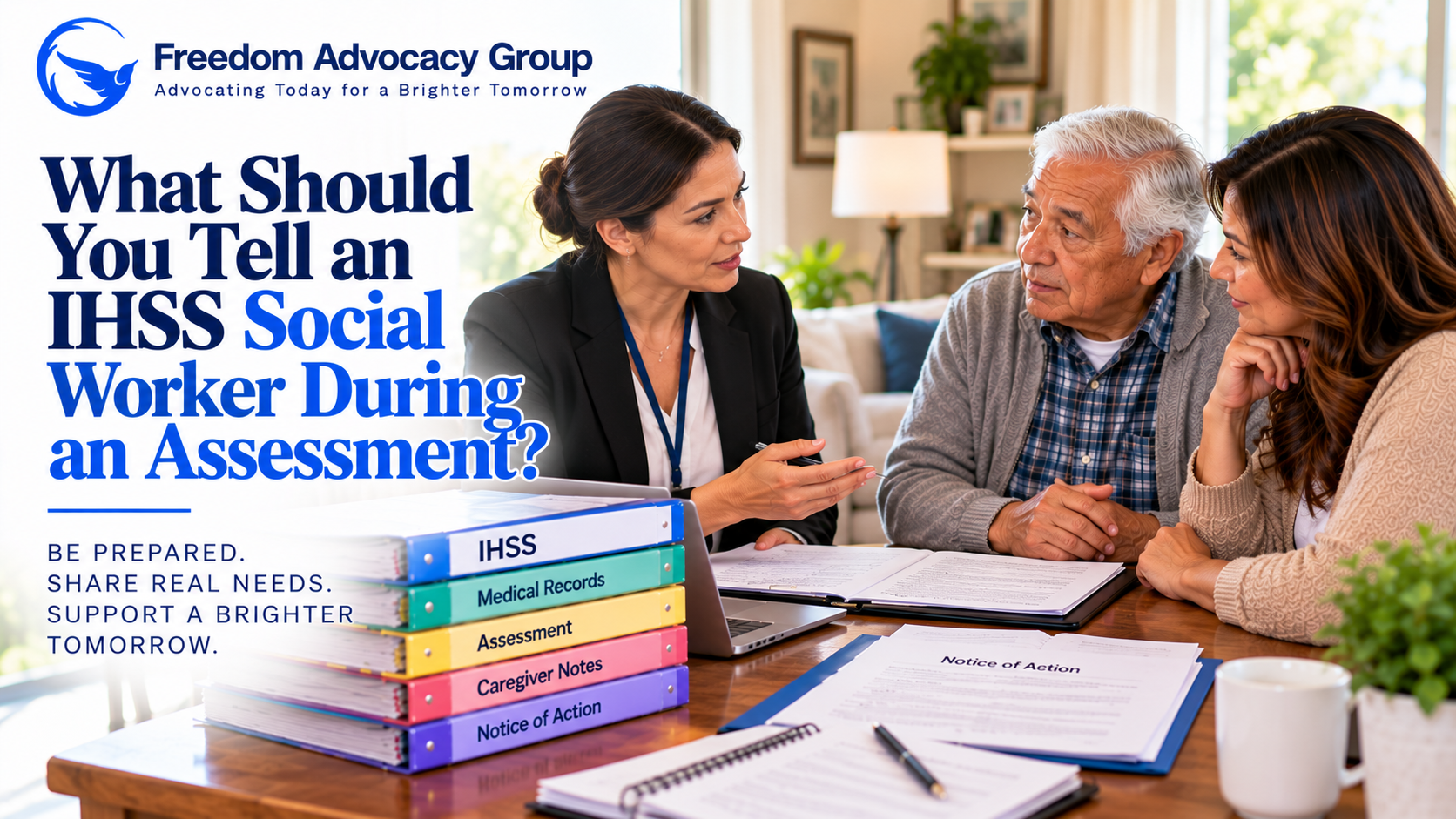
What to Tell an IHSS Social Worker
An IHSS home assessment may feel like an ordinary conversation, but the information gathered during that visit can play an important role in determining the services and hours a recipient is authorized to receive.
A county social worker may ask about the recipient’s daily activities, physical abilities, cognitive functioning, living situation, medical conditions, and the assistance currently being provided.
For families, the challenge is often not knowing that their loved one needs help.
The challenge is making sure the assessment accurately reflects those needs.
Caregivers become accustomed to helping.
After months or years of preparing meals, assisting with personal care, helping with mobility, providing reminders, managing household tasks, or watching over someone with cognitive impairment, those responsibilities can begin to feel like ordinary life.
During an IHSS assessment, however, the county is evaluating the recipient’s actual functional needs. What Should You Tell an IHSS So…
The most important principle is simple:
Be accurate. Don’t exaggerate the recipient’s limitations, but don’t unintentionally minimize them either.
Knowing exactly how to prepare for that conversation can be more complicated.
Freedom Advocacy Group helps California families prepare for IHSS assessments and reassessments so important care needs are not overlooked.
Learn more about our IHSS assessment assistance or call 714-248-3871 to discuss your situation.
Table of Contents
What Is an IHSS Home Assessment?
An IHSS assessment is part of the process California counties use to evaluate an applicant’s or recipient’s need for In-Home Supportive Services.
For a new applicant, the assessment helps determine what eligible services may be authorized.
For an existing recipient, a reassessment can help determine whether the person’s current IHSS authorization continues to reflect their needs.
Depending on the circumstances, the county may evaluate areas involving personal care, meals, mobility, household activities, cognitive functioning, safety, and other IHSS-related needs. What Should You Tell an IHSS So…
Families applying to the program for the first time can learn more about IHSS application help.
The assessment is individualized.
Two people with the same diagnosis may have very different IHSS needs.
That is why the assessment should focus on the recipient—not simply the name of the medical condition.
What Should You Tell an IHSS Social Worker?
The social worker needs an accurate understanding of the recipient’s current circumstances.
That includes what the person can safely do independently and where human assistance is actually required.
But this does not mean families should memorize a list of phrases or rehearse predetermined answers.
There are no magic words that automatically produce additional IHSS hours.
In fact, attempting to make every answer sound as severe as possible can hurt credibility.
At the same time, giving overly broad answers can unintentionally hide legitimate needs.
The objective is accuracy.
A recipient may be independent in one area, need limited assistance in another, and require substantial assistance somewhere else.
Those differences matter.
Freedom Advocacy Group’s assessment preparation goes beyond simply giving clients a list of things to say.
We review the individual situation and help families understand which issues deserve attention based on the recipient’s actual circumstances.
Don’t Let Familiar Caregiving Become Invisible
One of the most important concepts in the original guide is that caregivers can become so accustomed to providing assistance that they stop recognizing how much they actually do. What Should You Tell an IHSS So…
Consider what happens when you have cared for someone for years.
You may automatically help throughout the day without consciously labeling every action as caregiving.
Eventually, it becomes routine.
That can create a problem during an assessment.
When the social worker asks:
“How much help does your mother need?”
you may think:
“Not that much. We manage.”
But your family may “manage” precisely because someone is consistently providing the assistance that makes daily life possible.
That does not mean every action necessarily qualifies for IHSS.
It means families should be careful not to confuse successful caregiving with independence.
Should You Describe a Good Day or a Difficult Day?
Many medical conditions fluctuate.
Someone may function relatively well one day and require considerably more assistance another day.
That can create uncertainty during an IHSS assessment.
Should you describe the recipient’s best day?
Their worst day?
The goal should be to provide an accurate representation of the person’s normal circumstances rather than presenting an unusually good or unusually difficult day as though it happens all the time. The source article makes the same important distinction. What Should You Tell an IHSS So…
Exactly how fluctuating needs should be explained depends on the recipient’s situation.
This is one area where individualized preparation can be valuable, particularly when dealing with conditions that vary substantially from day to day.
Safety Can Be Different From Physical Ability
One concept families sometimes overlook is the difference between being physically capable of attempting something and being able to complete it independently and safely.
An individual may have enough physical ability to begin an activity but still experience limitations affecting safe completion.
This can arise with physical disabilities, mobility limitations, cognitive impairment, dementia, developmental disabilities, and other conditions.
That does not mean families should characterize every activity as unsafe.
It means the recipient’s actual abilities should be evaluated accurately.
A simple yes-or-no answer may not always communicate the complete situation. What Should You Tell an IHSS So…
Freedom Advocacy Group helps families identify circumstances that may deserve additional explanation without coaching recipients or caregivers to exaggerate their limitations.
What If the Recipient Has Dementia or Cognitive Impairment?
Cognitive impairment can make an IHSS assessment more complicated.
A recipient may look physically capable.
They may speak clearly.
They may carry on a pleasant conversation with the social worker.
They may even describe themselves as completely independent.
That does not necessarily tell the county everything about how the person functions throughout the rest of the day.
California’s IHSS assessment process can involve mental functioning considerations such as memory, orientation, and judgment. What Should You Tell an IHSS So…
This can be especially relevant for recipients with:
- Alzheimer’s disease
- Dementia
- Autism
- Developmental disabilities
- Intellectual disabilities
- Brain injuries
- Other cognitive impairments
At the same time, cognitive impairment should not be exaggerated.
Someone can have dementia and still remain independent in particular areas.
The objective is to ensure that the recipient’s actual abilities and limitations are accurately understood.
What If the Recipient Says They Don’t Need Help?
This can be emotionally difficult for families.
A recipient may sincerely believe they are doing more independently than they actually are.
That can occur with cognitive impairment, memory problems, or other conditions.
The family may feel caught between two concerns:
They do not want to embarrass or disrespect their loved one.
But they also do not want inaccurate information to become the basis for the assessment.
The original article provides specific scripts for handling this situation. What Should You Tell an IHSS So…
For the public version, we are intentionally not providing scripts or suggested wording.
The general principle is enough:
Treat the recipient respectfully while making sure relevant information is accurately communicated.
How that should be handled in an individual assessment depends on the family and recipient.
Memory, Orientation and Judgment May Matter
Physical limitations are not the only issues that can affect someone’s ability to function independently.
Cognitive limitations can also affect everyday activities.
For some recipients, questions involving memory, orientation, judgment, or safety awareness may be relevant.
However, a cognitive diagnosis by itself does not automatically establish a particular IHSS service or number of hours.
The person’s actual functional circumstances matter.
This becomes particularly important when families are also considering Protective Supervision.
Freedom Advocacy Group provides specialized IHSS Protective Supervision assistance for families dealing with cognitive safety concerns.

What About Protective Supervision?
Protective Supervision is a specialized IHSS service that may apply to certain recipients with qualifying mental impairments who require supervision to safeguard against injury, hazard, or accident.
It has specific requirements.
Simply telling a social worker that someone needs constant supervision does not automatically establish eligibility.
Likewise, a diagnosis of dementia, autism, or another cognitive disability does not automatically establish Protective Supervision.
The original article provides detailed examples of specific incidents and explains how a family could connect those incidents to the recipient’s cognitive impairment. What Should You Tell an IHSS So…
We are intentionally removing that level of instruction from this public article.
How a Protective Supervision issue should be evaluated and presented depends on the individual recipient.
Families concerned about this service can learn more through our IHSS Protective Supervision services.
For broader educational information, see our Protective Supervision behavior log resource.
Don’t Be Embarrassed About Care Needs
Some of the most important caregiving responsibilities are also the most personal.
Families can understandably feel uncomfortable discussing sensitive areas of daily care with a social worker.
But an assessment cannot accurately evaluate needs that remain completely unknown.
The original guide discusses sensitive areas such as personal care, hygiene, continence, cognitive confusion, and other private caregiving responsibilities. What Should You Tell an IHSS So…
Families should remember that IHSS assessments routinely involve personal-care and disability-related needs.
You do not need to feel ashamed because someone you love requires help.
At the same time, only information relevant to the recipient’s actual situation should be presented.
Don’t Forget That Care Needs Can Occur at Different Times
A social worker visits for a limited period.
That visit cannot show everything occurring throughout the week.
Some recipients may have different needs in the morning, afternoon, evening, or overnight.
The important point is not to create an exhaustive hour-by-hour presentation for the social worker.
It is to recognize that a short assessment visit may not automatically reveal the recipient’s complete situation.
This becomes particularly relevant when the recipient’s needs fluctuate or when certain difficulties are unlikely to occur while the social worker happens to be present.
How those circumstances should be communicated is something Freedom Advocacy Group can review with a family before the assessment.
What If the Recipient’s Needs Have Changed?
An assessment or reassessment should reflect the recipient’s current circumstances.
A person’s needs can change because of:
- Progression of an existing condition
- Hospitalization
- Surgery
- Changes in mobility
- Cognitive decline
- New disability-related limitations
- Changes in personal-care needs
- Changes in household circumstances
- Other significant developments
An existing IHSS recipient whose needs have materially changed may be able to request reassessment rather than simply waiting for the next routine review. What Should You Tell an IHSS So…
For more information, see our IHSS reassessment guide.
The important distinction is that changed circumstances do not automatically guarantee additional hours.
The county reassesses the recipient’s current needs.
Don’t Let a Well-Cared-For Home Create the Wrong Impression
This is one of the most important issues families can overlook.
The social worker arrives and sees:
A clean home.
Clean clothing.
Food in the kitchen.
An organized bedroom.
A recipient who is freshly bathed and comfortable.
That can be evidence that caregiving is going well.
It does not necessarily establish that the recipient performed all of those activities independently.
The original article correctly points out that successful caregiving can make disability-related needs less visible. What Should You Tell an IHSS So…
That does not mean you should intentionally leave the home messy.
Do not stage conditions.
Do not manufacture problems.
Simply remember that the assessment should accurately reflect the recipient’s actual functional circumstances.

What Documents Should You Have for an IHSS Assessment?
Relevant documentation can help provide context during an assessment.
However, more paperwork is not automatically better.
The original article provides families with a fairly detailed checklist of specific records to assemble and instructions for organizing them. What Should You Tell an IHSS So…
For this public article, we are deliberately keeping the guidance broader.
Depending on the recipient’s circumstances, information relating to their medical condition, functional abilities, prior IHSS determination, or recent changes may be relevant.
The important issue is relevance, not simply volume.
Freedom Advocacy Group’s client assessment-preparation process includes a more individualized review of what information deserves attention.
That prevents families from trying to build an assessment packet based on a generic online checklist that may not fit their case.
Should You Track Every Caregiving Task Before the Assessment?
The original version of this article provides a detailed daily-care checklist, sample times, task examples, frequency instructions, and advice about timing individual activities. What Should You Tell an IHSS So…
That is useful information—but it goes beyond what we want to provide publicly.
For general educational purposes, families should understand this principle:
The county is evaluating the recipient’s actual need for eligible IHSS assistance.
Accurate information is important.
But the best way to prepare that information can depend on the recipient’s current authorization, functional limitations, medical circumstances, household situation, and the services at issue.
That individualized preparation is part of what Freedom Advocacy Group provides to clients.
Should You Practice Answers Before the Social Worker Arrives?
You should not coach a recipient to appear more disabled than they are.
You should not manufacture limitations.
You should not intentionally create an unsafe situation so the social worker can observe it.
You should not memorize exaggerated answers designed to obtain more hours.
Credibility matters.
The purpose of assessment preparation should be to help the family understand what information is relevant and communicate it accurately—not to manufacture a particular outcome.
Freedom Advocacy Group’s approach is based on helping families prepare to explain real needs clearly and truthfully.
Are There Things You Should Avoid Saying?
The original guide includes an entire section identifying phrases such as “he’s fine,” “she can do it herself,” “I do everything,” and “we manage,” then explains how families should replace those phrases with more detailed responses. What Should You Tell an IHSS So…
That begins to cross into assessment coaching.
For this public version, the better principle is:
Avoid answers that unintentionally create an inaccurate picture.
Do not worry about memorizing “good” or “bad” phrases.
There are no secret words that guarantee approval.
Instead, families should focus on accuracy, context, and the recipient’s actual circumstances.
How that principle applies to specific assessment questions is something we can address during individualized preparation.
Don’t Exaggerate to Get More IHSS Hours
This deserves its own section.
Freedom Advocacy Group does not recommend:
- Inflating care needs
- Inventing safety incidents
- Falsifying medical limitations
- Increasing task times that are not accurate
- Coaching recipients to give false answers
- Claiming limitations that do not exist
The original article makes the same point: inconsistencies can damage credibility and make legitimate needs more difficult for the county to understand. What Should You Tell an IHSS So…
The purpose of advocacy is not to manufacture eligibility.
It is to help ensure real needs are properly understood.
What Happens After the IHSS Assessment?
After completing the assessment process, the county determines what IHSS services and hours it will authorize.
The recipient should receive a Notice of Action explaining the determination. What Should You Tell an IHSS So…
Review that document carefully.
If you believe important needs were overlooked or disagree with an adverse determination, hearing rights may be available.
Deadlines can be important.
You can learn more about the IHSS appeals process.
For families preparing for a hearing, Freedom Advocacy Group also has information about the IHSS appeal hearing process and offers IHSS due process representation.
Why Professional Assessment Preparation Can Matter
A public article can explain the fundamentals.
It can tell you that:
Accuracy matters.
Functional needs matter.
Safety may matter.
Cognitive limitations may matter.
Changed circumstances may matter.
Documentation may matter.
But that is different from analyzing a particular recipient’s IHSS situation.
The original article goes much further by teaching readers how to break down caregiving activities, measure task times, organize documentation, prepare responses, discuss frequency, handle recipient answers, and address individual assessment topics. What Should You Tell an IHSS So…
We intentionally do not publish Freedom Advocacy Group’s complete assessment-preparation process online.
That process may involve reviewing the recipient’s circumstances, current IHSS authorization, functional limitations, medical information, cognitive issues, prior county determinations, relevant documentation, and the particular services being evaluated.
Those details should be individualized.
How Freedom Advocacy Group Helps With IHSS Assessments
Many families know their loved one needs help.
The difficult part is understanding how those needs fit within IHSS and making sure the assessment accurately reflects the recipient’s circumstances.
Freedom Advocacy Group helps California families navigate that process.
Depending on the individual situation and service selected, assistance may include reviewing the existing IHSS situation, identifying issues that deserve attention, reviewing relevant documentation, helping families prepare for an assessment or reassessment, evaluating Protective Supervision concerns, reviewing Notices of Action, and assisting with next steps following an unfavorable determination.
Our public articles provide general education.
Our client services go further.
We do not publish our complete assessment-preparation methodology, individualized documentation review process, interview preparation techniques, case-development methods, or strategies for addressing particular assessment issues.
Those services are provided based on the recipient’s individual circumstances.
Learn more about Freedom Advocacy Group’s services or contact Freedom Advocacy Group.
Frequently Asked Questions About IHSS Assessments
What should I tell an IHSS social worker?
Provide truthful and accurate information about the recipient’s circumstances and assistance needs. Avoid exaggerating or unintentionally minimizing legitimate limitations.
Should I memorize answers before an IHSS assessment?
No. There are no magic answers that guarantee approval or additional hours. Preparation should focus on understanding the recipient’s actual circumstances rather than memorizing a script.
What if my parent says they don’t need help?
This can occur, particularly when cognitive impairment affects a person’s understanding of their abilities. Treat the recipient respectfully while making sure relevant and accurate information is available to the social worker.
Should I describe the recipient’s best day or worst day?
The goal should be an accurate picture of the recipient’s normal range of functioning rather than presenting an unusually good or difficult day as typical.
Should I clean my house before the IHSS assessment?
There is no reason to intentionally make the home messy. A clean home may reflect successful caregiving. What matters is that the assessment accurately reflects the recipient’s circumstances.
Does dementia matter during an IHSS assessment?
It can. Cognitive impairment may affect memory, orientation, judgment, safety, and daily functioning. A diagnosis alone does not automatically establish a particular IHSS service or number of hours.
Can I request reassessment if the recipient’s needs get worse?
A recipient may request reassessment when needs or circumstances change. Learn more through our IHSS reassessment resource.
What if I disagree with the county’s decision?
Review the Notice of Action promptly. Depending on the circumstances, state hearing rights may be available, and deadlines can apply.
Can Freedom Advocacy Group prepare me for the assessment?
Yes. Freedom Advocacy Group provides individualized IHSS assessment assistance. The preparation provided to clients goes beyond the general educational information published in this article.
An IHSS Social Worker Can Only Evaluate the Information Available
The social worker sees your family for a limited period.
They do not live in your home.
They do not automatically know what occurs throughout the rest of the week.
At the same time, the solution is not exaggeration or a rehearsed performance.
The goal is a fair and accurate assessment of the recipient’s legitimate needs.
That is where thoughtful preparation can make a difference.
Get Help Before Your IHSS Assessment
If you have an upcoming IHSS assessment or reassessment and are unsure whether your loved one’s needs will be accurately understood, Freedom Advocacy Group can help.
We assist California families with IHSS applications, assessments, reassessments, Protective Supervision, denials, reductions, and appeals.
The website gives you the fundamentals. Our client services provide the individualized preparation, review, and advocacy that cannot responsibly be reduced to a generic blog post.
Call Freedom Advocacy Group at 714-248-3871 or contact our team today.
Hablamos Español.
Advocating today for a brighter tomorrow.
Legal Disclaimer
This information is provided for general informational purposes only and does not constitute legal advice. No attorney-client relationship is created. Consult a qualified attorney regarding your specific circumstances.