

For many California parents caring for a child or adult with autism, supervision means much more than simply being nearby.
A loved one may be physically capable of walking, opening doors, moving around the home, or completing certain daily activities independently while still having difficulty recognizing danger or responding appropriately to unsafe situations.
For some families, that means supervision is woven into nearly every part of the day.
California’s In-Home Supportive Services program includes a service known as Protective Supervision for certain eligible recipients whose mental impairment creates qualifying supervision needs.
For some children and adults with autism, Protective Supervision can become an important part of their IHSS services.
However, there is one critical distinction:
An autism diagnosis by itself does not automatically qualify someone for IHSS Protective Supervision.
California evaluates the recipient’s individual circumstances, including how the person’s mental impairment affects their ability to safely direct their own behavior. IHSS Protective Supervision for…
That makes Protective Supervision one of the more individualized—and sometimes confusing—areas of IHSS.
Freedom Advocacy Group helps California families understand the process, prepare for assessments, evaluate Protective Supervision issues, and respond when a service has been denied.
Learn more about our IHSS Protective Supervision services or call 714-248-3871 to discuss your situation.
Table of Contents
Table of Contents
What Is IHSS Protective Supervision?
Protective Supervision is an IHSS service intended to safeguard certain recipients with qualifying mental impairments from injury, hazard, or accident.
It is different from ordinary childcare.
It is different from companionship.
It is also different from simply having someone nearby because a person has a disability.
For an individual with autism, the issue may involve whether cognitive limitations affect the person’s ability to recognize danger and safely direct their own behavior. The original guide correctly distinguishes this from diagnosis alone. IHSS Protective Supervision for…
This distinction is important because autism affects individuals differently.
One person may have substantial support needs in some areas while still understanding everyday safety rules.
Another person may be physically independent but have significant limitations involving judgment, danger awareness, or self-direction.
Protective Supervision therefore requires an individualized evaluation.
Does Autism Automatically Qualify for Protective Supervision?
No.
Having a diagnosis of autism does not automatically establish eligibility for Protective Supervision.
Two people can have the same diagnosis and very different abilities.
One person may reliably understand common hazards, follow safety instructions, and remain safe without continuous observation.
Another may have cognitive limitations that substantially affect their ability to recognize or appropriately respond to danger. IHSS Protective Supervision for…
This is why families should be cautious about advice such as:
“My friend’s child has autism and gets Protective Supervision, so mine should too.”
The other family’s case does not determine yours.
Likewise, a parent should not assume that their child cannot qualify simply because another child with autism was denied.
The relevant question is how the individual recipient’s mental impairment and functional limitations relate to California’s Protective Supervision requirements.
If you’re unsure how your child’s circumstances fit into the program, Freedom Advocacy Group provides individualized IHSS assessment assistance.
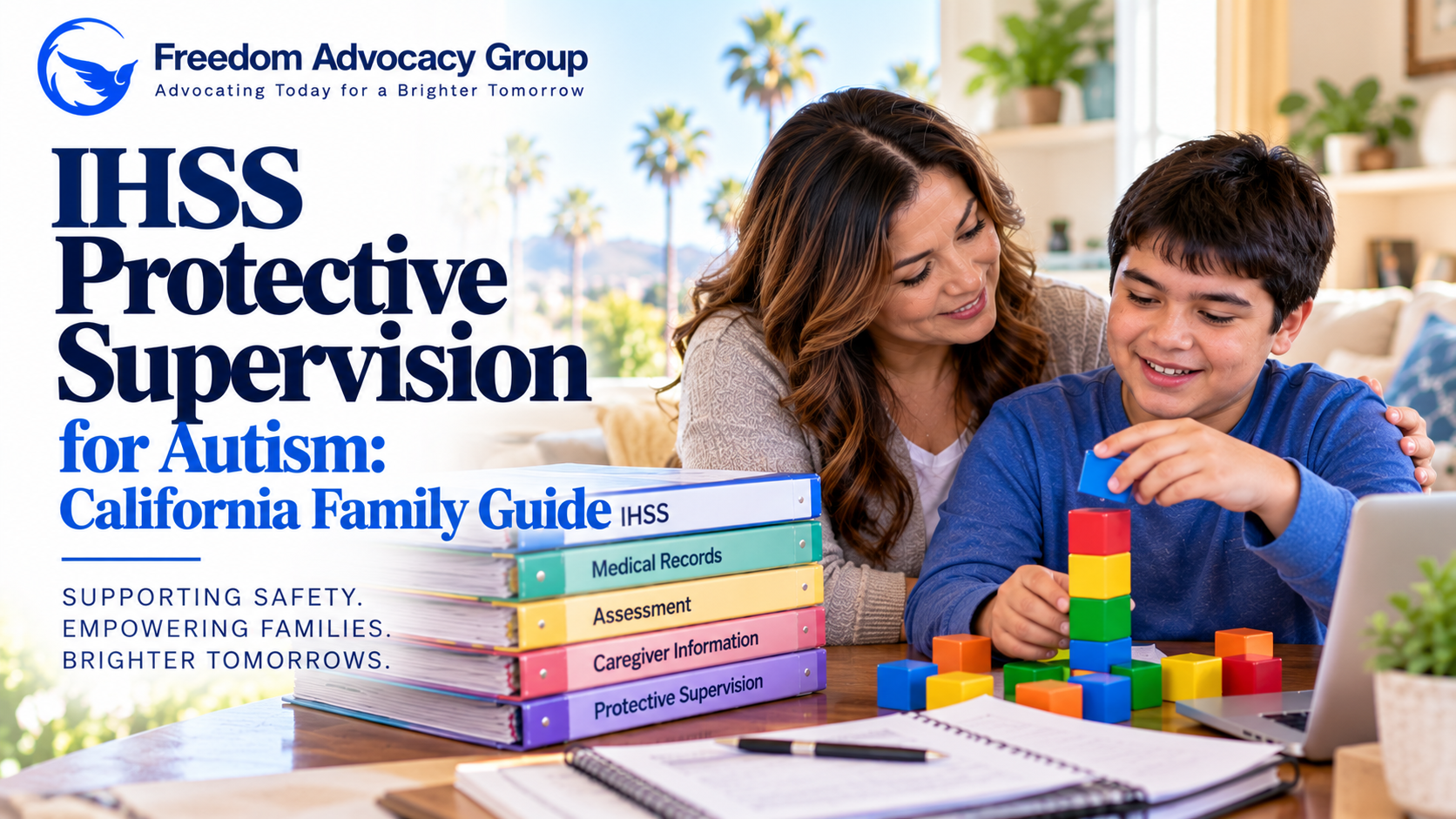
IMAGE PLACEMENT #1 — After the Autism Eligibility Section
Detailed Image Description:
Create a bright, respectful Southern California family scene showing a parent spending time with a school-age child with autism inside a comfortable home.
The child should be participating in a normal household activity while the parent remains attentively nearby.
The scene should communicate care and supervision without portraying the child as frightened, helpless, restrained, or distressed.
Place an organized IHSS binder on a nearby kitchen counter, but do not display completed behavior logs, case strategies, assessment answers, or detailed evidence-building instructions.
Use bright natural California lighting.
Add the Freedom Advocacy Group logo in the bottom-right corner.
Suggested Overlay Text:
“Autism Is the Diagnosis. Individual Needs Tell the Story.”
What Does “Non-Self-Directing” Mean?
The concept of being non-self-directing is important in Protective Supervision.
A person may be physically capable of performing an activity while having cognitive limitations that affect their ability to understand whether the activity is safe.
That means physical ability and cognitive self-direction are not necessarily the same thing.
For example, someone may be physically capable of opening an exterior door.
That fact alone does not tell you whether they understand when it is safe to leave, recognize environmental hazards, or consistently apply safety instructions.
Similarly, a person may be able to repeat a safety rule while having difficulty applying that rule consistently in everyday situations. IHSS Protective Supervision for…
These distinctions can become important in a Protective Supervision assessment.
However, determining whether an individual’s behavior meets California’s requirements requires more than matching that behavior against examples on the internet.
The entire situation needs to be evaluated.
Memory, Orientation and Judgment
Protective Supervision cases may involve questions about mental functioning, including areas such as:
Memory
Orientation
Judgment
These concepts can look very different from one person with autism to another.
A recipient may have excellent memory in certain subjects but difficulty retaining or consistently applying safety information.
Another individual may communicate well but have significant difficulty evaluating danger.
Someone else may have strengths in many daily activities while requiring substantial supervision in particular situations.
The original guide emphasizes that families should accurately represent both the recipient’s abilities and limitations. IHSS Protective Supervision for…
That is important.
The purpose of an IHSS assessment is not to portray a person with autism as incapable.
It is to accurately evaluate the recipient’s individual needs.
What Types of Safety Concerns Can Be Relevant?
Autism-related Protective Supervision cases vary substantially.
Potential concerns may involve situations where cognitive limitations affect a person’s ability to recognize or appropriately respond to ordinary hazards.
But there is no universal list of behaviors that automatically qualifies someone for Protective Supervision. IHSS Protective Supervision for…
That means families should not treat an online list as a checklist for approval.
One behavior may be significant in one recipient’s circumstances and have a completely different explanation in another case.
The relationship between the recipient’s mental impairment, the behavior, the potential danger, and the supervision being provided can matter.
Freedom Advocacy Group evaluates these issues on an individual basis rather than publishing a formula families can simply copy.
Why a Diagnosis Is Only Part of the Picture
Consider two hypothetical children who both have autism.
One child may require assistance with several daily activities but consistently recognize common dangers and follow safety directions.
Another child may be physically capable in many areas but have substantial cognitive limitations affecting their ability to remain safe without supervision.
Both have autism.
Their IHSS needs may be different.
This illustrates why Protective Supervision should not be approached as:
Diagnosis = automatic eligibility.
The county evaluates the recipient’s individual circumstances.
For families dealing with broader disability-related IHSS needs, Freedom Advocacy Group also provides information about IHSS services for special needs.
Why Documentation Can Matter
The IHSS social worker does not live in your home.
An assessment represents only a limited period of time.
A recipient may be calm, comfortable, and cooperative during the visit even though the family experiences substantially different circumstances at other times.
That is one reason relevant documentation can matter.
However, documentation is not about creating a story designed to obtain benefits.
It should accurately reflect the recipient’s real circumstances.
The original article goes much further by explaining specific incident-log fields and providing examples of stronger versus weaker entries. IHSS Protective Supervision for…
For the public version of this article, we are intentionally stopping short of that.
Freedom Advocacy Group’s individualized services can help families understand what information may be relevant, what may not be relevant, and how their existing documentation relates to their particular case.
For general background, you can read our Protective Supervision behavior log resource.
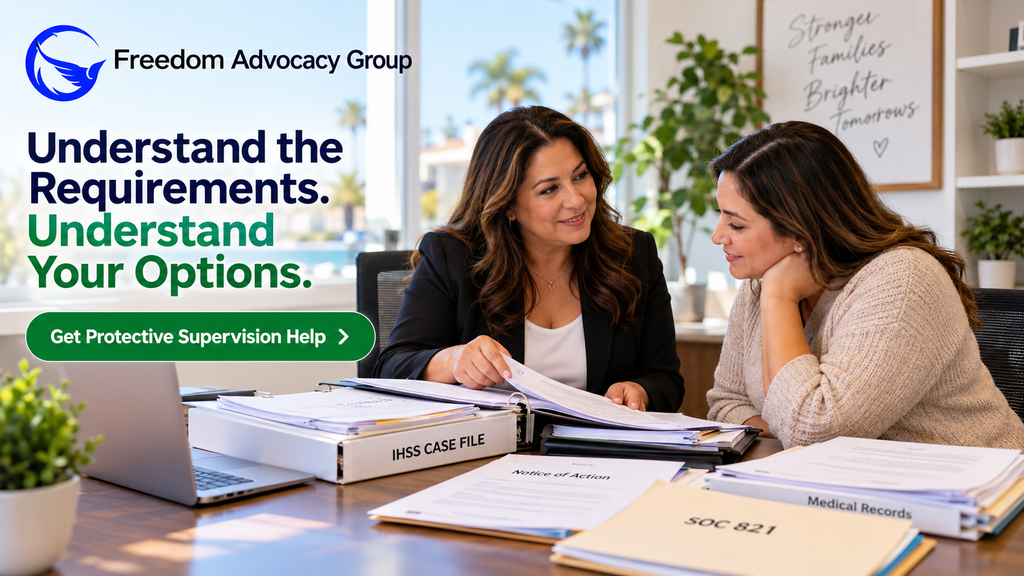
What Is the SOC 821?
The SOC 821 — Assessment of Need for Protective Supervision for In-Home Supportive Services Program is an important California form used in many Protective Supervision evaluations.
An appropriate medical professional provides information concerning the recipient’s mental functioning.
The form can be important, but families should understand something equally important:
The SOC 821 does not exist in isolation.
A Protective Supervision determination can involve additional information and the recipient’s overall circumstances. The original article likewise explains that families should not assume a physician’s form automatically determines the outcome. IHSS Protective Supervision for…
Because the way medical information relates to the rest of a Protective Supervision case can become complicated, this article intentionally does not provide:
- Suggested answers for the SOC 821
- Language to ask a physician to use
- Strategies for individual SOC 821 sections
- Sample completed forms
- Methods for coordinating the form with other evidence
Those issues should be addressed based on the recipient’s actual circumstances.
What Is the SOC 825?
California also uses the SOC 825 — Protective Supervision 24-Hours-A-Day Coverage Plan in connection with Protective Supervision.
The original guide explains that a coverage plan can address how supervision is provided throughout the day using IHSS and other available resources. IHSS Protective Supervision for…
The important takeaway for families is that the concept of a 24-hour supervision need does not necessarily mean that IHSS pays one caregiver for every minute of every day.
Exactly how a family’s actual supervision arrangements should be evaluated or reflected in the process can depend on the circumstances.
For that reason, we are intentionally not publishing a completed sample coverage plan or a step-by-step strategy for constructing one.
That is better addressed through individualized assistance.
Protective Supervision Does Not Cover Every Type of Supervision
A person with autism may unquestionably require substantial assistance while still having some needs that do not fall within Protective Supervision.
The original guide identifies several distinctions, including supervision that is primarily medical, ordinary companionship, certain aggressive behavior, and deliberate self-destructive behavior. IHSS Protective Supervision for…
This distinction matters because families sometimes use the word “supervision” broadly.
IHSS Protective Supervision has a more specific program meaning.
A recipient may potentially have other IHSS service needs even when a particular type of monitoring does not fall under Protective Supervision.
Families beginning the program can learn more through our IHSS application help.
Protective Supervision for Children With Autism
Protective Supervision involving a minor raises an additional consideration.
Children naturally require supervision because of their age.
A very young child without a disability cannot safely be left alone either.
Therefore, when Protective Supervision is being considered for a child with autism, the analysis can involve distinguishing ordinary age-related supervision from supervision associated with the child’s disability-related needs. IHSS Protective Supervision for…
This becomes highly individualized.
Age, development, functional abilities, cognitive limitations, safety awareness, and other circumstances may all be relevant.
Rather than trying to compare your child against a generic internet example, an individual case review can help identify the issues that actually matter.
Can a Parent Be Paid as an IHSS Provider?
Potentially.
California allows family members to serve as IHSS providers in various circumstances when applicable requirements are satisfied.
However, two separate questions should not be confused:
Does the recipient qualify for an IHSS service such as Protective Supervision?
and
Who is eligible to be paid to provide authorized services?
The original article also distinguishes recipient eligibility from provider eligibility. IHSS Protective Supervision for…
Families interested in the provider side of the program can read our guide to becoming a family member paid IHSS caregiver.
What Happens During an IHSS Assessment?
The home assessment gives the county an opportunity to evaluate the recipient’s circumstances and IHSS needs.
For a person with autism, the assessment may include discussion of the recipient’s daily functioning, mental functioning, supervision needs, available resources, and other relevant circumstances. IHSS Protective Supervision for…
One challenge is that a relatively short visit cannot necessarily demonstrate everything that occurs during an ordinary week.
At the same time, families should not exaggerate limitations or attempt to make the recipient appear less capable than they are.
Accuracy matters.
The appropriate way to prepare depends on the individual’s situation.
Freedom Advocacy Group provides IHSS assessment assistance for families who want individualized help before an assessment or reassessment.
We intentionally reserve our detailed assessment-preparation process for clients rather than publishing a complete script online.
Why Protective Supervision Requests May Be Denied
A denial does not necessarily mean that the recipient does not have significant support needs.
It means the county determined that the applicable requirements for the requested service were not established based on the information it considered.
The original guide discusses several possible issues, including insufficiently specific documentation, information focused primarily on diagnosis, inconsistencies, medical-monitoring issues, and the recipient appearing more independent during the assessment. IHSS Protective Supervision for…
Those are useful concepts to understand.
But this is where the public article should stop.
The next step should not be a published formula explaining exactly how to restructure the evidence to overcome each type of denial.
A denial should be reviewed based on:
- The individual Notice of Action
- The county’s stated reason
- The recipient’s circumstances
- Existing records
- Applicable hearing rights
That individualized review is part of the service Freedom Advocacy Group provides.
What Should You Do After a Protective Supervision Denial?
Start by carefully reviewing the Notice of Action.
The document should explain the county’s decision and provide information regarding hearing rights.
Deadlines can matter.
If Protective Supervision has been denied, learn more about the IHSS appeals process and consider getting help before attempting to build an appeal entirely from internet information.
Freedom Advocacy Group also provides IHSS due process representation services.
The original article goes substantially further by explaining how to diagnose the county’s reason for denial and connect particular categories of evidence to specific disputed issues. IHSS Protective Supervision for…
That level of case-development strategy should remain part of the client service rather than the public blog.
Avoid Building Your Case From Somebody Else’s Autism Story
Online parent groups can be valuable sources of emotional support and shared experiences.
But another family’s IHSS case should not become the template for yours.
You may read:
“My child has autism and receives Protective Supervision.”
That does not mean your child automatically qualifies.
You may also read:
“My child was denied, so autism doesn’t qualify.”
That conclusion is equally unreliable.
Protective Supervision is individualized.
Differences in mental functioning, age, safety awareness, supervision needs, medical information, assessment findings, and other circumstances can produce different outcomes.
Your loved one’s case should be based on your loved one’s circumstances—not somebody else’s approval or denial.
Why Professional IHSS Guidance Can Be Valuable
There is a difference between understanding the general Protective Supervision rules and knowing how those rules apply to a particular recipient.
A public article can explain:
What Protective Supervision is.
Why diagnosis alone is insufficient.
Why mental functioning matters.
Why assessments and documentation matter.
Why denials can occur.
What a responsible public article should not attempt to do is tell every family exactly:
- How to construct its evidence
- What wording to use
- How to prepare individual forms
- How to structure a behavior record
- How to answer specific assessment questions
- How to construct a coverage plan
- How to overcome a particular denial
- How to organize an appeal strategy
Those decisions depend on the facts of the individual case.
That individualized analysis is where professional advocacy assistance provides value.
How Freedom Advocacy Group Helps Families With Autism and IHSS
Parents and caregivers often spend years adapting their lives around a loved one’s needs.
What feels routine to you may actually represent a substantial amount of daily care and supervision.
At the same time, families are expected to navigate:
- IHSS applications
- Assessments
- Protective Supervision
- Medical documentation
- County decisions
- Notices of Action
- Reassessments
- Appeals
Freedom Advocacy Group helps families understand how these pieces fit together.
Depending on the service and circumstances, we can help review the existing IHSS situation, identify areas that deserve attention, prepare families for assessments or reassessments, evaluate Protective Supervision issues, review denials, and assist families navigating the appeal process.
Most importantly, our client work goes beyond the general information available in this article.
We do not publish our complete case-development methodology, assessment preparation strategies, documentation review process, or individualized approach online.
Those services are tailored to the recipient’s circumstances.
You can learn more about Freedom Advocacy Group’s IHSS services or contact Freedom Advocacy Group to discuss your situation.
Frequently Asked Questions About IHSS Protective Supervision for Autism
Does autism qualify for IHSS Protective Supervision?
Autism may be associated with circumstances relevant to Protective Supervision, but an autism diagnosis by itself does not automatically establish eligibility. The recipient’s individual circumstances are evaluated.
Can a child with autism receive Protective Supervision?
Potentially. When a minor is involved, ordinary age-related supervision and disability-related supervision needs can be important considerations.
Can an adult with autism receive Protective Supervision?
Potentially. Protective Supervision is not limited to children. Eligibility depends on the recipient’s individual circumstances and applicable IHSS requirements.
Does my child have to be nonverbal?
No. The ability to speak does not, by itself, determine Protective Supervision eligibility. Mental functioning and the individual’s overall circumstances matter.
What is the SOC 821?
The SOC 821 is California’s Assessment of Need for Protective Supervision for In-Home Supportive Services Program. It provides medical information relevant to the assessment. IHSS Protective Supervision for…
Does a completed SOC 821 guarantee approval?
No. The SOC 821 can be important, but Protective Supervision is an individualized determination and other information may also be considered. IHSS Protective Supervision for…
What is the SOC 825?
The SOC 825 is California’s Protective Supervision 24-Hours-A-Day Coverage Plan. It relates to how supervision needs are addressed throughout the day. IHSS Protective Supervision for…
Can a parent become the paid IHSS provider?
Potentially, when applicable IHSS provider requirements are satisfied. Provider eligibility and the recipient’s eligibility for Protective Supervision are separate issues.
What if Protective Supervision was denied?
Review the Notice of Action and its hearing information promptly. Families can learn more about IHSS appeals and seek individualized assistance before proceeding.
Should I copy another family’s successful Protective Supervision case?
No. Another recipient’s circumstances do not establish what is appropriate for your loved one’s case. Protective Supervision is individualized.
Your Loved One’s Autism Diagnosis Is Only the Beginning of the IHSS Analysis
Autism can affect communication, judgment, behavior, safety awareness, independence, and daily functioning in very different ways.
That is why the diagnosis alone does not answer the Protective Supervision question.
The real issue is the individual recipient.
What are their abilities?
What are their limitations?
What supervision do they actually require?
How does their mental impairment affect their ability to safely direct their own behavior?
And how do those circumstances fit within California’s IHSS requirements?
Those questions cannot be reliably answered by copying an internet checklist.
Your loved one’s circumstances deserve an individual review.
Get Help With IHSS Protective Supervision for Autism
If you’re considering Protective Supervision for a child or adult with autism—or the county has already denied your request—Freedom Advocacy Group can help you understand your next steps.
We help California families navigate IHSS applications, assessments, Protective Supervision, reassessments, denials, and appeals.
Our public articles explain the fundamentals.
Our client services provide the individualized review, preparation, and guidance that a general article cannot.
Call Freedom Advocacy Group today at 714-248-3871 or contact our team to discuss your situation.
Hablamos Español.
Advocating today for a brighter tomorrow.
Legal Disclaimer
This information is provided for general informational purposes only and does not constitute legal advice. No attorney-client relationship is created. Consult a qualified attorney regarding your specific circumstances.