

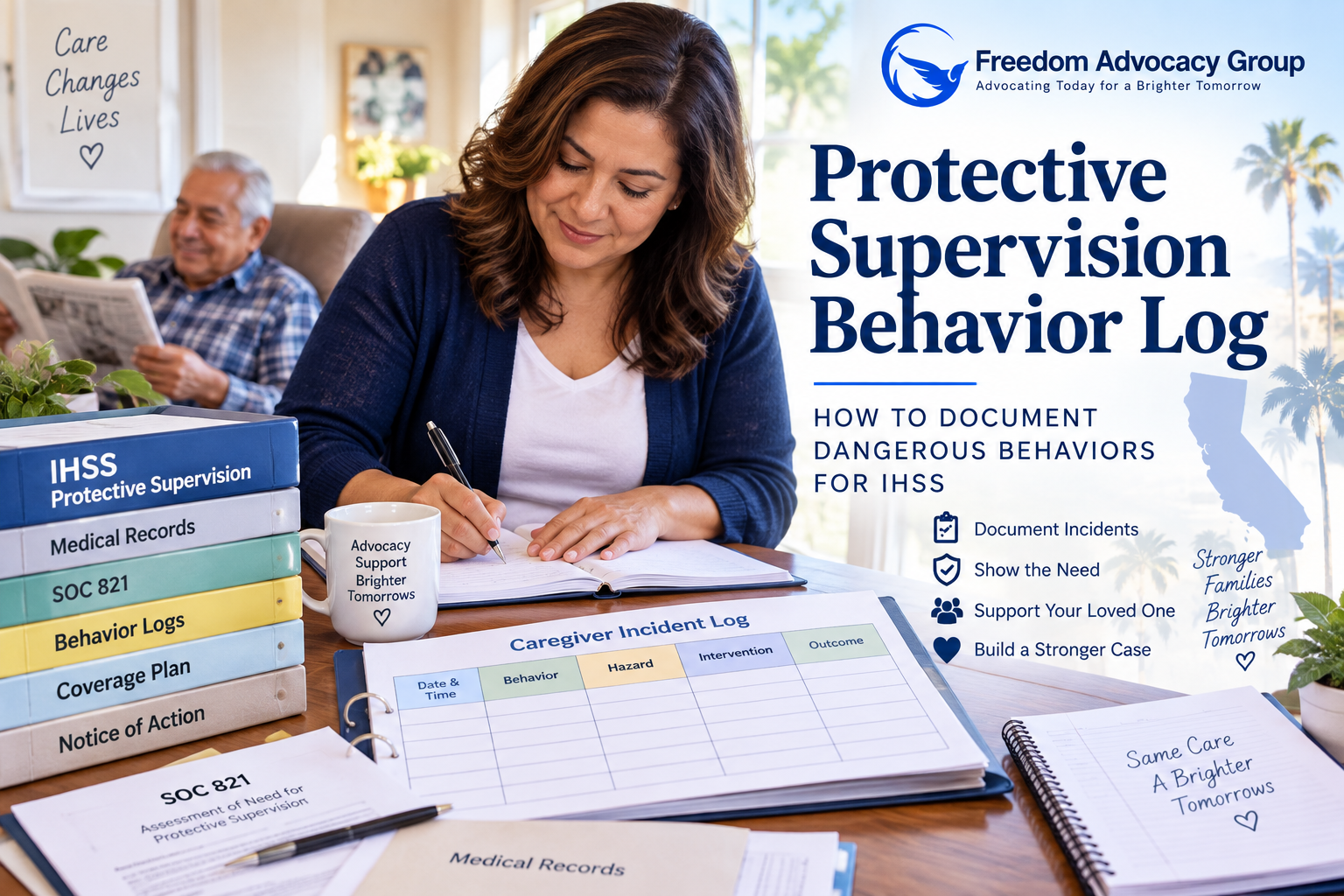
When you care for a child, adult, or senior with a cognitive or mental impairment, preventing accidents can become such a normal part of your day that you barely notice how often you intervene.
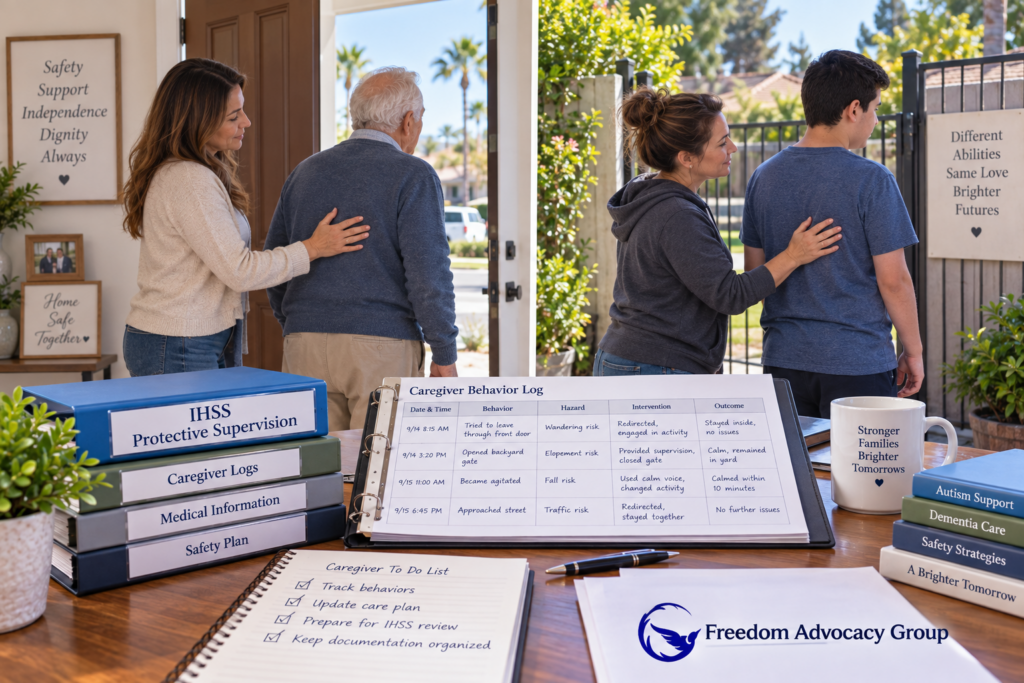
You stop your child from running toward the street.
You redirect your father away from the stove.
You prevent your adult son from leaving the house alone.
You move hazardous household products out of reach.
You intervene when your loved one attempts to climb onto unsafe furniture.
Then you continue with your day.
But when you apply for IHSS Protective Supervision in California, these everyday interventions can become extremely important.
A county social worker does not live in your home. During a relatively short assessment, the recipient may appear calm, cooperative, and safe. The social worker may never personally observe the behaviors that require supervision throughout the day.
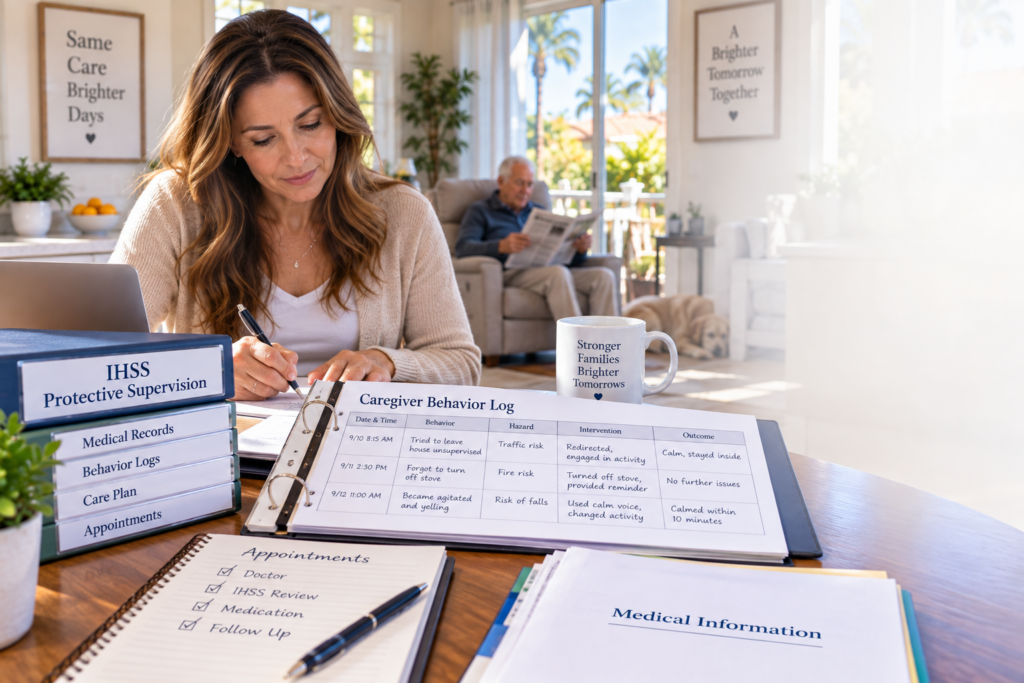
A Protective Supervision behavior log helps document what happens when a caregiver must intervene to prevent injury, hazard, or accident.
Instead of simply telling the county:
“He has no safety awareness.”
Your documentation can explain:
- What happened.
- When and where it happened.
- What danger existed.
- What the recipient appeared not to understand.
- How the caregiver intervened.
- Whether the behavior occurred repeatedly.
This guide explains how to create an IHSS Protective Supervision behavior log, what dangerous behaviors to document, how to organize evidence, and how to prepare your documentation for an IHSS assessment or appeal.
Freedom Advocacy Group helps California families understand the IHSS process and organize documentation that accurately reflects their loved one’s supervision needs.
Need help preparing your Protective Supervision documentation? Call 714-248-3871 today.
Table of Contents
Table of Contents
What Is a Protective Supervision Behavior Log?
A Protective Supervision behavior log is a written record of specific incidents in which a recipient engages in potentially hazardous behavior and requires caregiver intervention.
It provides a chronological record of actual events.
A useful behavior log does not need to be complicated. Consistent, factual documentation can be more informative than pages of general statements.
For example:
“Mom is always confused and unsafe.”
This statement does not explain what happened.
Compare it with:
“At approximately 8:15 p.m., Mom opened the front door and stated that she needed to walk home. She was already at home. She walked down the driveway toward the sidewalk. I followed her and redirected her inside before she reached the street.”
The second description provides information about the recipient’s orientation, behavior, potential hazard, and required intervention.
The purpose is not to exaggerate someone’s disability.
It is to document the recipient’s actual supervision needs.
Why Documentation Matters for IHSS Protective Supervision
Protective Supervision is an IHSS service for certain recipients who are non-self-directing because of a mental impairment or mental illness and require supervision to safeguard them against injury, hazard, or accident.
A diagnosis alone does not automatically establish eligibility.
For example, telling the county that someone has Alzheimer’s disease, autism, or an intellectual disability provides important medical context.
However, the assessment must also consider the individual’s functioning and supervision needs.
Documentation can help explain the relationship between:
Mental impairment → Non-self-directing behavior → Safety hazard → Caregiver intervention
A behavior log can provide examples of how a recipient’s cognitive limitations affect their ability to recognize and respond to everyday dangers.
Families who are beginning the application process should review our IHSS Protective Supervision services to better understand this specialized IHSS service.
What Dangerous Behaviors Should You Document?
There is no universal list of behaviors that automatically qualifies someone for Protective Supervision.
Every recipient’s circumstances are different.
The important issue is whether the person’s mental impairment causes non-self-directing behavior that creates a risk of injury, hazard, or accident and requires supervision and intervention.
The following examples illustrate behaviors that may be relevant, depending on the individual circumstances.
1. Wandering and Elopement
Document situations in which the recipient leaves or attempts to leave a safe environment without appropriately understanding the danger.
Examples include:
- Walking out the front door without supervision.
- Leaving through a side gate.
- Wandering away from a caregiver in public.
- Leaving a store alone.
- Entering a parking lot without checking for vehicles.
- Becoming lost.
- Attempting to leave the house during the night.
Do not simply write:
“Dad wandered again.”
Explain where he went, what danger existed, whether he responded to redirection, and what you did.
2. Traffic and Parking Lot Hazards
Some recipients may not consistently recognize traffic dangers.
Document incidents involving:
- Walking into the street.
- Running through parking lots.
- Stepping behind moving vehicles.
- Ignoring traffic signals.
- Failing to stop at curbs.
- Moving toward traffic despite verbal warnings.
Explain the circumstances and the intervention that prevented the recipient from entering a hazardous situation.
3. Unsafe Appliance Use
Document unsafe interactions with household appliances when they are related to the recipient’s mental functioning.
Examples may involve:
- Stoves
- Ovens
- Microwaves
- Space heaters
- Toasters
- Garbage disposals
- Electrical equipment
For example:
“At approximately 10:30 a.m., Dad turned on the stove while a kitchen towel was lying across the burner. I immediately turned off the stove and removed the towel. When I explained the danger, he appeared confused and asked why the stove was on.”
This describes the behavior, hazard, and intervention.
4. Unsafe Climbing and Fall Hazards
Some individuals may climb onto unsafe surfaces without recognizing the danger.
Document relevant incidents involving:
- Counters
- Furniture
- Shelves
- Fences
- Window ledges
- Railings
Explain the actual circumstances.
A fall caused solely by a physical mobility limitation is not necessarily the same as a non-self-directing behavior caused by mental impairment.
The documentation should accurately describe why supervision was necessary.
5. Water Hazards
Relevant incidents may involve unsafe behavior around:
- Swimming pools
- Bathtubs
- Ponds
- Fountains
- Hot tubs
- Other bodies of water
Explain what happened, why the situation was hazardous, and how the caregiver intervened.
6. Accessing Hazardous Objects
Depending on the recipient’s circumstances, relevant incidents may involve attempts to access:
- Cleaning products
- Medications
- Sharp objects
- Tools
- Electrical cords
- Matches or lighters
Do not simply list the object.
Describe the recipient’s behavior and the specific safety concern.
7. Unsafe Eating or Ingestion Behaviors
Certain recipients may attempt to consume unsafe substances or objects.
When relevant, document what happened, the potential danger, and what intervention was necessary.
If a recipient has swallowing difficulties or other medical feeding needs, those issues should also be addressed with an appropriate medical professional. Not every feeding-related concern establishes a Protective Supervision need.
The Five-Part Protective Supervision Documentation Method
One practical way to organize your behavior log is to record five essential elements for every incident.
Step 1: Record the Date and Time
Write down when the incident occurred.
Example:
September 12, 2026 — approximately 7:20 a.m.
An approximate time is acceptable when you do not remember the exact minute.
Do not invent details.
Step 2: Describe What Happened
Record the recipient’s observable behavior.
Avoid vague descriptions.
Instead of:
“He was acting dangerously.”
Write:
“He turned on the front stove burner while a plastic container was sitting on it.”
Step 3: Identify the Hazard
Explain why the behavior created a risk of accidental injury.
Example:
“The plastic container could have melted or caught fire, creating a burn and fire hazard.”
Step 4: Explain the Caregiver Intervention
Describe exactly what you did.
Example:
“I immediately turned off the burner, removed the container, and redirected him away from the stove.”
Step 5: Explain Why Supervision Was Necessary
When relevant, document facts demonstrating the recipient’s inability to recognize or respond appropriately to the danger.
Example:
“After I explained the fire risk, he attempted to turn the same burner on again several minutes later.”
That final detail may help explain why the behavior was not simply an isolated mistake.
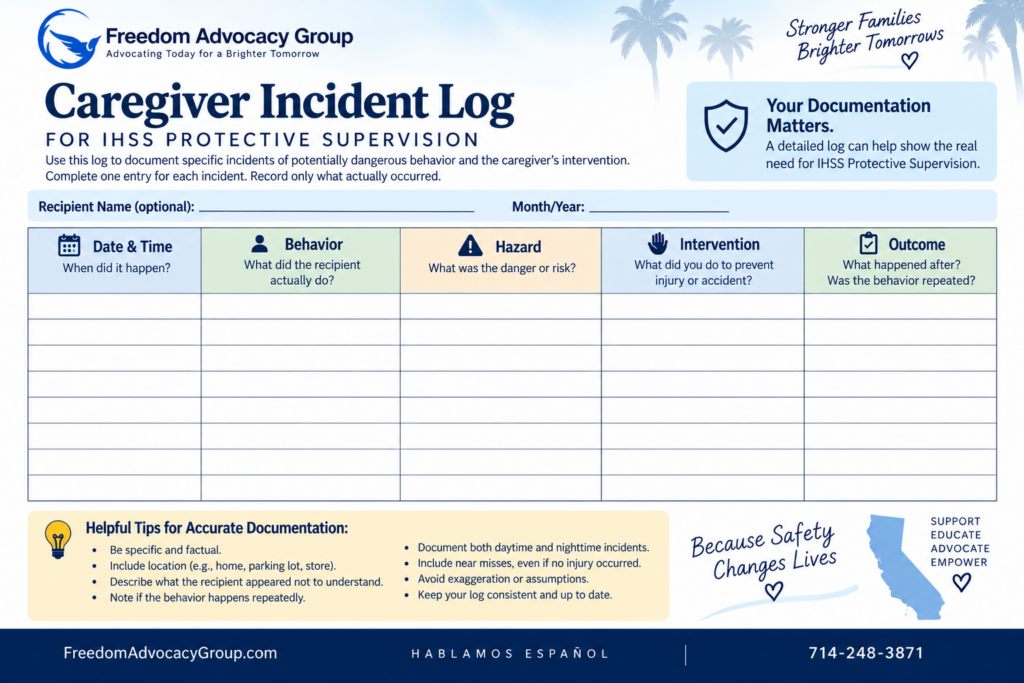
Free Protective Supervision Behavior Log Template
Families can use the following format to document actual incidents.
Caregiver Incident Log
Document Observable Facts Instead of Guessing Motives
Your behavior log should distinguish between observations and assumptions.
For example, avoid writing:
“He wanted to hurt himself.”
Unless there is reliable evidence supporting that conclusion, you may be assigning a motive that you cannot establish.
Instead, describe what happened:
“He attempted to climb over the second-floor balcony railing. I redirected him away from the railing three times within approximately 20 minutes.”
That description identifies the behavior and intervention without guessing the recipient’s intentions.
This distinction matters because Protective Supervision addresses qualifying non-self-directing behavior and accidental safety risks.
Explain What the Recipient Does Not Understand
A dangerous action by itself does not always establish why Protective Supervision is necessary.
The recipient’s mental functioning matters.
Whenever appropriate, document observable facts demonstrating difficulty recognizing or responding to danger.
For example:
“After I stopped Mom from placing a metal container in the microwave, I explained that it was unsafe. Approximately 15 minutes later, she attempted to place the same container into the microwave again.”
This provides more information than:
“Mom doesn’t understand microwave safety.”
It describes an actual event that illustrates the concern.
Document Repeated Behaviors and Patterns
Patterns can help explain the recipient’s supervision needs.
Suppose your child attempted to leave the house once six months ago.
Compare that with a log documenting attempted elopement on:
- Monday morning
- Tuesday afternoon
- Thursday evening
- Saturday morning
- Sunday night
The second record shows a different frequency and pattern.
Do not manufacture repetition.
However, if a relevant incident occurs again, document it again.
A recurring behavior should not disappear from your records simply because you previously documented it.
Document Near Misses
A caregiver’s successful intervention does not make the underlying hazardous behavior irrelevant.
For example, suppose your father walks toward a busy street because he believes he needs to go to work, even though he has been retired for years.
You redirect him before he reaches traffic.
Nobody is injured.
The incident may still be relevant because your intervention prevented him from continuing toward a hazard.
Examples of near misses include:
- Stopping someone before they enter traffic.
- Redirecting someone before they leave the property.
- Turning off an appliance before a burn occurs.
- Removing a hazardous item before it is used.
- Preventing unsafe climbing.
Protective Supervision is preventive in nature.
Families should not wait for a serious injury before documenting actual hazardous behavior.
Avoid Exaggerating Potential Outcomes
There is a difference between explaining a reasonable hazard and predicting an extreme outcome.
Avoid statements such as:
“If I wasn’t there, he definitely would have died.”
Unless the evidence genuinely supports that conclusion, the statement may overstate what can be known.
A more objective description would be:
“Without intervention, he would have continued toward the active roadway, creating a risk of being struck by a vehicle.”
The second description communicates the danger without claiming certainty about an outcome.
How Often Should You Keep a Protective Supervision Behavior Log?
There is no universal number of entries that guarantees approval.
The objective is to create an accurate record of the recipient’s normal behavior.
If relevant incidents occur several times per day, document them.
If they occur several times per week, document them.
If different types of hazardous behavior occur, record each type accurately.
A consistent log maintained over time may be more informative than attempting to reconstruct months of incidents immediately before an assessment.
A simple routine is to record:
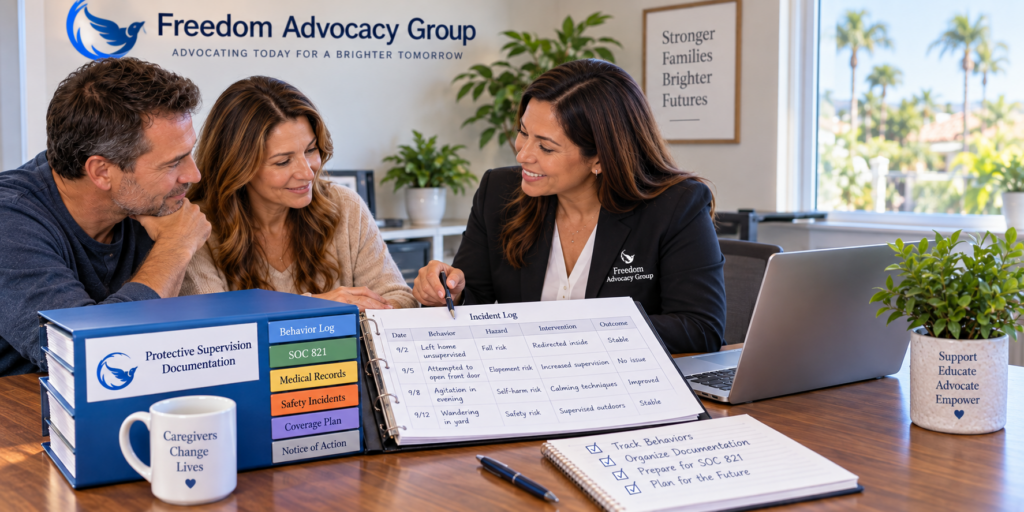
Date → Time → Behavior → Hazard → Intervention → Outcome
These entries can help establish the frequency and nature of the recipient’s supervision needs.
Should You Document Nighttime Behaviors?
Yes, when relevant incidents actually occur at night.
For example:
“2:10 a.m. — Mom got out of bed and attempted to leave through the front door. She stated that she needed to walk home even though she was already home. I redirected her to the bedroom and remained with her until she settled.”
This entry provides information about:
- Time
- Orientation
- Behavior
- Hazard
- Intervention
Do not invent nighttime incidents or assume they occur.
However, do not exclude genuine incidents simply because they happen outside normal waking hours.
Document Incidents Outside the Home
Relevant behavior does not necessarily occur only inside the house.
Incidents may occur:
- In parking lots
- At grocery stores
- On sidewalks
- At parks
- During appointments
- During family outings
- In unfamiliar environments
For example:
“At approximately 3:25 p.m., Michael suddenly ran ahead while we were leaving a grocery store. He did not stop when I called his name. I caught up with him before he entered the vehicle lane. He had not looked for moving cars.”
The entry explains the actual behavior and hazard.
How to Document Wandering in Dementia Cases
Wandering can be particularly important in cases involving Alzheimer’s disease, dementia, and other cognitive impairments.
Do not simply document:
“Dad wandered.”
Record the circumstances.
For example:
“At approximately 9:30 p.m., Dad opened the front door and said he needed to drive home. He has lived in this house for eight years. He walked toward the driveway and attempted to open the car door. I redirected him inside. Approximately 20 minutes later, he again asked when we were leaving to go home.”
This describes both the behavior and the recipient’s orientation.
Families should document incidents respectfully.
The goal is not to embarrass the recipient. It is to explain the supervision required to keep them safe.
How to Document Dangerous Behaviors for Autism
For children and adults with autism, documentation should focus on actual functional behavior rather than the diagnosis alone.
Relevant incidents may involve:
- Elopement
- Traffic awareness
- Unsafe climbing
- Accessing hazardous objects
- Unsafe appliance interaction
- Water-related hazards
For example:
“At 4:10 p.m., Alex opened the backyard gate and ran toward the driveway. I followed and redirected him before he entered the sidewalk area. He did not respond to my first two verbal requests to stop and did not look for moving vehicles.”
Families dealing with autism-related supervision needs can also review our IHSS Protective Supervision for Autism guide .
The important issue is the recipient’s individual functioning, not simply the diagnostic label.
Match Your Behavior Log With the SOC 821
The SOC 821, Assessment of Need for Protective Supervision for In-Home Supportive Services Program, is an important document in many Protective Supervision cases.
It addresses mental functioning, including:
- Memory
- Orientation
- Judgment
Your behavior log and medical documentation do not need to use identical wording.
However, they should provide an accurate and understandable picture of the recipient’s circumstances.
For example, if a medical professional identifies significant impairment in judgment, your log may contain real-world examples illustrating that limitation.
If orientation is significantly impaired, the log may document incidents in which the recipient:
- Believes they are somewhere else.
- Attempts to go home while already home.
- Becomes lost.
- Cannot safely navigate familiar surroundings.
- Leaves without understanding where they are going.
These examples can provide practical context for clinical information.
The medical professional completing the SOC 821 must make their own independent assessment. Caregivers should provide accurate information rather than attempting to dictate clinical findings.
What Other Documents Can Support a Protective Supervision Case?
A behavior log is one part of the documentation.
Depending on the recipient’s circumstances, relevant supporting records may include:
- Medical evaluations
- Cognitive assessments
- Psychological evaluations
- Regional Center records
- School incident reports
- IEP documentation
- Therapy records
- Previous IHSS assessments
- Notices of Action
- Relevant professional observations
- SOC 821 documentation
- SOC 825 coverage information, when applicable
Not every case requires every type of document.
The goal is to organize relevant evidence that accurately explains the recipient’s functioning and supervision needs.
Keep Your Documentation Consistent
Inconsistencies can raise questions.
Suppose a behavior log states:
“The recipient cannot safely be left alone at any time.”
But another document states:
“The recipient stays home alone every weekday from 1:00 p.m. to 3:00 p.m.”
That difference may require clarification.
Perhaps the second document is outdated.
Perhaps circumstances changed.
Perhaps another caregiver is actually present.
Review the records and explain genuine discrepancies accurately.
Do not alter truthful records merely to make every document sound identical.
Should You Take Photos or Videos of Dangerous Behaviors?
Use caution.
Your first priority must always be the recipient’s safety.
Never allow a dangerous situation to continue so you can photograph or record it.
Never stage an incident.
Never recreate hazardous behavior.
Never ask the recipient to demonstrate something unsafe.
Written documentation may provide a safer way to record an incident.
If relevant photos, videos, or other evidence already exist, consider whether they genuinely help explain the recipient’s needs and whether sharing them is appropriate for the recipient’s privacy.
Intervene first. Document afterward.
Organize Your Protective Supervision Evidence Binder
Consider creating one dedicated binder or secure digital folder.
A practical organization system could include:
| Section | Documentation |
|---|---|
| 1. Notice of Action | Current and previous IHSS decisions |
| 2. SOC 821 | Protective Supervision assessment form and supporting medical information |
| 3. Behavior Logs | Chronological incident records |
| 4. Medical Records | Relevant cognitive, developmental, psychological, or medical documentation |
| 5. Supporting Evidence | School, Regional Center, therapy, and incident records |
| 6. Coverage Information | SOC 825 and other applicable supervision coverage records |
| 7. Appeals | Hearing requests, correspondence, evidence, and deadlines |
An organized binder can make it easier to prepare for an assessment, respond to questions, and identify missing information.
How to Use Your Behavior Log During an IHSS Home Assessment
During an IHSS home assessment or reassessment, the social worker may ask about the recipient’s daily functioning and supervision needs.
A behavior log can help you provide accurate answers.
Instead of saying:
“She tries to leave the house all the time.”
You may be able to say:
“I documented seven incidents during the last 30 days.”
If the social worker asks what happened, you can refer to specific entries.
Families preparing for an initial assessment can also review our IHSS application help resources to understand the application process.
For a more detailed assessment checklist, see our guide on how to prepare for an IHSS home assessment .
What If Protective Supervision Has Already Been Denied?
A denial does not necessarily mean you have no options.
Start by reviewing the Notice of Action.
Identify the county’s stated reason for denying Protective Supervision.
Then consider whether your existing documentation addresses that reasoning.
For example, if the county determined that the recipient is self-directing, documentation concerning memory, orientation, judgment, danger awareness, hazardous behavior, and required interventions may be relevant.
A vague statement such as:
“Needs constant supervision.”
May provide less information than a chronological record of actual incidents.
However, do not allow documentation efforts to cause you to miss an appeal deadline.
Families receiving an unfavorable decision should promptly review the IHSS appeal deadline and the hearing instructions in their Notice of Action.
If a case progresses beyond the administrative hearing process, families may also wish to learn about IHSS Writ Petition assistance and consult a qualified California attorney regarding applicable court procedures.
Case Example: From a Weak Log to Useful Documentation
Consider a hypothetical caregiver named Maria who cares for her mother, Elena, who has significant cognitive impairment.
Maria’s original notes look like this:
“Monday — Mom confused.”
“Tuesday — Mom tried to leave.”
“Thursday — Mom got into kitchen.”
These entries may describe real problems, but they provide little context.
Maria begins keeping a structured behavior log.
Her entries now look like this:
September 7, 8:45 p.m.
Elena opened the front door and stated that she needed to walk home. She was already at her residence. She walked down the driveway toward the sidewalk. I followed her and redirected her inside. She continued stating that this was not her home for approximately 15 minutes.
September 9, 11:20 a.m.
Elena turned on the front stove burner while a kitchen towel was lying partly over it. I immediately turned off the burner and removed the towel. When I explained the fire risk, she appeared confused and asked why the stove was on.
The diagnosis has not changed.
The recipient has not changed.
The documentation has changed.
The new entries provide a clearer picture of what supervision looks like in Elena’s daily life.
Case Example: Documenting Repeated Elopement
Consider a hypothetical 15-year-old with autism named David.
His parent reports:
“David has no danger awareness and constantly tries to escape.”
Now consider a 30-day log documenting 11 separate incidents.
The entries identify:
- Date and time
- Location
- How David attempted to leave
- Where he went
- Whether he responded to verbal redirection
- Nearby hazards
- Caregiver intervention
- Outcome
That documentation provides a clearer picture of the frequency and nature of the behavior than the word “constantly.”
Specific evidence is generally more informative than broad adjectives.
How Freedom Advocacy Group Can Help Organize Your Protective Supervision Documentation
Families often understand their loved one’s needs better than anyone.
The challenge is translating everyday caregiving into organized information that someone outside the household can understand.
Freedom Advocacy Group helps California families prepare for the IHSS process and organize Protective Supervision documentation.
Depending on the family’s circumstances and the services requested, assistance may include:
- Reviewing existing IHSS documentation.
- Identifying gaps in behavior logs.
- Helping families understand relevant information.
- Organizing behavior and hazard records.
- Preparing for an IHSS home assessment.
- Reviewing SOC 821-related documentation.
- Organizing supporting medical and professional records.
- Reviewing an unfavorable Notice of Action.
- Helping families prepare documentation for an IHSS appeal or state hearing.
The objective is not to manufacture a stronger story.
It is to help families accurately document what is already happening.
Frequently Asked Questions About Protective Supervision Behavior Logs
What should I write in a Protective Supervision behavior log?
Record the date, approximate time, location, observed behavior, potential hazard, caregiver intervention, outcome, and relevant facts explaining why supervision was necessary.
How many incidents do I need to document?
There is no universal number that guarantees approval. Document relevant incidents accurately as they occur.
How long should I keep a behavior log?
There is no single duration appropriate for every recipient. Consistent documentation over time can help establish patterns and may be useful during assessments, reassessments, or appeals.
Can I document incidents that happened in the past?
Yes, you can provide truthful historical information. However, records created close to the time of an incident may contain more accurate details. Never invent dates or events.
Should I document the same behavior every time?
If a relevant behavior occurs repeatedly, documenting multiple incidents can help establish its frequency and pattern.
Should I document nighttime incidents?
Yes, when relevant incidents actually occur overnight.
Should I photograph dangerous behavior?
Never delay an intervention or allow danger to continue to obtain a photograph. Safety comes first.
Can I use a spreadsheet or phone to keep a behavior log?
Yes. A notebook, spreadsheet, or digital document can work. Accuracy, consistency, organization, and appropriate privacy protections matter more than the format.
Should I give my doctor the behavior log?
Relevant records may help a medical professional understand everyday functioning. The professional must make their own independent clinical assessment.
What if my family member appears completely normal during the assessment?
A short assessment may not capture everything that occurs throughout the day. Accurate records can help explain behaviors and patterns that the social worker does not personally observe.
Does an autism or dementia diagnosis automatically qualify someone?
No. Protective Supervision involves an individualized assessment of mental functioning, non-self-direction, safety risk, and supervision needs.
Can I start a behavior log after a denial?
Yes. Accurate ongoing documentation may still be useful. However, do not miss an applicable hearing deadline while collecting additional evidence.
Your Daily Interventions Tell an Important Story
Protective Supervision is not only about accidents that happen.
It may also involve accidents that do not happen because a caregiver intervenes.
The door your father did not walk through because you redirected him.
The street your child did not enter because you caught up with them.
The stove that did not cause a fire because you turned it off.
The fall that did not happen because you stopped unsafe climbing.
These interventions can become invisible because they happen every day.
A behavior log makes them visible.
Remember this simple formula:
What happened → What was dangerous → Why the recipient did not recognize the danger → What you did to prevent the accident.
Be specific.
Be consistent.
Be truthful.
Keep your documentation organized.
Get Help With Your Protective Supervision Behavior Log Today
If you are applying for IHSS Protective Supervision or preparing after a denial, Freedom Advocacy Group can help you understand and organize your documentation.
Do not wait until the day before an assessment or hearing to reconstruct months of incidents.
Start building an accurate record now.
Call Freedom Advocacy Group at 714-248-3871 today or book an appointment online.
Hablamos Español.
Advocating today for a brighter tomorrow.
Legal Disclaimer
The information on this page is provided for general educational and informational purposes only and is not legal advice.
Freedom Advocacy Group is an advocacy service and should not be assumed to be a law firm or a substitute for advice from a licensed attorney unless expressly stated otherwise.
IHSS eligibility, Protective Supervision eligibility, authorized hours, documentation requirements, state hearing procedures, and individual circumstances can vary. California laws, regulations, policies, forms, and procedures may change.
Nothing on this website guarantees IHSS eligibility, Protective Supervision approval, a particular number of authorized hours, continuation of benefits, or a successful appeal.
Never place a recipient in danger, delay an intervention, recreate an incident, or stage unsafe behavior for documentation purposes.
Always review current California Department of Social Services requirements and your individual Notice of Action.
If you need legal advice regarding your circumstances, hearing rights, deadlines, or court proceedings, consult a qualified California attorney.