

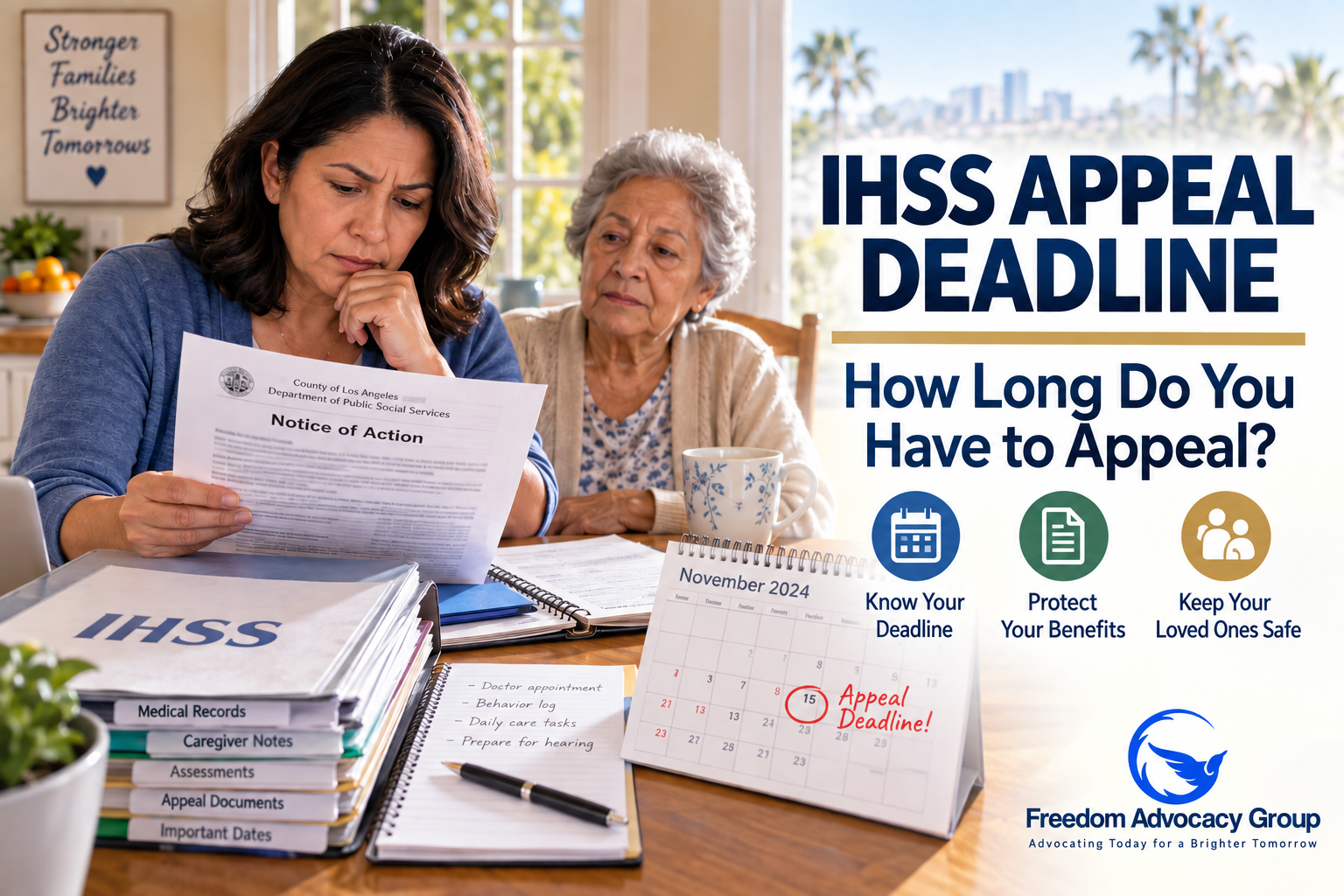
Receiving an IHSS denial or a Notice of Action reducing your hours can be frightening—especially when those services help keep a child, senior, or person with a disability safely at home.
But receiving an unfavorable decision does not necessarily mean the process is over.
California’s In-Home Supportive Services (IHSS) program gives applicants and recipients the right to challenge many county decisions through the state hearing process. The important part is knowing when to act.
The IHSS appeal deadline is generally 90 days from the county action you disagree with. However, families should not automatically assume they have 90 days to wait.
If an existing recipient’s IHSS services are being reduced or stopped, acting before the effective date on the Notice of Action can be especially important because it may affect whether existing services continue while the appeal is pending.
That distinction can make an enormous difference to a family depending on IHSS care.
This guide explains the California IHSS appeal deadline, what happens after receiving a Notice of Action, why the effective date matters, what to do if you think you missed the deadline, and how to start preparing an effective appeal.
Important: This article provides general educational information about IHSS and is not legal advice. Deadlines and rights can depend on the circumstances of an individual case. Review your Notice of Action carefully and seek qualified assistance when necessary.
Table of Contents
What Is the IHSS Appeal Deadline in California?
For most IHSS recipient disputes handled through the California state hearing process, you generally have 90 days to request a state hearing after the county takes the action you are challenging.
The California Department of Social Services explains that the 90-day period often begins with the date the county mailed or gave you the Notice of Action announcing the decision.
A Notice of Action may tell you that:
- Your IHSS application was denied
- Your authorized IHSS hours were reduced
- Certain requested services were denied
- Protective Supervision was denied
- Your IHSS services are being terminated
- Your assessed needs were changed
- The county made another decision affecting your IHSS benefits
Do not treat those 90 days as extra time to decide whether the problem matters.
The safest approach is to review the Notice of Action and take action immediately.
Waiting until the end of the appeal period can create unnecessary risk and may affect other rights associated with challenging a reduction or termination.
The 90-Day IHSS Appeal Rule Is Not the Same as Three Months
This is an easy mistake to make.
The California Department of Social Services specifically warns that 90 days is not necessarily the same as three months.
For example, months have different numbers of days. Counting forward three calendar months could produce a different date than counting the actual 90-day appeal period.
Instead of estimating your deadline, identify the date on your Notice of Action and determine the applicable deadline as soon as you receive it.
Also keep:
- The original Notice of Action
- The envelope it arrived in
- Any additional pages included with the notice
- Copies of anything you submit
- Confirmation showing when your hearing request was submitted
The mailing envelope may become important if there is ever a disagreement about when you received notice.
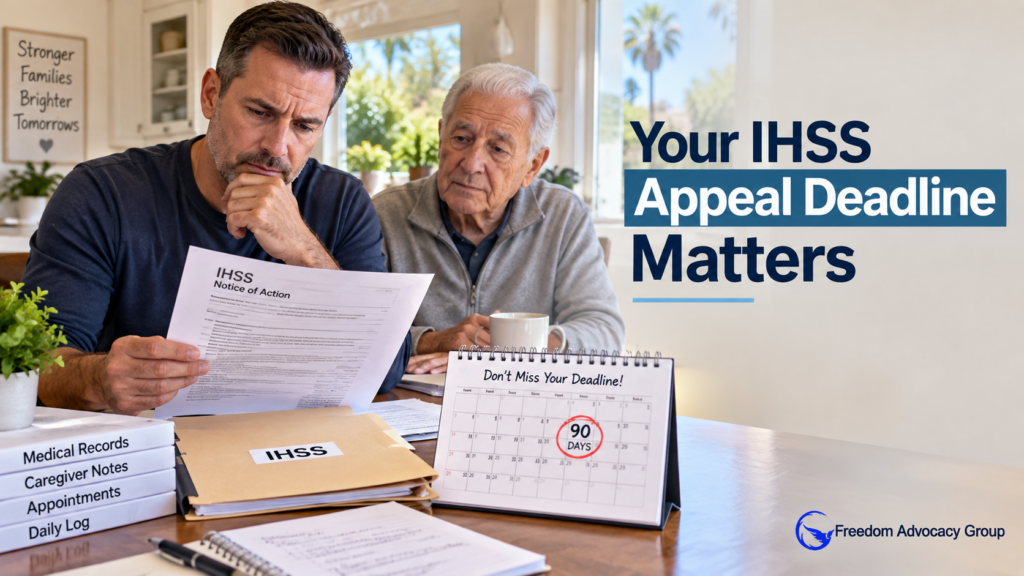
Your Notice of Action Is One of the Most Important Documents in an IHSS Appeal
When the county makes a decision affecting your IHSS case, the Notice of Action—often called an NOA—is critical.
Do not throw it away.
Read the entire notice rather than looking only at the number of approved hours.
Depending on the action, the notice can provide important information about:
- What the county decided
- Which services were approved or denied
- How many hours were authorized
- Whether hours were increased or decreased
- When the action becomes effective
- Your hearing rights
- Instructions for requesting a hearing
If you believe the county’s determination does not accurately reflect the recipient’s needs, the NOA is often the starting point for determining what should be challenged.
Families who are still going through the initial process can also read our IHSS application help guide to understand how the assessment, Notice of Action, and appeal stages fit together.
The Effective Date May Be More Urgent Than the 90-Day Deadline
This is one of the most important parts of this article.
There can effectively be two dates that deserve your attention:
- The deadline for requesting your state hearing.
- The effective date of a proposed reduction or termination of existing benefits.
These dates should not be confused.
California Department of Social Services guidance states that when a claimant requests a hearing before the effective date shown on the Notice of Action, existing aid may continue while the hearing is pending when the applicable requirements are met.
This is commonly referred to as aid paid pending.
For an IHSS recipient who depends on existing services, this can be extremely important.
Example
Imagine Maria receives 190 IHSS hours each month to help her mother remain safely at home.
After a reassessment, Maria receives a Notice of Action stating that the county intends to substantially reduce those services.
Maria may still have time within the general 90-day appeal period to request a hearing.
But waiting several weeks could mean missing the opportunity to request continued services before the reduction’s effective date.
That is why a family should never look at “90 days” and assume:
“We have plenty of time.”
The earlier you review an adverse Notice of Action, the better.
What Is Aid Paid Pending?
Aid paid pending generally refers to the continuation of existing assistance while a timely challenge to a proposed adverse action is being decided.
For IHSS families facing a reduction or termination of existing services, this can be particularly important.
Imagine that an individual with dementia, autism, an intellectual disability, or another impairment is currently receiving substantial IHSS support.
The county decides to reduce those services.
If the family waits until after the effective date to appeal, the reduction may already take effect even though the family later requests a hearing.
If the hearing request is submitted before the applicable effective date and the requirements for aid pending are satisfied, existing services may continue while the dispute is pending.
Because the rules can depend on the type of action and circumstances, families should carefully review their NOA rather than assuming aid pending automatically applies.
If your IHSS hours are about to be reduced or terminated, treat the effective date on your Notice of Action as urgent.
IHSS Protective Supervision Denied? The Appeal Deadline Still Matters
One of the most important IHSS disputes involves Protective Supervision.
Protective Supervision can apply when an eligible IHSS recipient has a mental impairment, is non-self-directing, and requires supervision to prevent injury, hazard, or accident.
Cases may involve people with conditions such as:
- Autism
- Intellectual or developmental disabilities
- Alzheimer’s disease
- Dementia
- Traumatic brain injury
- Other cognitive impairments affecting judgment and safety
A common mistake is assuming that a Protective Supervision denial means the county has conclusively determined the person does not qualify.
You have the right to challenge an adverse IHSS determination through the appropriate appeal process.
However, an appeal needs more than disagreement.
It needs evidence.
If your loved one was denied, our guide to IHSS Protective Supervision explains the benefit, qualifying considerations, documentation issues, and common reasons these cases are denied.
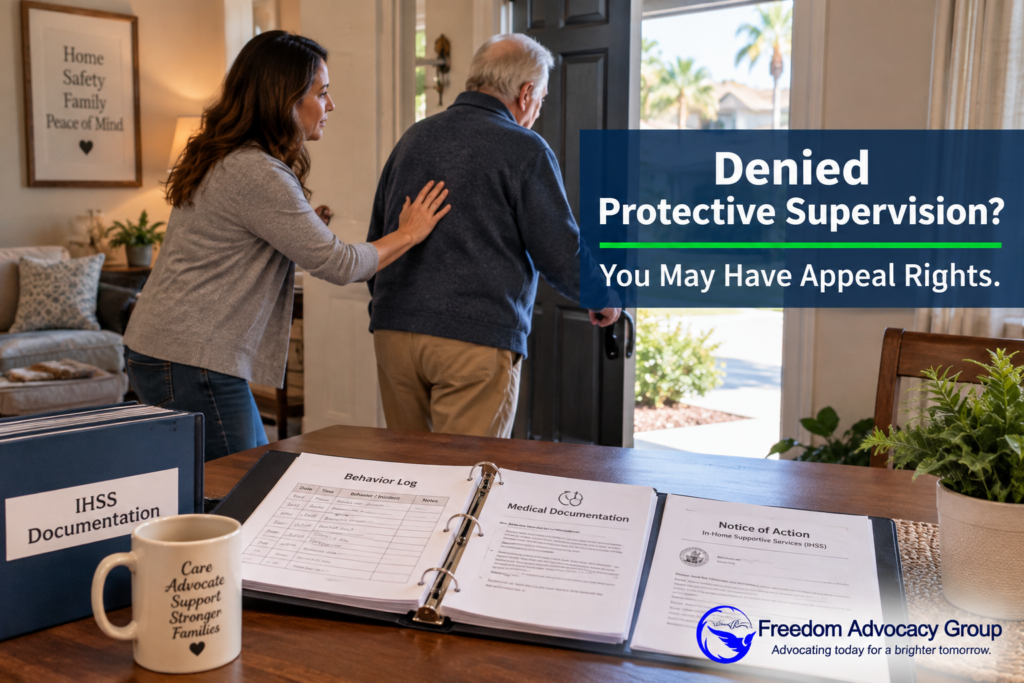
Common IHSS Decisions Families May Want to Appeal
An appeal isn’t limited to a complete denial of IHSS.
A family may disagree with many types of county decisions.
Your IHSS Application Was Denied
You believe the applicant qualifies for IHSS, but the county denied the application.
Your IHSS Hours Were Reduced
Perhaps your loved one’s condition has not improved—or has actually become more difficult—but the reassessment resulted in fewer authorized hours.
You Were Approved for Too Few Hours
Sometimes the dispute isn’t whether the recipient qualifies for IHSS. The disagreement is over the amount of assistance reasonably required.
For example, the county’s assessment of bathing, dressing, toileting, meal preparation, mobility, accompaniment, or another service may not accurately reflect what occurs in the home.
Protective Supervision Was Denied
The county may determine that a recipient does not satisfy Protective Supervision requirements even though the caregiver regularly intervenes to prevent dangerous behavior.
A Service Was Eliminated
A recipient may continue receiving IHSS but lose authorization for a particular service.
Each situation can require different evidence.
That is why an effective IHSS appeal should focus on exactly what the county got wrong and what evidence demonstrates the recipient’s actual need.
What Should You Do Immediately After Receiving an IHSS Denial?
Don’t begin by writing an emotional five-page argument.
Start by getting organized.
Step 1: Read the Entire Notice of Action
Determine exactly what changed.
Highlight the:
- Notice date
- Effective date
- Services affected
- Hours affected
- County’s stated reasoning
- Hearing instructions
Step 2: Calendar the Deadline Immediately
Do not rely on memory.
Record the relevant appeal deadline and, when benefits are being reduced or terminated, prominently record the effective date as well.
Step 3: Keep the Envelope
The California Department of Social Services recommends keeping the envelope in which the Notice of Action was mailed.
That can provide evidence concerning mailing or receipt if timing later becomes an issue.
Step 4: Request the Hearing Promptly
California permits state hearing requests through several methods, including online, by telephone, and in writing.
Keep proof that you requested the hearing.
Step 5: Start Building the Evidence
Filing the appeal protects your ability to challenge the decision.
Preparing the case is the next step.
How Do You Request an IHSS State Hearing?
California’s State Hearings Division provides several methods for requesting a hearing.
A claimant can generally request a hearing online, by telephone, or in writing. A written request can be submitted using the hearing-request section associated with the Notice of Action or through a separate written request containing the necessary information.
The California Department of Social Services State Hearings Division can be reached at 800-743-8525.
You can also use the state’s official State Hearing Request information to review current submission options.
When requesting your hearing, clearly identify the action you disagree with.
Keep copies of everything.
If submitting something electronically, save confirmation of the submission. If sending documents by mail, consider using a method that gives you reliable proof of mailing or delivery.
Don’t Confuse an IHSS Complaint With an IHSS Appeal
This distinction could save a case.
A caregiver might call the county, complain to a supervisor, send emails, or file another type of complaint after receiving an unfavorable decision.
Those actions do not necessarily substitute for requesting a state hearing.
Most importantly, California warns that the 90-day state hearing period does not stop simply because a separate complaint is pending.
Imagine receiving an IHSS denial and spending two months trying to convince the social worker or supervisor to change the decision.
You may believe the problem is being worked out informally.
Meanwhile, the state hearing deadline continues running.
Communicating with the county can be useful, but do not assume those discussions preserve your appeal rights.
What Evidence Should You Start Collecting for an IHSS Appeal?
An effective IHSS appeal is usually built around documentation that directly addresses the disputed service or assessment.
Depending on the case, useful evidence may include:
- Medical records
- Physician statements
- IHSS forms
- Prior Notices of Action
- Previous assessments
- Caregiver logs
- Daily care schedules
- Incident records
- Behavior logs
- School records
- Regional Center records
- Therapy records
- Photographs when relevant
- Witness statements
- Documentation of changes in condition
- Records showing how long specific care tasks actually take
The goal isn’t to create the biggest stack of paperwork possible.
The goal is to provide relevant evidence that clearly demonstrates why the county’s determination does not accurately reflect the recipient’s needs.
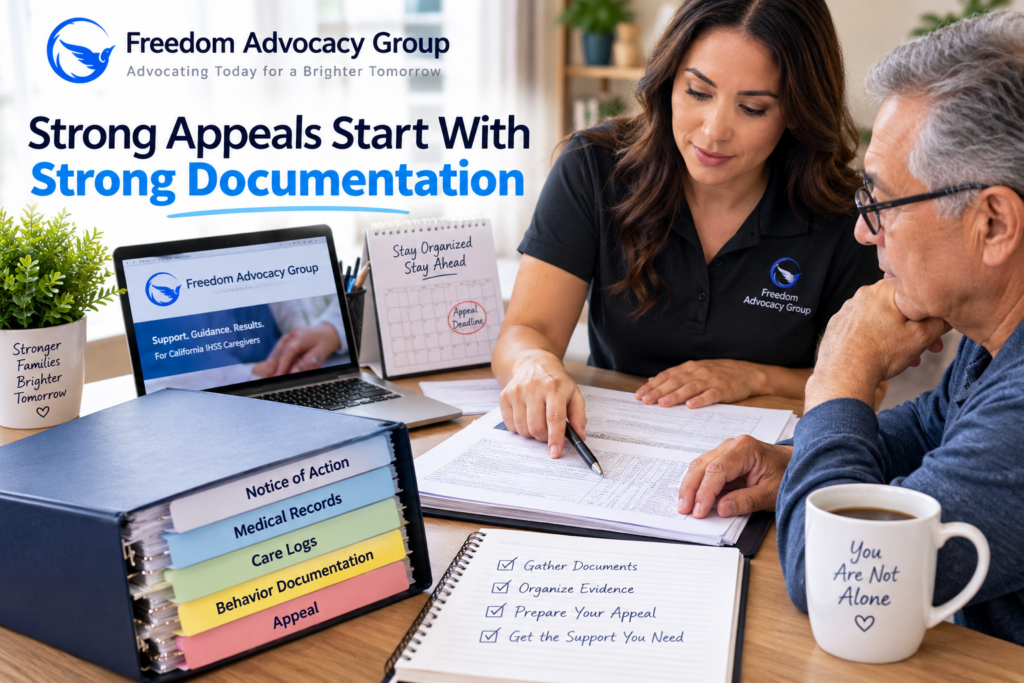
Why Caregiver Documentation Can Be So Important
Caregivers often know more about the recipient’s daily needs than anyone else.
Unfortunately, they sometimes unintentionally minimize those needs.
A caregiver might say:
“My dad needs a little help getting dressed.”
But what actually happens may be:
The caregiver selects appropriate clothing, provides repeated verbal prompts, assists with buttons, helps maintain balance, redirects the recipient when confused, and remains present until dressing is completed.
Those are very different descriptions.
Similarly, a parent seeking Protective Supervision might say:
“My son wanders sometimes.”
That statement provides very little information.
A detailed record may instead document:
- When the wandering occurred
- What triggered or preceded it
- Where the person attempted to go
- Why the situation created a safety risk
- What the caregiver did to intervene
- How frequently similar incidents occur
Specific facts can be far more useful than general statements.
What Happens After You Request an IHSS Hearing?
After the hearing request is received, the State Hearings Division handles the administrative hearing process.
The claimant receives information about the hearing, and the county will have an opportunity to explain and support its decision.
The claimant can present evidence and explain why the decision should be changed.
An Administrative Law Judge evaluates the dispute.
You are not necessarily required to have an attorney to participate in a California state hearing. California also permits claimants to have an authorized representative, which may include someone other than an attorney.
That does not mean preparation is unimportant.
The hearing is your opportunity to clearly explain:
- What the county decided.
- Why you believe the decision was incorrect.
- What the applicable facts are.
- What documentation supports those facts.
- What outcome you are asking for.
A disorganized case can make strong facts difficult to understand.
A well-prepared case creates a much clearer picture.
What If You Missed the 90-Day IHSS Appeal Deadline?
Do not automatically assume there is nothing you can do.
California’s current State Hearings guidance says that after the normal 90-day period, a person requesting a hearing late must establish a good reason for the late request.
CDSS also explains that circumstances involving a person not knowing about the county’s action—such as not receiving the Notice of Action—can be relevant.
This is very different from saying that every late appeal will be accepted.
It won’t necessarily be.
If you believe the 90 days have already expired, act promptly and explain the circumstances accurately.
Do not invent an excuse.
Gather anything that supports the reason the hearing request was late, such as correspondence, mailing information, or other relevant records.
Because late-hearing issues are fact-specific, getting individualized assistance can be particularly valuable.
Case Example: IHSS Hours Reduced After a Reassessment
Consider a hypothetical family caring for a senior with progressive dementia.
The recipient has been receiving IHSS services, but following a reassessment, the family receives a Notice of Action reducing authorized hours.
The caregiver believes the assessment failed to account for the amount of assistance now required.
Instead of waiting, the family immediately reviews the NOA, identifies the proposed effective date, requests a state hearing, preserves the relevant records, and begins documenting the recipient’s actual daily needs.
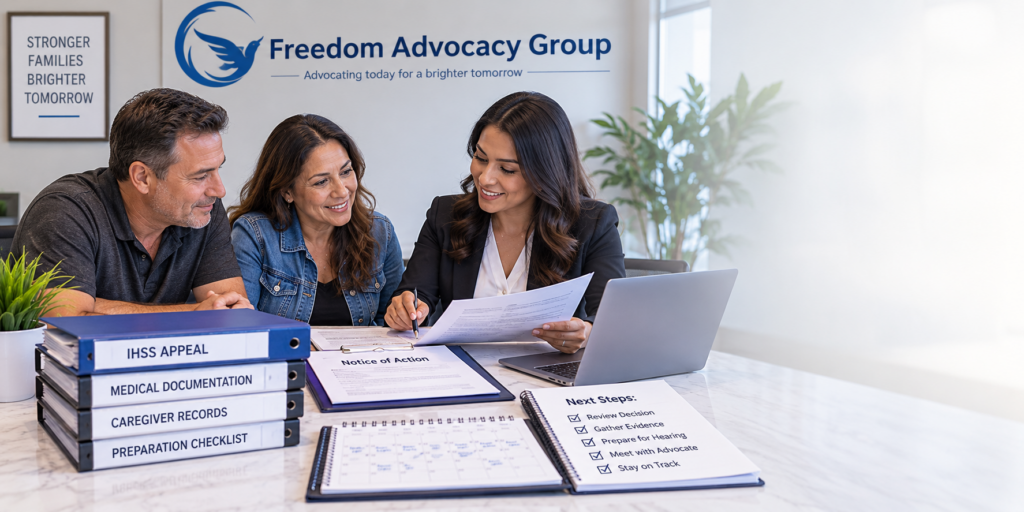
The family then organizes:
- Medical documentation
- The previous and current Notices of Action
- Daily care records
- Examples of cognitive difficulties
- Safety incidents
- Information about the recipient’s functional limitations
The lesson isn’t that filing an appeal guarantees the hours will be restored.
There are no guarantees in an IHSS appeal.
The lesson is that acting quickly preserves options and gives the family more time to prepare a clear, evidence-based case.
Case Example: Protective Supervision Denial
Consider another hypothetical case involving a child with a developmental disability.
The parent requests Protective Supervision because the child lacks danger awareness and repeatedly engages in potentially hazardous behavior.
The county denies Protective Supervision.
Rather than simply telling the hearing officer, “My child needs to be watched all the time,” the parent begins documenting specific incidents.
The record identifies:
- What happened
- When it happened
- How frequently similar behavior occurs
- Why intervention was necessary
- What could have happened without supervision
- How the behavior relates to the child’s cognitive impairment
The parent also gathers relevant medical and professional documentation.
This creates a much clearer picture of the disputed need.
Families facing this situation can learn more from Freedom Advocacy Group’s Protective Supervision assistance resources .
How Freedom Advocacy Group Can Help With an IHSS Appeal
An IHSS denial or reduction can feel personal.
For the county, the Notice of Action may be another administrative decision.
For your family, it can affect who helps your parent bathe, who keeps your child safe, whether you can continue providing care at home, and how your family manages everyday life.
Freedom Advocacy Group helps Southern California families understand and navigate IHSS disputes.
Depending on the case and services being provided, assistance may include:
- Reviewing the Notice of Action
- Identifying the disputed issues
- Helping families understand the appeal process
- Organizing documentation
- Identifying weaknesses in existing evidence
- Preparing caregiver information
- Helping families prepare for the state hearing process
- Addressing Protective Supervision disputes
- Helping families understand potential next steps after an unfavorable hearing decision
If your dispute involves Protective Supervision, start with our IHSS Protective Supervision assistance .
If you’re earlier in the process, review our IHSS application help resources .
And if you’ve already completed the administrative hearing process and received an unfavorable decision, Freedom Advocacy Group also provides information about IHSS Writ Petition assistance , where appropriate.
Frequently Asked Questions About the IHSS Appeal Deadline
How long do I have to appeal an IHSS decision in California?
The general deadline for requesting a California state hearing is 90 days from the county action you disagree with. The date is often associated with when the county mailed or gave you the Notice of Action.
Read the NOA carefully because your individual circumstances matter.
Should I wait until the end of the 90 days?
Generally, no. There is usually no benefit to intentionally waiting. If existing IHSS benefits are being reduced or stopped, waiting can also affect whether you request a hearing before the effective date of the adverse action.
What is the deadline if IHSS is reducing my hours?
Although the general state-hearing deadline is 90 days, a recipient seeking continuation of existing services while the appeal is pending should pay close attention to the effective date shown on the Notice of Action.
Act immediately rather than relying solely on the 90-day deadline.
What happens if I request a hearing before the effective date?
Under California’s aid-pending rules, existing assistance may continue while the hearing is pending when the hearing request is filed before the applicable effective date and the requirements are satisfied.
Review your Notice of Action and the current California rules applicable to your situation.
Can I appeal a Protective Supervision denial?
Yes. An adverse Protective Supervision determination can be challenged through the applicable state hearing process.
The appeal should focus on the relevant eligibility requirements and evidence rather than simply disagreeing with the social worker.
Can I appeal because IHSS gave me too few hours?
Potentially, yes. A recipient can challenge an IHSS assessment when they believe the authorized services or hours do not accurately reflect their needs.
Does calling my social worker count as filing an appeal?
Do not assume that it does.
Calling a social worker or supervisor to discuss the decision is not the same thing as properly requesting a state hearing. Follow the hearing-request procedures provided by California and your Notice of Action.
Does filing a complaint stop the 90-day deadline?
No. California specifically warns that the 90-day state hearing period continues even when a separate complaint is pending.
What if I never received my Notice of Action?
That can be important. California recognizes circumstances in which a late hearing request may be considered when the claimant did not know about the county’s action, including situations involving nonreceipt of the Notice of Action.
You should act promptly once you discover the adverse action and be prepared to explain and support the circumstances.
Do I need an attorney for an IHSS state hearing?
Not necessarily. California permits claimants to represent themselves, and a claimant can also have an authorized representative.
The more important question is whether you understand the disputed issues and can present the relevant evidence clearly.
Can Freedom Advocacy Group help me after I’ve already been denied?
Yes. Freedom Advocacy Group assists Southern California families with IHSS denials and appeals, including disputes involving insufficient hours and Protective Supervision.
The sooner the case is reviewed, the more time there may be to identify deadlines and prepare supporting documentation.
Your IHSS Appeal Deadline Is Too Important to Ignore
When you receive an IHSS denial, reduction, or other unfavorable Notice of Action, it can be tempting to put the paperwork aside.
Don’t.
California generally gives you 90 days to request a state hearing, but waiting can cost you valuable options.
If existing benefits are being reduced or terminated, the effective date on your Notice of Action can be especially important.
Start by identifying:
- What did the county change?
- When was the Notice of Action issued?
- When will the action become effective?
- What specifically do you disagree with?
- What evidence supports your position?
Then act.
Get Help With Your IHSS Appeal Today
Freedom Advocacy Group helps families throughout Southern California navigate IHSS applications, denials, Protective Supervision disputes, reassessments, and appeals.
If you have received a Notice of Action and don’t know what to do next, don’t wait until your deadline is approaching.
Call Freedom Advocacy Group at 714-248-3871 today or book an appointment online .
Hablamos Español.
Advocating today for a brighter tomorrow.
Legal Disclaimer
This information is provided for general informational purposes only and does not constitute legal advice. No attorney-client relationship is created. Consult a qualified attorney regarding your specific circumstances.