

IHSS for Alzheimer’s and Dementia
Caring for someone with Alzheimer’s disease or another form of dementia often changes slowly.
At first, a family member may only need a little help. You might drive your mother to appointments, pick up groceries for your father, organize medications, or stop by to make dinner.
Over time, those responsibilities can grow.
Your loved one may begin forgetting meals, leaving appliances on, wearing the same clothes repeatedly, getting confused about the time of day, or trying to leave home because they believe they need to go somewhere.
Eventually, what once felt like “helping out” can become daily caregiving.
For California families facing this transition, In-Home Supportive Services (IHSS) may provide important assistance. IHSS is designed to help eligible aged, blind, and disabled individuals remain safely in their own homes rather than requiring out-of-home care.
For someone living with Alzheimer’s disease or dementia, authorized IHSS services may potentially include assistance with personal care, meals, household activities, accompaniment, and other eligible needs. In certain circumstances, a person with significant cognitive impairment may also qualify for Protective Supervision.
But there is an important distinction every family should understand:
A dementia or Alzheimer’s diagnosis does not automatically determine IHSS eligibility, services, or hours.
The county looks at the individual’s actual functional limitations and assessed care needs.
That makes documentation, assessment preparation, and clearly explaining what happens at home extremely important.
Families beginning the process can learn more through Freedom Advocacy Group’s IHSS application help.
This guide explains how IHSS may help California families caring for someone with Alzheimer’s disease or dementia, what services may be available, when Protective Supervision may become relevant, whether a family member can become a paid IHSS caregiver, and what families can do when care needs increase.
Table of Contents
Table of Contents
Can Someone With Alzheimer’s or Dementia Receive IHSS?
Potentially.
A person with Alzheimer’s disease, dementia, or another cognitive impairment may receive IHSS when they meet applicable program eligibility requirements and have an assessed need for covered services.
The important word is need.
Two people can have the same medical diagnosis while requiring very different levels of assistance.
For example, one person in the early stages of dementia may still independently:
- Bathe
- Dress
- Prepare simple meals
- Use the bathroom
- Walk safely through the home
- Recognize common hazards
- Remain home alone for periods of time
Another person with a similar diagnosis may become disoriented, forget how to complete personal-care activities, leave appliances running, wander outside, or require frequent caregiver intervention.
The diagnosis provides medical context.
The person’s functional limitations help explain the care they actually require.
That distinction is one of the most important concepts for dementia caregivers to understand when preparing for IHSS.
Families who need help preparing for the county’s evaluation can learn more about IHSS assessments.
Dementia Can Affect Much More Than Memory
People often associate dementia primarily with forgetfulness.
Memory loss can certainly be significant, but cognitive decline can affect many other areas of daily functioning.
Depending on the individual, dementia may affect:
- Orientation
- Judgment
- Decision-making
- Safety awareness
- Communication
- Sequencing of tasks
- Recognition of familiar places
- Personal hygiene
- Dressing
- Meal preparation
- Toileting
- Medication routines
- Mobility
- Ability to recognize danger
- Ability to respond appropriately during an emergency
A person may remain physically capable of performing an activity but no longer understand how to perform it safely.
For example, your father may still be physically capable of operating a stove.
The problem may be that he turns the burner on, walks away, and forgets he was cooking.
Your mother may still be physically capable of walking several blocks.
The problem may be that she becomes disoriented and cannot find her way home.
For IHSS purposes, families should focus not only on what a loved one is physically capable of doing, but also on what assistance is actually required because of cognitive or physical limitations.

What IHSS Services May Help Someone With Dementia?
IHSS services are based on the recipient’s assessed eligible needs.
The services appropriate for one person with dementia may be very different from those needed by another.
Personal Care Assistance
As dementia progresses, a recipient may require help with personal-care activities such as:
- Bathing
- Grooming
- Dressing
- Toileting
- Bowel and bladder care
- Feeding
- Ambulation
- Transfers
- Repositioning
Cognitive impairment can affect these activities even when physical ability remains.
For example, someone may be physically capable of putting on clothing but become unable to select appropriate clothing, remember the correct sequence, or recognize that clothing needs to be changed.
When discussing these needs during an assessment, explain what assistance is actually provided rather than simply stating that the recipient has dementia.
Meal Preparation and Cleanup
Food preparation can become a serious concern for people experiencing cognitive decline.
A recipient may:
- Forget that food is cooking
- Leave a burner on
- Misuse kitchen appliances
- Forget ingredients
- Become unable to follow cooking steps
- Forget whether they have eaten
- Need meals prepared and placed in front of them
- Require assistance with cleanup
The question isn’t simply whether someone can physically hold a frying pan.
The assessment should reflect whether that person can safely and consistently prepare meals without assistance.
Domestic and Related Services
Depending on the circumstances and applicable IHSS rules, authorized assistance may also include certain household tasks necessary to maintain an appropriate home environment.
Accompaniment
Some recipients may have qualifying accompaniment needs related to medical appointments or other authorized activities.
A person with dementia may be physically capable of walking into a medical office but unable to safely travel there, remember appointment information, or navigate the process independently.
Paramedical Services
Some IHSS recipients have health-related care needs that may fall within applicable paramedical-services requirements.
Each recipient’s circumstances should be evaluated individually.
Protective Supervision
For some families caring for a person with significant cognitive impairment, one of the most important IHSS services to understand is Protective Supervision.
Freedom Advocacy Group has a dedicated guide explaining IHSS Protective Supervision and the issues families should understand when considering this service.
What Is IHSS Protective Supervision for Dementia?
Protective Supervision addresses certain situations in which a qualifying IHSS recipient’s mental impairment results in non-self-directing behavior and a need for observation and intervention to help protect against injury, hazard, or accident.
This is different from ordinary companionship.
It is also different from simply wanting someone nearby because a loved one is elderly.
For a person with dementia, the issue may arise when cognitive impairment creates recurring safety concerns.
Examples could include a recipient who:
- Wanders away from home
- Attempts to leave during the night
- Walks toward traffic without recognizing danger
- Turns on a stove and forgets about it
- Leaves water running
- Attempts unsafe household activities
- Becomes lost in familiar surroundings
- Repeatedly tries to perform activities they can no longer safely complete
- Fails to recognize environmental hazards
- Requires caregiver redirection to prevent accidental injury
Not every person with dementia qualifies for Protective Supervision.
The diagnosis alone is not enough.
Families should be prepared to explain how the cognitive impairment affects safety and why caregiver observation and intervention are necessary.
Memory, Orientation and Judgment Can Be Critical
Three areas can be particularly important when documenting dementia-related safety needs.
Memory
Consider questions such as:
Does your loved one remember safety instructions?
Do they repeatedly forget that the stove is hot?
Do they remember that they cannot safely leave the house alone?
Do they forget warnings only minutes after receiving them?
Orientation
Does the recipient know where they are?
Can they find their way home?
Do they become confused about the day or time?
Do they believe they are living in another period of their life?
Do they leave the house looking for a person or place that is no longer part of their current routine?
Judgment
Can the recipient recognize that an activity is dangerous?
Do they understand traffic hazards?
Can they determine whether an appliance is safe to use?
Would they know how to respond to smoke, an unlocked door, overflowing water, or another household hazard?
These questions help turn the general phrase “Mom has dementia” into specific information about how cognitive impairment affects everyday safety.
A Person With Dementia May Look Fine During the Assessment
This can be one of the most difficult parts of an IHSS assessment.
Your loved one may have significant dementia and still have a pleasant conversation with the social worker.
They may remember their name.
They may talk about childhood.
They may tell stories from decades ago.
They may walk independently.
They may smile, joke, and insist:
“I don’t need any help.”
That short interaction does not necessarily show how the person functions throughout an entire day.
Someone can remember an event from 40 years ago and forget what happened 15 minutes ago.
A person may be having an unusually good morning when the social worker arrives.
This is why families should not rely solely on what happens during a brief home visit.
Documentation can help show the broader pattern.
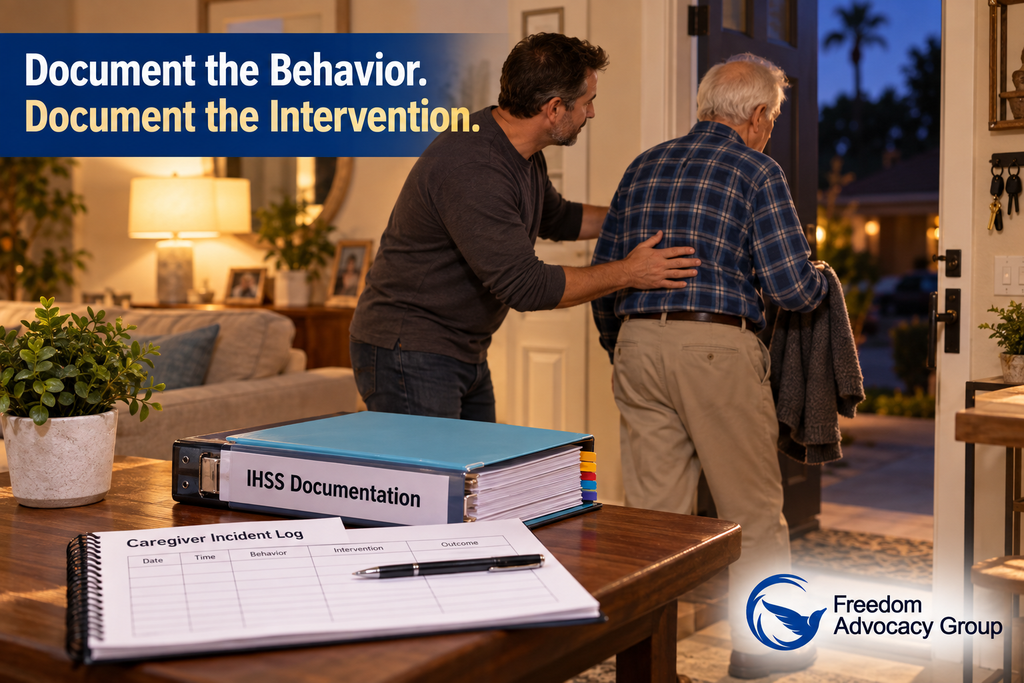
Keep a Dementia Behavior and Safety Log
Instead of telling the social worker:
“Dad wanders all the time.”
Document specific incidents.
For example:
September 8 — approximately 6:45 p.m.
Dad opened the front door and said he needed to catch the bus to work. He has been retired for more than a decade. I reminded him that he no longer worked there, but he continued outside toward the driveway. I followed him and redirected him back into the house before he reached the street.
That entry explains much more than the word “wandering.”
It identifies:
- What happened
- When it occurred
- The confusion involved
- The potential hazard
- The caregiver’s response
- Why intervention was necessary
Another entry might describe a recipient placing a pan on a burner, turning the stove on, and leaving the kitchen.
The objective is not to create dramatic stories.
It is to accurately document real events.
Freedom Advocacy Group’s Protective Supervision behavior log resource provides additional guidance for families organizing this type of information.
What Should Dementia Caregivers Document?
Depending on your loved one’s circumstances, relevant incidents might involve:
- Wandering
- Attempts to leave home
- Unsafe appliance use
- Getting lost
- Leaving doors open
- Leaving water running
- Traffic hazards
- Confusion about location
- Confusion about time
- Unsafe transfers or climbing
- Repeatedly forgetting safety instructions
- Misusing household objects
- Other accidental hazards associated with cognitive impairment
For an incident, record information such as the date, approximate time, location, what happened, what the recipient did, the potential danger, and what intervention was required.
Be factual.
Accurate documentation is more useful than exaggerated language.
Medical Documentation and Dementia-Related IHSS Needs
Medical documentation can provide important support for understanding a recipient’s condition.
However, a medical professional may not know everything happening inside the home.
A doctor may know that your father has Alzheimer’s disease.
They may not know that he tried to leave the house four times last week.
They may not know that he turned on the stove and forgot about it.
They may not know that he recently became lost walking down his own street.
Families can help by keeping accurate records and sharing relevant changes with appropriate healthcare professionals.
Depending on the circumstances, useful information may include:
- Medical records
- Cognitive evaluations
- Specialist records
- Hospital records
- Medication information
- Caregiver incident logs
- Documentation of functional decline
- Records of falls or accidents
- A concise description of significant changes
The purpose isn’t to tell a doctor what conclusion to reach.
The goal is to ensure that medical professionals have accurate information about what is actually occurring outside the examination room.
Can a Family Member Be Paid as an IHSS Caregiver for Someone With Dementia?
Potentially.
A family member may be able to become an IHSS provider for an eligible recipient when applicable requirements are satisfied.
But IHSS does not automatically pay someone simply because they care for a parent or another relative.
The recipient must first qualify for IHSS and have authorized services.
The provider must also satisfy applicable provider-enrollment requirements.
This distinction matters.
A daughter may already spend significant time helping her mother.
An adult son may have reduced his work hours to care for his father.
Those circumstances do not automatically mean every hour of caregiving is payable through IHSS.
Families interested in this issue should read our complete guide about becoming a family member paid IHSS caregiver.
Can a Spouse Be Paid to Care for Someone With Dementia?
Spouse-provider situations can involve additional IHSS rules.
The answer should not be reduced to either:
“A spouse can never be paid.”
or:
“Everything a spouse does is payable.”
The type of authorized service, circumstances of the household, spouse’s availability, and applicable IHSS requirements can affect the analysis.
Families caring for a husband or wife can review Freedom Advocacy Group’s information about IHSS spouse services.
How Many IHSS Hours Can Someone With Dementia Receive?
There is no single number of IHSS hours assigned to an Alzheimer’s or dementia diagnosis.
That is important because families sometimes hear statements such as:
“Dementia automatically gets the maximum.”
That is not how the assessment works.
Authorized hours depend on the recipient’s assessed eligible service needs and applicable IHSS program rules.
Instead of approaching an assessment by asking:
“How do we get the most hours possible?”
A more useful question is:
“Does the county’s assessment accurately reflect all of the eligible assistance this person actually requires?”
That keeps the focus where it belongs—on the recipient’s individual needs.
Preparing for an IHSS Assessment When Your Loved One Has Dementia
A county social worker evaluates the recipient’s individual needs.
For a person with dementia, families should be prepared to discuss both physical limitations and cognitive limitations.
Relevant areas may include:
- Bathing
- Dressing
- Grooming
- Toileting
- Feeding
- Meal preparation
- Mobility
- Transfers
- Household activities
- Memory
- Orientation
- Judgment
- Safety awareness
- Wandering
- Ability to remain safely alone
- Caregiver intervention
One of the biggest mistakes caregivers can make is minimizing what they do.
After providing care for months or years, the assistance becomes routine.
You may say:
“I just make Dad breakfast.”
But what actually happens?
Perhaps Dad can no longer safely operate the stove, remember whether he ate, or prepare a complete meal.
You may say:
“I just help Mom get ready.”
But that might mean selecting clothing, helping with dressing, assisting with grooming, providing toileting help, and redirecting confusion.
During an assessment, explain the complete task.
Don’t Describe Only Your Loved One’s Best Day
Dementia can fluctuate.
Your loved one may be alert one day and considerably more confused the next.
If a social worker asks:
“Can your mother dress herself?”
A simple “yes” may not tell the whole story.
Perhaps she can physically put clothing on but needs someone to lay it out, remind her to change clothes, correct clothing worn backward, or redirect her when she becomes confused.
Explain the typical pattern.
Do not exaggerate the worst day.
Do not minimize the difficult days either.
The goal is an accurate description.
What If Your Loved One’s Dementia Gets Worse?
Dementia-related care needs can change significantly.
An IHSS authorization that reflected someone’s needs a year ago may no longer accurately reflect their current condition.
A person who previously needed only meal preparation and bathing assistance may later begin to:
- Wander
- Require dressing assistance
- Need toileting help
- Become unsafe around appliances
- Get lost
- Require transfer assistance
- Need substantially more supervision
Document these changes.
Families may also want to contact the county regarding changed circumstances and reassessment.
Freedom Advocacy Group provides IHSS assessment and reassessment assistance for families navigating changing care needs.
A useful question is:
What could my loved one safely do at the last assessment that they can no longer safely do today?
That comparison can make functional decline easier to explain.
What If IHSS Reduces Your Loved One’s Hours?
Read the Notice of Action carefully.
Determine:
- What service changed
- How many hours changed
- Why the county says it changed
- When the change becomes effective
- What hearing rights are listed
Do not assume that simply calling the social worker automatically protects your appeal rights.
Families disputing an IHSS decision can review Freedom Advocacy Group’s information about the IHSS appeals process.
For more complex disputes, Freedom Advocacy Group also provides information about IHSS due process representation.
What If Protective Supervision Is Denied?
Start with the county’s reason for the denial.
Do not respond only by saying:
“My mother has Alzheimer’s.”
Instead, determine what part of the claimed need the county disputes.
Then compare the county’s reasoning with your documentation.
Ask:
- Do the medical records explain the cognitive impairment?
- Have safety incidents been documented?
- Does the evidence show problems with memory, orientation, or judgment?
- Have you documented caregiver intervention?
- Does the county have an incomplete picture of what happens at home?
An effective appeal should address the disputed decision and supporting evidence rather than relying only on diagnosis.
Case Example: Dad’s Needs Have Changed
Consider a hypothetical 79-year-old named Thomas.
Thomas has received IHSS for several years.
When he was originally assessed, he needed assistance with meals, housework, bathing, and transportation.
His dementia progresses.
His daughter begins noticing significant changes.
Thomas now leaves the house because he believes he needs to report to a job he retired from years ago.
He has become lost near his own home.
He has left a burner on.
He becomes confused while bathing.
He sometimes believes nighttime is morning.
Simply telling the county:
“Dad’s dementia is worse”
doesn’t fully explain the situation.
His daughter instead documents what changed, when it changed, what Thomas can no longer safely do, and what additional assistance she now provides.
That creates a much clearer picture of his current needs.
How Freedom Advocacy Group Helps Alzheimer’s and Dementia Caregivers
Dementia caregiving often develops gradually.
One responsibility becomes three.
Three become six.
Eventually, much of the family’s daily routine may revolve around meals, appointments, personal care, supervision, paperwork, and keeping a loved one safe.
At the same time, caregivers are expected to understand IHSS assessments, service categories, documentation, Protective Supervision, reassessments, Notices of Action, and appeals.
Freedom Advocacy Group helps California families better understand and prepare for this process.
Depending on the situation, assistance may include:
- Preparing for an IHSS application
- Preparing for an assessment or reassessment
- Reviewing existing IHSS services
- Identifying overlooked care needs
- Organizing dementia-related documentation
- Preparing Protective Supervision information
- Organizing behavior and safety logs
- Reviewing reductions or denials
- Preparing for an appeal
- Organizing relevant hearing documentation
You can review Freedom Advocacy Group’s IHSS services or contact Freedom Advocacy Group to discuss your family’s circumstances.

Frequently Asked Questions About IHSS for Alzheimer’s and Dementia
Can someone with Alzheimer’s disease qualify for IHSS?
Potentially. Eligibility and authorized services depend on applicable IHSS requirements and the recipient’s assessed needs. An Alzheimer’s diagnosis by itself does not determine the services or number of hours authorized.
Does dementia automatically qualify someone for Protective Supervision?
No. Protective Supervision has specific program requirements. Families should focus on the recipient’s mental functioning, non-self-directing behavior, safety risks, and need for appropriate observation and intervention.
Can I get paid to take care of my parent with dementia?
A family member may potentially become an IHSS provider for an eligible recipient when provider-enrollment and other applicable requirements are satisfied. Read our guide to becoming a family member paid IHSS caregiver for more information.
Can a spouse become an IHSS provider?
A spouse may potentially be paid for certain authorized services depending on applicable IHSS rules and the family’s circumstances. Spouse-provider situations have additional considerations.
Does everyone with dementia receive the same IHSS hours?
No. IHSS hours are based on assessed eligible needs rather than a standard number assigned to a dementia diagnosis.
What dementia behaviors should caregivers document?
Depending on the case, useful documentation may include wandering, unsafe appliance use, getting lost, traffic risks, confusion, attempts to leave home, forgotten safety instructions, and other incidents showing how cognitive impairment affects safety.
What if the IHSS social worker doesn’t see the behaviors we see every day?
An assessment is a limited period of time. Accurate caregiver logs, medical documentation, cognitive evaluations, incident records, and specific examples can help explain what occurs outside the assessment.
Can I ask for a reassessment if dementia progresses?
Changed functional or supervision needs can be reported to the county for evaluation. Keep documentation showing what has changed and what additional assistance is now being provided.
Can an IHSS denial or reduction be appealed?
IHSS recipients generally have hearing rights regarding appealable county actions. Read the Notice of Action carefully and pay close attention to the listed deadlines and effective date. Freedom Advocacy Group’s IHSS appeals page provides additional information.
Dementia Changes—and the IHSS Case Should Reflect Current Needs
Dementia does not remain frozen at the stage when someone first applies for IHSS.
Care needs can evolve.
Someone who once made breakfast may eventually become unable to safely operate the stove.
Someone who once showered independently may begin needing reminders and physical assistance.
Someone who once walked around the neighborhood may begin getting lost.
Someone who once stayed home alone may begin wandering.
When circumstances change, document the change.
Instead of simply saying:
“Dad is getting worse,”
describe what that means.
What could he safely do before?
What can he safely do now?
What assistance are you providing?
How frequently is that assistance necessary?
What safety problems have developed?
What happens when nobody intervenes?
Those details can help turn a broad medical diagnosis into a clear description of the recipient’s everyday care and supervision needs.
Get IHSS Help for a Loved One With Alzheimer’s or Dementia
If you’re caring for a parent, spouse, grandparent, or other loved one with dementia, you may already be providing substantial assistance every day.
Understanding how those needs fit into the IHSS process can be much harder.
Freedom Advocacy Group helps California families prepare for IHSS applications, assessments, reassessments, Protective Supervision requests, reductions, denials, and appeals.
Whether your family is applying for the first time or your loved one’s needs have changed significantly, preparation and documentation can help present a clearer picture of the care being provided.
Call Freedom Advocacy Group today at 714-248-3871 or contact our team to discuss your situation.
Hablamos Español.
Advocating today for a brighter tomorrow.
Legal Disclaimer
This information is provided for general informational purposes only and does not constitute legal advice. No attorney-client relationship is created. Consult a qualified attorney regarding your specific circumstances.