


How to Prepare for an IHSS Home Assessment
An IHSS home assessment can significantly affect the services and hours a California senior, person with a disability, or child with qualifying care needs receives.
Yet many families enter the assessment without fully understanding what the county social worker will evaluate.
They know their loved one needs help.
They know how much caregiving they provide.
But when the social worker asks, “Can you dress yourself?” or “Can you prepare your own meals?” the answers may not fully explain what happens at home.
A person might be physically capable of performing part of a task while still needing substantial assistance to complete it safely.
A family caregiver may also perform so many tasks automatically that they no longer recognize everything they do as caregiving.
Preparing for an IHSS home assessment means making sure the county receives an accurate, complete picture of the recipient’s functional limitations and actual assistance needs.
It does not mean exaggerating a disability or trying to manufacture additional hours.
This guide explains what to expect during an IHSS home assessment, which documents to prepare, how to explain daily care needs, common mistakes to avoid, and what to do if the county’s decision does not accurately reflect your loved one’s needs.
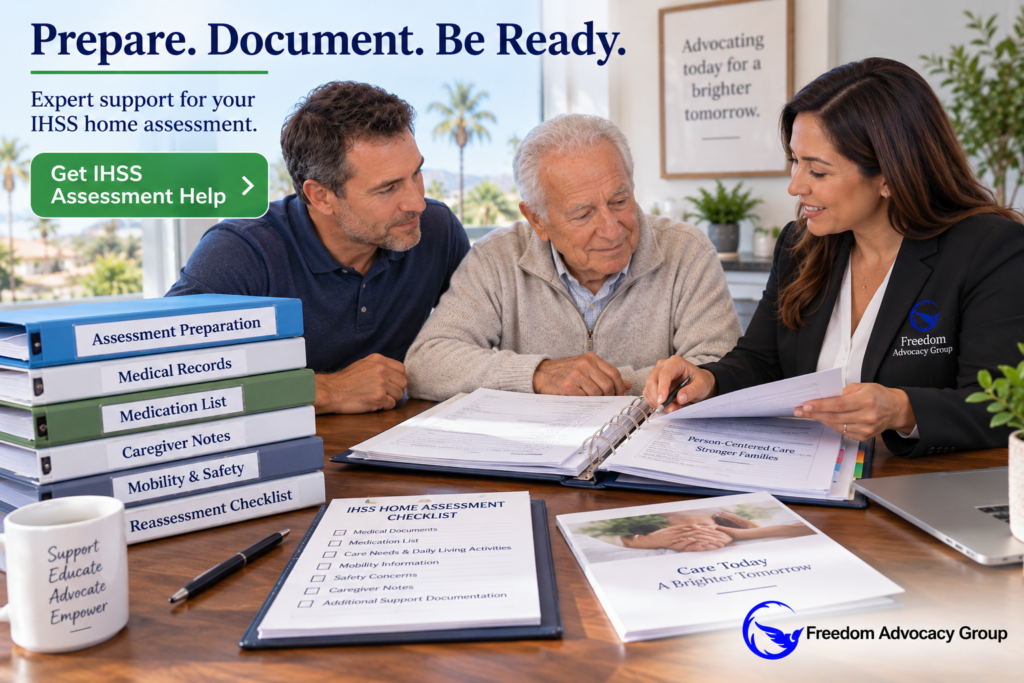
If your family needs assistance understanding the process, Freedom Advocacy Group offers IHSS assessment assistance for California families.
Table of Contents
Table of Contents
What Is an IHSS Home Assessment?
The In-Home Supportive Services program helps eligible aged, blind, and disabled Californians receive assistance that can help them remain safely in their own homes.
After an individual applies for IHSS, a county social worker evaluates the applicant’s need for authorized services.
The assessment considers the person’s functional abilities, limitations, and assistance requirements.
The social worker may review information from the applicant, family members, caregivers, physicians, and other appropriate sources.
An IHSS home assessment can occur during an initial application or a reassessment.
If the recipient’s condition changes and additional assistance becomes necessary, the family may request a reassessment rather than simply waiting for the next annual review.
Families who have not started the process can review our IHSS application help resources before applying.
Why Preparing for an IHSS Home Assessment Matters
The county social worker does not live in your home.
They do not see what happens every morning when your father needs help getting out of bed.
They do not see how long bathing takes.
They do not see your mother becoming confused while dressing.
They do not see the additional laundry after an accident.
They do not see every time you help someone transfer from a chair.
They do not see every safety intervention.
The assessment provides only a limited opportunity to observe the recipient and discuss their needs.
That makes clear communication extremely important.
For example, a recipient may be able to walk from the bedroom to the bathroom.
If asked, “Can you walk to the bathroom?” the recipient may answer yes.
However, the complete answer might be:
“Yes, but he uses a walker, needs someone beside him because of balance problems, and sometimes requires physical assistance getting up from the toilet.”
Those answers describe very different levels of functioning.
Your responsibility is to explain the complete situation accurately.
What Does an IHSS Social Worker Evaluate?
An IHSS assessment involves more than reviewing medical diagnoses.
The social worker evaluates the applicant’s functional needs and determines which IHSS services may be appropriate.
Depending on the circumstances, the assessment may address:
- Medical history and diagnoses
- Physical limitations
- Cognitive limitations
- Mobility
- Bathing
- Dressing
- Grooming
- Toileting
- Meal preparation
- Eating
- Domestic services
- Laundry
- Shopping
- Accompaniment
- Paramedical services, when applicable
- Protective Supervision, when applicable
The social worker may also consider household circumstances and assistance already available.
The important distinction is that a diagnosis alone does not determine the amount of IHSS assistance authorized.
For example:
“My mother has Alzheimer’s disease.”
This provides medical context.
But the assessment also needs to understand how the condition affects her ability to perform everyday activities.
Understand Functional Ability Before the Assessment
California’s IHSS assessment process evaluates the amount of assistance a recipient needs with applicable tasks.
A recipient may:
- Perform a task independently.
- Need verbal reminders.
- Require some physical assistance.
- Need substantial assistance.
- Depend entirely on another person.
These differences matter.
Before the assessment, walk through your loved one’s normal daily routine.
Identify which tasks they perform independently and which require assistance.
Do not assume that being able to perform one portion of a task means the recipient can complete the entire task without help.
Document Your Loved One’s Daily Care Needs
One practical preparation method is to review an entire day, beginning when the recipient wakes up.
Think about the assistance provided in the morning, afternoon, evening, and overnight when applicable.
Morning Care
Does the recipient need assistance with:
- Getting out of bed?
- Walking?
- Using the bathroom?
- Cleaning after toileting?
- Changing continence supplies?
- Bathing?
- Grooming?
- Dressing?
- Preparing breakfast?
- Eating?
Daytime Care
Does the recipient require assistance with:
- Meal preparation?
- Meal cleanup?
- Laundry?
- Shopping?
- Domestic tasks?
- Mobility?
- Transfers?
- Medical appointments?
- Other applicable care needs?
Evening and Overnight Care
Consider whether assistance is required with:
- Dinner
- Toileting
- Changing clothing
- Bathing
- Getting into bed
- Transfers
- Other nighttime care needs
Write down the assistance actually provided.
Do not assume you will remember every detail during the assessment.
Explain the Entire Task, Not Just Whether It Can Be Done
One of the most common assessment mistakes is answering questions with a simple yes or no.
Suppose the social worker asks:
“Can your father dress himself?”
Your father answers yes.
But perhaps he:
- Cannot manage buttons.
- Needs help with socks.
- Cannot safely bend to put on pants.
- Requires clothing to be laid out.
- Needs reminders to change dirty clothing.
A more complete explanation would be:
“He can put on his shirt once I give it to him, but I help with his pants and socks and lay out his clothing because he cannot complete the entire dressing process independently.”
That is not exaggerating.
It is describing the assistance actually required.
Describe Good Days and Difficult Days Accurately
Some conditions fluctuate.
A recipient may function better in the morning than in the evening.
Pain, fatigue, cognitive impairment, and other conditions may affect functioning.
Do not describe an unusually good day as though it represents every day.
Do not exaggerate an unusually difficult day either.
Explain the pattern.
For example:
“She usually needs hands-on assistance entering and exiting the shower. On better days, she can stand using the grab bar while I remain nearby.”
This gives the social worker a more accurate picture.
What Documents Should You Prepare for an IHSS Home Assessment?
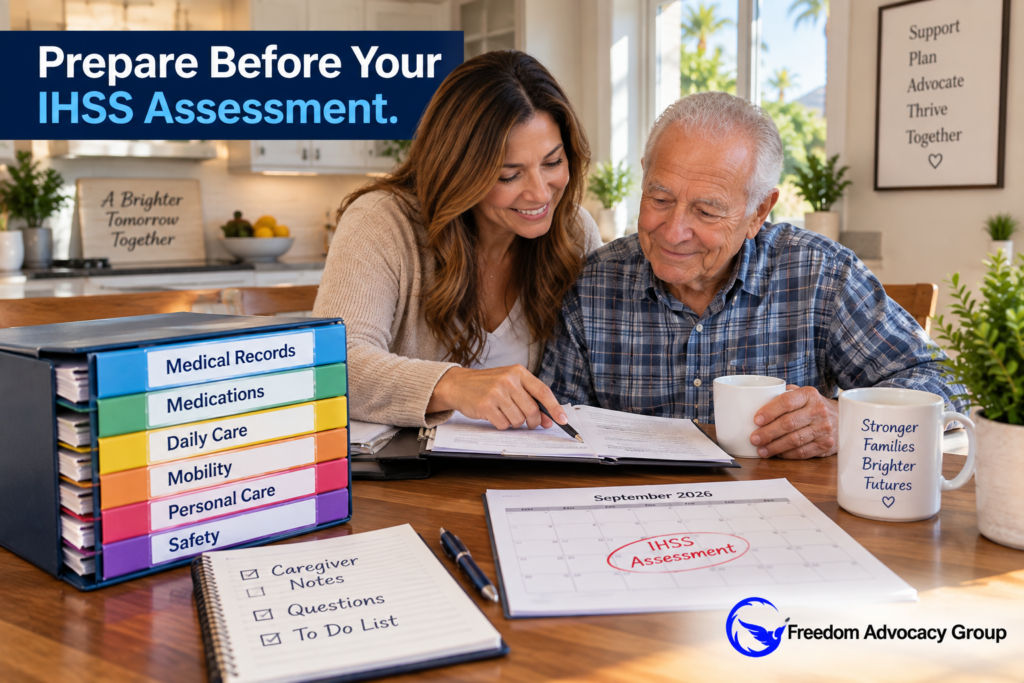
Create an organized folder before the appointment.
Depending on the recipient’s circumstances, useful documents may include:
- Current medication list
- Medical diagnoses
- Physician information
- Relevant medical records
- Hospital discharge documentation
- Therapy evaluations
- Mobility documentation
- Fall records
- Cognitive assessments
- Behavioral documentation
- Existing care plans
- Previous IHSS Notices of Action
- Prior assessment information
- Caregiver notes
- Documentation of recent changes
Not every case requires every document.
The objective is to organize information relevant to the recipient’s functional limitations.
Avoid overwhelming the assessment with unrelated paperwork.
Prepare an Updated Medication List
Medication information can provide useful medical context.
Prepare a list showing:
- Medication name
- Dosage, if known
- Frequency
- Purpose
- Assistance required
If the recipient needs help managing medication, explain the actual assistance provided.
For example:
“My mother cannot reliably remember whether she has taken her medication. I organize it and provide reminders according to her care instructions.”
The county must evaluate any claimed assistance under the applicable IHSS service rules.
Explain Bathing Needs Completely
Bathing can involve considerably more than standing under running water.
Consider whether the recipient needs assistance:
- Entering the shower
- Exiting the shower
- Maintaining balance
- Washing particular body areas
- Washing hair
- Adjusting water
- Drying
- Following bathing steps because of cognitive limitations
Explain what the recipient can do independently and what assistance is required.
Explain Dressing and Grooming Needs
Consider the entire dressing process.
Can the recipient independently:
- Select appropriate clothing?
- Put on a shirt?
- Put on pants?
- Manage socks?
- Put on shoes?
- Use buttons?
- Use zippers?
- Brush their hair?
- Complete oral hygiene?
A person may be able to perform some parts of these tasks while requiring help with others.
Describe the actual assistance.
Explain Toileting Needs Without Embarrassment
Toileting assistance can be uncomfortable to discuss.
However, leaving out relevant information can result in an incomplete assessment.
Consider whether assistance is required with:
- Getting to the toilet
- Transferring onto the toilet
- Transferring off the toilet
- Clothing management
- Cleaning after toileting
- Continence-related care
- Changing applicable supplies
- Handwashing
Describe the assistance respectfully and accurately.
These are legitimate care needs that should not be hidden because they are embarrassing.
Explain Meal Preparation and Eating Separately
Meal preparation and eating involve different activities.
A recipient may need assistance preparing food because they cannot safely:
- Stand long enough to cook
- Chop ingredients
- Lift cookware
- Operate appliances
- Follow cooking instructions
- Recognize spoiled food
Another recipient may require assistance with eating itself.
Explain each need separately.
If swallowing problems or specialized feeding concerns exist, obtain appropriate medical guidance and provide relevant documentation when applicable.
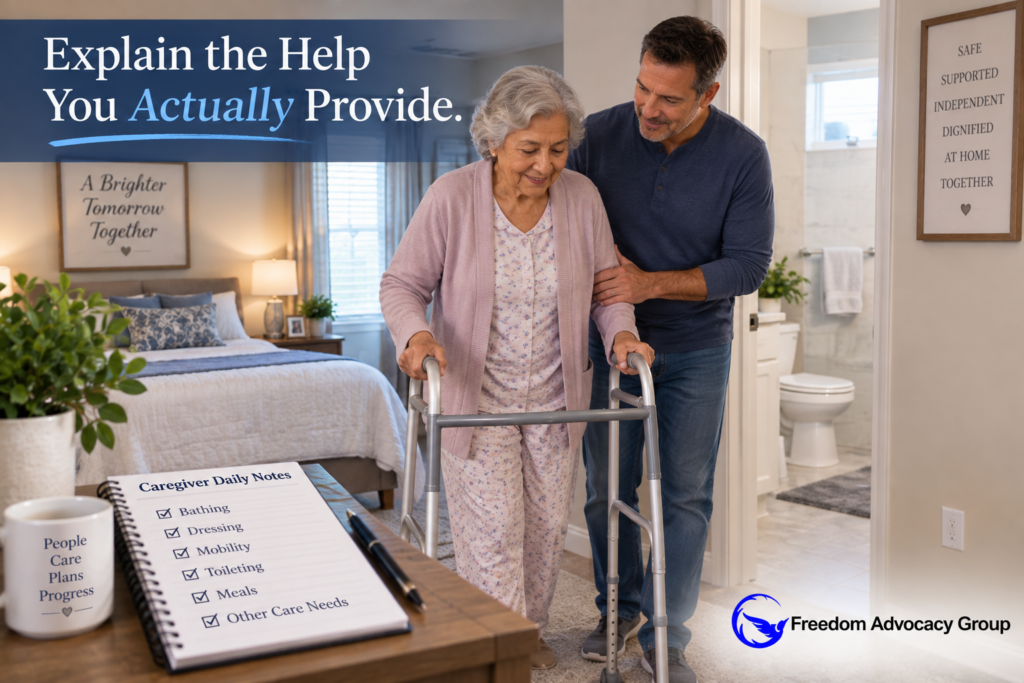
Explain Mobility and Transfers
A social worker may observe the recipient walking during the assessment.
However, walking a short distance does not necessarily explain the person’s full mobility needs.
Describe whether the recipient:
- Uses a walker
- Uses a cane
- Uses a wheelchair
- Needs physical assistance
- Has difficulty standing
- Requires help getting into bed
- Requires help getting out of bed
- Needs help transferring to a toilet
- Has balance problems
Explain the actual assistance required.
What If Your Parent Says They Can Do Everything Independently?
This situation can occur when an older adult values independence or has difficulty remembering the assistance they receive.
For example, the social worker asks:
“Do you prepare your own meals?”
Your father answers:
“Yes, every day.”
However, you actually shop for groceries, prepare his food, place meals in front of him, and clean afterward.
Do not argue with or embarrass your parent.
Calmly explain:
“Dad likes being independent. I prepare his meals now because he can no longer safely use the stove. I cook the food and put the meals out for him.”
This provides important information while preserving the recipient’s dignity.
Preparing for an IHSS Assessment When the Recipient Has Dementia
Dementia and other cognitive impairments can make assessments more complicated.
A recipient may:
- Speak clearly
- Answer simple questions
- Appear physically healthy
- Carry on a pleasant conversation
Yet still require substantial assistance with everyday activities.
For example, a person may remember their birthday but forget whether they have taken medication.
They may walk independently but become lost after leaving home.
They may know how to turn on the stove but forget to turn it off.
Document the functional consequences of the cognitive impairment.
If the recipient’s mental impairment causes non-self-directing behavior that creates qualifying safety risks, families may also want to explore IHSS Protective Supervision .
For families recording recurring safety incidents, our Protective Supervision behavior log guide explains how to organize documentation.
Preparing for an IHSS Assessment for a Child With Special Needs
Families caring for children with disabilities should also focus on individual functional needs.
A diagnosis does not automatically determine which IHSS services will be authorized.
The assessment must consider applicable program rules, including whether the assistance exceeds ordinary age-appropriate parental care.
Explain what the child can and cannot do independently and how their disability affects the assistance required.
Freedom Advocacy Group provides information about IHSS special needs services for families navigating the program.
Should You Clean Your House Before the IHSS Assessment?
You do not need to stage your home.
Reasonable cleanliness and safety are appropriate, but do not alter the environment in a way that hides how the recipient normally functions.
Do not hide mobility aids.
Do not remove adaptive equipment that the recipient regularly uses.
Do not create an artificial environment.
The home should accurately reflect the recipient’s normal living circumstances.
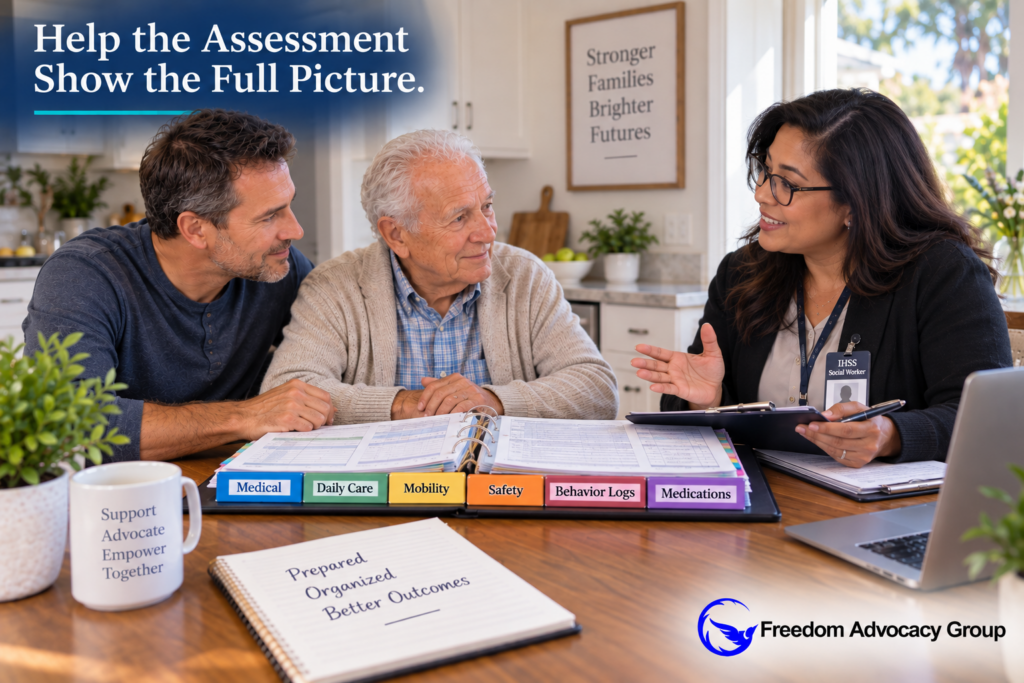
Should a Family Member Be Present During the Assessment?
When appropriate, a knowledgeable family member, caregiver, or authorized representative may provide useful information.
This can be particularly important when the recipient has difficulty accurately describing their own needs.
The caregiver should understand:
- Daily routines
- Assistance provided
- Physical limitations
- Cognitive limitations
- Safety concerns
- Changes in condition
Allow the recipient to participate as appropriate.
The caregiver can respectfully provide additional information when necessary.
Do Not Exaggerate or Minimize the Recipient’s Condition
Preparation does not mean making someone appear more disabled than they are.
If your mother can independently feed herself, say so.
If your father can brush his teeth without assistance, acknowledge it.
Then accurately explain the areas where assistance is still required.
The opposite mistake is minimizing the care you provide.
Caregivers sometimes say:
“I just help a little.”
But that may involve preparing meals, assisting with bathing, managing laundry, helping with transfers, and performing numerous other tasks.
Be specific.
A credible assessment should accurately describe both abilities and limitations.
Explain How Often Assistance Is Required
The county must understand more than whether assistance is necessary.
The frequency of applicable tasks can also matter.
Instead of:
“I help her use the bathroom.”
Explain the actual pattern:
“She typically needs assistance approximately five times during the day and twice overnight.”
Do not invent frequencies.
Keep accurate notes before the assessment so you can describe what normally occurs.
Keep a Caregiver Record Before the Assessment
A simple record can help identify assistance that you might otherwise forget.
Record the time, task, assistance provided, and reason assistance was necessary.
For example:
| Time | Task | Assistance |
|---|---|---|
| 7:15 a.m. | Getting out of bed | Physical assistance because of weakness and balance |
| 7:25 a.m. | Toileting | Help with transfer and clothing |
| 7:45 a.m. | Dressing | Assistance with pants, socks, and shoes |
| 8:10 a.m. | Breakfast | Meal preparation and cleanup |
These records should describe actual care.
They are not a method of manufacturing additional IHSS hours.
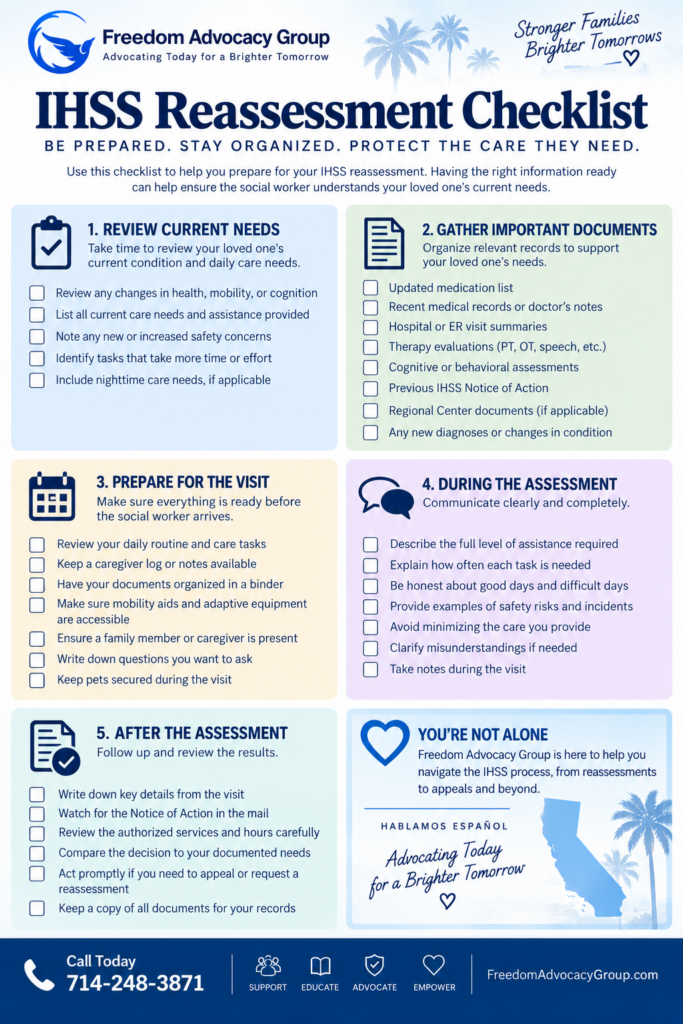
IHSS Reassessment Checklist
Families preparing for a reassessment should review changes in the recipient’s condition, daily care requirements, and existing authorization before the appointment.
The checklist below is intended to help organize that preparation.
IMAGE PLACEMENT — Insert the IHSS Reassessment Checklist PDF image here.
What Questions Should You Ask During the IHSS Assessment?
The assessment is an opportunity to clarify the process.
If something is unclear, ask.
Useful questions include:
- What service category does this task fall under?
- Is additional documentation needed?
- How should I report a change in condition?
- What happens after the assessment?
- When should we expect a Notice of Action?
- Where can we find information about hearing rights?
Take notes during the meeting.
What Happens After an IHSS Home Assessment?
After completing the assessment process, the county determines whether services will be authorized and the amount of time approved for applicable tasks.
The applicant or recipient receives a Notice of Action explaining the decision.
Review it carefully.
Do not look only at the total monthly hours.
Review the authorized services and consider whether the decision reflects the needs discussed during the assessment.
If the county denies services or authorizes fewer hours than you believe are appropriate, you may have hearing rights.
Freedom Advocacy Group provides information about the IHSS appeals process for families facing unfavorable decisions.
What If the IHSS Hours Are Too Low?
Compare the Notice of Action with the recipient’s actual needs.
Consider whether:
- Important services were missed.
- The frequency of a task was misunderstood.
- Physical limitations were overlooked.
- Cognitive limitations were not fully explained.
- Relevant medical documentation was missing.
- The recipient unintentionally minimized their needs.
- The recipient’s condition has changed.
Depending on the circumstances, the recipient may need to discuss the decision with the county, request a reassessment, or pursue an appeal.
Do not assume that an informal conversation automatically preserves hearing rights.
Review the Notice of Action and act within applicable deadlines.
Families needing assistance can explore Freedom Advocacy Group’s IHSS due process representation services .
Case Example: A Recipient Who Says She Can Bathe Independently
Consider a hypothetical 78-year-old named Maria.
Maria has arthritis, limited shoulder movement, and balance problems.
During the assessment, the social worker asks:
“Can you shower yourself?”
Maria answers:
“Yes.”
Her daughter knows that this is not the complete picture.
Maria can wash the front of her upper body.
However, her daughter:
- Helps her enter the shower.
- Assists with washing areas she cannot reach.
- Helps rinse her hair.
- Helps her exit the shower.
- Assists with drying.
If Maria’s daughter says nothing, the social worker may receive an incomplete description.
Instead, she respectfully explains which parts Maria performs independently and which require assistance.
This provides a more accurate picture of Maria’s bathing needs.
Case Example: Dementia and Meal Preparation
Consider a hypothetical 82-year-old named Robert.
Robert has dementia.
During the assessment, he tells the social worker:
“I cook all the time.”
His son explains that Robert has not safely used the stove independently for several months.
Robert has previously turned on a burner and walked away.
His son now:
- Purchases groceries.
- Prepares cooked meals.
- Portions food.
- Places meals where Robert can access them.
- Cleans afterward.
Robert’s ability to assemble a sandwich does not necessarily describe his complete meal preparation needs.
The family provides the missing context.
How Freedom Advocacy Group Can Help With an IHSS Home Assessment
Families often understand their loved one’s needs better than anyone.
The challenge is communicating those needs clearly during the IHSS process.
Freedom Advocacy Group helps California families understand and prepare for IHSS applications, assessments, reassessments, Protective Supervision requests, denials, and appeals.
Depending on the circumstances, assistance may include:
- Reviewing current care needs.
- Preparing for an IHSS home assessment.
- Identifying important functional limitations.
- Organizing relevant documentation.
- Preparing caregiver records.
- Understanding applicable IHSS service categories.
- Preparing for reassessments.
- Reviewing unfavorable Notices of Action.
- Understanding Protective Supervision.
- Preparing documentation for an appeal.
Learn more about Freedom Advocacy Group’s services or contact our team to discuss your family’s circumstances.
Frequently Asked Questions About IHSS Home Assessments
What happens during an IHSS home assessment?
A county social worker evaluates the applicant’s functional abilities, limitations, and need for applicable IHSS services.
What documents should I prepare?
Relevant documents may include medical records, medication information, caregiver notes, mobility documentation, previous IHSS paperwork, and records supporting the recipient’s functional limitations.
Can a family member participate in the assessment?
A knowledgeable family member or caregiver may provide relevant information when appropriate, particularly when the recipient has difficulty explaining their needs.
What if my parent says they can do everything independently?
Allow your parent to participate, then respectfully provide additional factual information about the assistance actually required.
Should I describe the recipient’s worst day?
Describe the recipient’s normal functioning and explain meaningful fluctuations. Do not exaggerate an unusually difficult day or present an unusually good day as typical.
Can I request more IHSS hours after an assessment?
A recipient may request a reassessment when their needs or circumstances change. If you disagree with an existing county decision, review the Notice of Action and applicable hearing rights.
What if the county denies IHSS services?
Review the Notice of Action carefully. Depending on the circumstances, the recipient may have state hearing rights.
Can Freedom Advocacy Group help me prepare?
Freedom Advocacy Group provides assistance with IHSS applications, assessments, documentation, Protective Supervision matters, and appeals.
Call 714-248-3871 to discuss available services.
Your IHSS Home Assessment Should Reflect the Full Picture
An IHSS assessment is not about proving that your loved one cannot do anything independently.
It is about explaining what they can and cannot safely do without assistance.
Your parent may be able to put on a shirt but not complete dressing.
They may be able to walk but require help with transfers.
They may be able to eat but not prepare meals.
They may speak clearly while having significant cognitive limitations.
They may appear independent during a short conversation while requiring extensive assistance throughout the day.
Do not assume the social worker will automatically observe every limitation.
Prepare your documentation.
Understand the care you provide.
Explain the entire task.
Describe actual frequency.
Be honest and specific.
The objective is to help the assessment accurately reflect the recipient’s everyday needs.
Get Help Preparing for Your IHSS Home Assessment Today
An IHSS home assessment can influence the services and hours a recipient receives.
You do not have to approach the process without understanding what to expect.
Freedom Advocacy Group helps California families prepare for applications, assessments, reassessments, Protective Supervision requests, denials, reductions, and appeals.
If you have an upcoming assessment or believe a previous assessment did not accurately capture your loved one’s needs, contact our team.
Call 714-248-3871 today or contact Freedom Advocacy Group to discuss your situation.
Hablamos Español.
Advocating today for a brighter tomorrow.
Legal Disclaimer
The information provided on this page is for general educational and informational purposes only and is not legal advice.
Freedom Advocacy Group is an advocacy service and should not be assumed to be a law firm or a substitute for advice from a licensed attorney unless expressly stated otherwise.
IHSS eligibility, assessment procedures, authorized services, service hours, Protective Supervision eligibility, hearing procedures, and individual circumstances may vary. California laws, regulations, forms, policies, and procedures can change.
Nothing on this website guarantees IHSS eligibility, approval, a particular number of authorized hours, Protective Supervision, continuation of benefits, or a successful appeal.
Applicants and recipients should review current California Department of Social Services requirements and their individual Notice of Action.
If you need legal advice concerning your individual rights, hearing deadlines, court proceedings, or other legal matters, consult a qualified California attorney.