

Family Member Paid IHSS Caregiver
Every day, thousands of California families provide care that most people never see.
An adult daughter helps her father shower and dress before work.
A son prepares his mother’s meals, takes her to medical appointments, helps her use the bathroom, and makes sure she can safely remain at home.
A parent spends the day caring for a child with a significant disability.
A spouse provides hands-on personal care to a husband or wife who can no longer complete certain daily activities independently.
A sibling reorganizes their life to help a brother or sister remain safely at home.
Many families perform this care for months or years before discovering an important fact:
In California, a family member can often become a paid IHSS caregiver when the recipient qualifies for IHSS and the family member meets the applicable provider requirements.
Family members are not automatically excluded simply because they are related to the recipient.
California specifically recognizes that IHSS care providers can include family members.
However, there are important rules families need to understand.
The recipient must first qualify for IHSS and have services authorized. The family caregiver generally must complete the provider enrollment process. Payment is limited to authorized IHSS services and hours.
Special rules can also apply depending on the relationship between the provider and recipient, particularly when the provider is a spouse or the parent of a minor child.
This guide explains how a family member can get paid to be an IHSS caregiver, which relatives may serve as providers, how enrollment works, what services family caregivers can be paid for, how IHSS hours are determined, what live-in caregivers should know, and how Freedom Advocacy Group can help families navigate the process.
Table of Contents
Can a Family Member Be an IHSS Provider?
Yes.
California Department of Social Services guidance specifically recognizes family members as potential IHSS care providers.
Depending on the circumstances, an IHSS provider might be:
- An adult child
- Parent
- Sibling
- Grandparent
- Other relative
- Spouse, subject to special program rules
- Friend
- Neighbor
- Another qualified individual provider
Being related to the recipient does not automatically prevent someone from becoming an IHSS provider.
But there is an important distinction:
Being someone’s family caregiver does not automatically make you a paid IHSS provider.
The recipient must be eligible for IHSS.
The county must authorize services.
The provider must satisfy applicable enrollment requirements.
And the provider can only claim payment for authorized IHSS services actually performed.
Families who have not yet applied should begin by understanding the IHSS application process and how California determines whether a person needs assistance to remain safely in their own home.
How Does a Family Member Get Paid Through IHSS?
There are really two sides to the IHSS process:
The recipient side and the provider side.
Understanding the difference makes the process much easier.
Step 1: The Person Needing Care Applies for IHSS
The person who needs assistance is the potential IHSS recipient.
They must satisfy applicable eligibility requirements.
IHSS is intended to provide eligible aged, blind, and disabled individuals with assistance that can help them remain safely in their own homes.
Step 2: IHSS Assesses the Recipient’s Needs
A county social worker evaluates the recipient.
The assessment looks at the assistance the person needs with authorized IHSS services.
Depending on the recipient, this might involve assistance with:
- Bathing
- Dressing
- Grooming
- Toileting
- Feeding
- Mobility
- Transfers
- Meal preparation
- Meal cleanup
- Laundry
- Shopping
- Domestic services
- Accompaniment
- Paramedical services when applicable
- Protective Supervision when applicable
Step 3: The County Authorizes Services and Hours
If IHSS is approved, the recipient receives a Notice of Action identifying authorized services and monthly hours.
Those authorized services are extremely important.
IHSS does not simply pay a family caregiver for every hour they spend with their loved one.
Payment is tied to authorized IHSS services.
Step 4: The Family Member Enrolls as an IHSS Provider
The family member who will provide the authorized care generally must complete the IHSS provider enrollment requirements before receiving payment as an enrolled provider.
Step 5: The Provider Reports Authorized Time
Once properly enrolled and linked to the recipient, the provider reports time worked according to IHSS requirements.
The provider should only claim authorized services actually provided.
Who Is the Employer of an IHSS Family Caregiver?
This is an unusual part of IHSS that surprises many families.
Under the individual provider model, the IHSS recipient is generally considered the provider’s employer for purposes including hiring, training, supervising, and terminating the provider.
So imagine an adult daughter caring for her mother.
The daughter may be the enrolled IHSS provider.
Her mother is the IHSS recipient.
Although they are mother and daughter, they also have a formal recipient-provider relationship within the IHSS program.
That means family caregivers still need to follow IHSS program requirements.
Being related does not eliminate the rules.
What Does a Family Member Need to Do to Become an IHSS Provider?
California requires prospective individual providers to complete an enrollment process.
The specific county process should be followed carefully.
Provider enrollment generally involves required enrollment documentation, provider orientation, and applicable eligibility/background requirements.
Do not assume that because you are the recipient’s son, daughter, parent, sibling, or spouse, the county can simply begin sending you checks.
You must be properly enrolled and approved as a provider.
The county IHSS office or Public Authority can provide information concerning the local provider enrollment process.
Can an Adult Child Get Paid to Care for a Parent?
Yes, an adult son or daughter can potentially become an IHSS provider for an eligible parent.
This is one of the most common family caregiving situations.
For example, imagine your father can no longer safely:
- Bathe independently
- Prepare meals
- Dress without assistance
- Get on and off the toilet
- Walk safely throughout the home
- Complete other authorized daily tasks
If your father qualifies for IHSS and those services are authorized, an adult child may potentially become the enrolled provider performing authorized care.
This can be enormously important for families.
Without IHSS, the adult child may already be providing the exact same assistance without compensation.
IHSS can potentially allow an eligible family to formalize some of that caregiving through authorized paid services.
But remember:
IHSS pays for authorized services—not simply for being someone’s son or daughter or being present in the home.
Can a Son Get Paid to Take Care of His Mother?
Potentially, yes.
The same general concept applies regardless of whether the adult child is a son or daughter.
What matters is whether:
- The mother qualifies for IHSS.
- The county authorizes IHSS services.
- The son satisfies applicable provider enrollment requirements.
- The son actually provides authorized services.
- Time is reported according to IHSS rules.
The family relationship by itself does not prevent an adult child from being a provider.
Can a Daughter Get Paid to Take Care of Her Father?
Potentially, yes.
An adult daughter may become the IHSS provider for an eligible father when applicable requirements are satisfied.
This arrangement can be particularly common when an aging parent develops:
- Dementia
- Alzheimer’s disease
- Mobility limitations
- Parkinson’s disease
- Stroke-related limitations
- Arthritis
- Vision loss
- Other physical or cognitive disabilities
The critical question for IHSS isn’t:
“Does his daughter help him?”
It is:
“What authorized IHSS assistance does the recipient need to remain safely at home?”
That is what the assessment is intended to determine.
Can a Parent Get Paid to Care for a Disabled Child?
Yes, in qualifying circumstances a parent may be able to serve as the paid IHSS provider for their minor child.
This is an area where California’s rules deserve careful attention.
IHSS is available to eligible children with disabilities who require qualifying assistance to remain safely at home.
California currently explains that minor recipients enrolled in certain IHSS subprograms may hire a provider who successfully completes provider enrollment, including a parent. Program placement matters because federal rules restrict parent providers under the Personal Care Services Program (PCSP).
Families should therefore avoid relying on outdated statements such as:
“Parents can never be paid.”
Or:
“Every parent of a disabled child can automatically become the paid provider.”
Neither statement accurately captures the current program.
The child’s eligibility, authorized services, IHSS subprogram, provider enrollment, and other applicable requirements matter.
Another important distinction is that IHSS does not pay a parent simply for ordinary age-appropriate parenting or routine child supervision.
The assessment must identify authorized services related to the child’s disability and applicable IHSS rules.
Can a Parent Be Paid for Protective Supervision?
Potentially, when applicable program requirements are satisfied and Protective Supervision is authorized.
This can be extremely important for families caring for a child with a significant cognitive impairment.
Protective Supervision is not ordinary babysitting.
It is an IHSS service for certain eligible individuals who are non-self-directing due to mental impairment or mental illness and require supervision to help safeguard them against injury, hazard, or accident.
A parent might spend much of the day:
- Preventing elopement
- Redirecting a child away from traffic
- Preventing unsafe climbing
- Intervening around household hazards
- Preventing accidental injury
- Monitoring other non-self-directing behaviors
But the existence of autism, intellectual disability, or another diagnosis does not automatically establish Protective Supervision eligibility.
Families need to understand the functional requirements and documentation.
Our detailed guide to IHSS Protective Supervision for autism explains this distinction in greater detail.
Families preparing medical documentation should also review the SOC 821 Protective Supervision form and understand why memory, orientation, judgment, and other evidence can matter.
Can a Spouse Get Paid as an IHSS Caregiver?
Potentially, but spouse-provider rules are more restrictive and service-specific.
California distinguishes among the services an able and available spouse is ordinarily expected to perform and services for which payment may be available.
For example, California regulations provide that an able and available spouse or another provider may be paid for certain personal care services and paramedical services.
Different restrictions apply to services such as domestic services and related services when there is an able and available spouse.
Additional rules address circumstances involving meal preparation, transportation, Protective Supervision, employment, health, and other reasons a spouse may or may not be available.
Because spouse-provider cases are more complicated than the typical adult-child caregiver situation, families should not assume:
“My spouse has IHSS, so every authorized hour can automatically be paid to me.”
The services authorized and the spouse’s circumstances matter.
Can a Sibling Be an IHSS Provider?
Potentially, yes.
A brother or sister may serve as an IHSS provider when the recipient is eligible, services are authorized, and the sibling successfully completes applicable provider enrollment requirements.
The same can potentially apply to other relatives.
California specifically recognizes that family members can be IHSS care providers.
The family relationship doesn’t eliminate the need to follow provider rules.
Can a Grandparent Become an IHSS Provider?
Potentially, yes.
A grandparent may be able to become an enrolled provider for an eligible IHSS recipient.
Again, the recipient’s eligibility and authorized services come first.
Then the provider must meet applicable enrollment requirements.
Families should not assume that only professional caregivers can become IHSS providers.
One of the defining features of the program is the recipient’s ability to hire an individual provider, which may include someone the recipient already knows and trusts.
Does the Family Caregiver Have to Live With the Recipient?
Not necessarily.
A family member does not generally have to live in the recipient’s home simply because they are related.
A provider may live elsewhere and travel to the recipient’s home to provide authorized services.
However, live-in providers have additional issues worth understanding, particularly concerning tax treatment.
Can a Live-In Family Caregiver Get Paid by IHSS?
Yes, qualifying live-in providers can receive IHSS wages for authorized services.
Living with the recipient does not automatically make the care unpaid.
A son might live with his father.
A daughter might live with her mother.
A parent may live with their disabled child.
The provider-recipient relationship can still exist when the applicable requirements are met.
However, living together can affect issues such as household service proration, taxation, and other program considerations.
Are Live-In IHSS Caregiver Wages Taxable?
This is an area where families should be careful about making broad assumptions.
Under IRS Notice 2014-7, certain Medicaid waiver payments made to qualifying providers who live in the same home as the person receiving care may be excluded from federal gross income.
California allows IHSS and WPCS providers to self-certify their live-in status for applicable purposes.
Tax treatment can depend on the provider’s individual circumstances.
There can also be separate questions involving:
- Federal income tax
- California income tax
- Social Security
- Medicare
- Earned-income calculations
- Tax credits
For that reason, families should not rely on a simple statement that:
“All IHSS income is tax-free.”
That is not accurate.
Live-in provider tax treatment can be different from non-live-in provider tax treatment.
For individual tax advice, consult a qualified tax professional familiar with IHSS and Medicaid waiver payments.
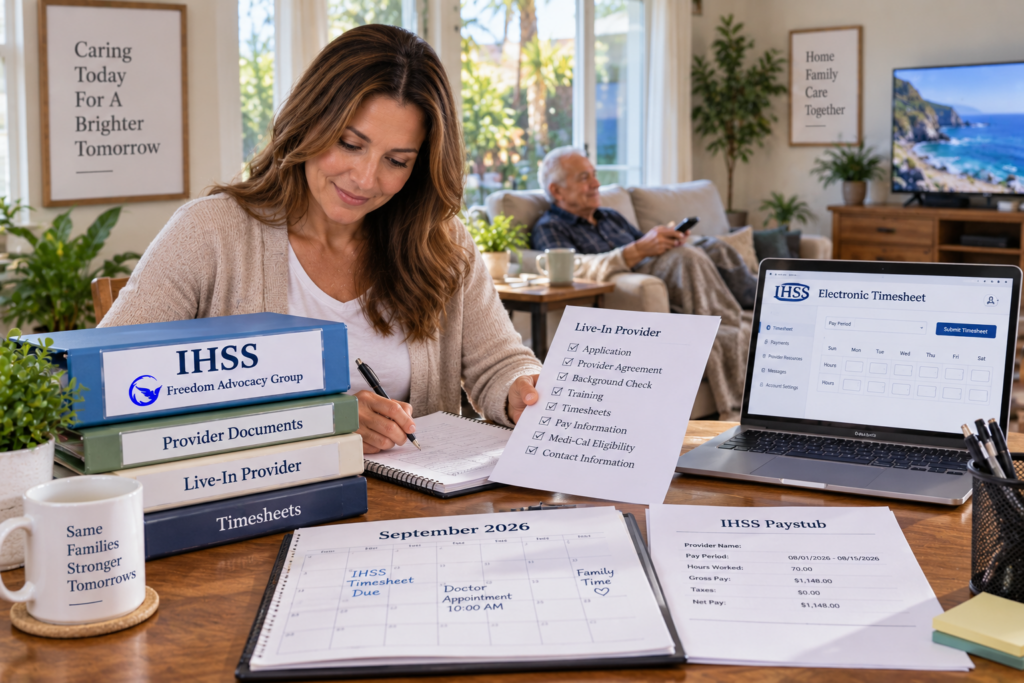
How Much Does IHSS Pay Family Caregivers?
IHSS provider wages vary by county.
California does not have one single statewide IHSS provider wage that applies identically in every county.
Provider rates are set at the county level, so families should verify the current wage in the county administering the recipient’s IHSS case.
The amount a particular family caregiver earns also depends on factors including:
- Authorized IHSS hours
- Hours actually worked
- Applicable workweek rules
- Provider wage rate
- Whether multiple providers share the authorized hours
- Applicable overtime rules
- Other program requirements
Do not calculate expected income by simply assuming the caregiver will be paid for every hour spent at home with the recipient.
Start with the recipient’s authorized IHSS services and hours.
Can IHSS Pay a Family Member for 24-Hour Care?
IHSS does not simply pay a family caregiver for 24 hours per day because the caregiver lives with someone who requires substantial assistance.
IHSS authorizes specific services and service time under program rules.
Even Protective Supervision, which involves a need for 24-hour-a-day supervision, does not mean one provider is automatically paid for 24 hours every day.
Authorized hours, service limitations, workweek rules, coverage arrangements, and other program requirements still apply.
This distinction is especially important for families caring for someone with dementia, autism, or another significant cognitive impairment.
What Can a Family IHSS Provider Be Paid to Do?
Payment depends on what services have actually been authorized for the recipient.
Depending on the case, authorized IHSS services may include assistance with activities such as:
- Bathing
- Dressing
- Grooming
- Feeding
- Toileting
- Bowel and bladder care
- Mobility
- Transfers
- Meal preparation
- Meal cleanup
- Laundry
- Shopping
- Accompaniment
- Domestic services
- Paramedical services
- Protective Supervision
Not every recipient receives every service.
Not every provider can be paid for every household task.
The Notice of Action and other IHSS documentation identify the recipient’s authorized services and hours.
Being a Family Member Does Not Mean You Can Claim Every Hour You Provide Care
This is extremely important.
California specifically instructs family providers that they remain responsible for standard IHSS provider requirements.
A family provider can only be paid for authorized IHSS tasks.
For example, suppose a daughter lives with her mother.
During the day, she:
- Helps Mom bathe
- Prepares Mom’s breakfast
- Cleans the entire house
- Does laundry for four family members
- Drives her own child to school
- Goes grocery shopping for the entire household
- Watches television with Mom
Not every minute of that day is automatically payable IHSS time.
Some tasks may be authorized.
Some may not.
Certain household services may also be prorated when other household members benefit from them.
Being a family member doesn’t change that.
Can You Get Paid for Care You Were Already Providing?
Families frequently ask this question after discovering IHSS.
They may have been caring for a loved one for months before applying.
IHSS is not simply a reimbursement program for every hour of unpaid care a family member previously provided.
The recipient must go through the IHSS process, services must be authorized, and the provider must meet applicable requirements.
Once a provider is successfully enrolled and approved, CDSS explains that electronic retroactive timesheets may become available back to the provider’s date of assignment to a recipient.
The specific dates applicable to an individual case should be confirmed with the county rather than assuming all prior caregiving will be paid retroactively.
Does IHSS Decide How Many Hours the Family Caregiver Gets?
IHSS primarily assesses the recipient’s needs.
This distinction matters.
The social worker isn’t supposed to determine hours based simply on:
“How much money does the daughter need?”
Or:
“How many hours would the son like to work?”
The assessment focuses on the recipient’s need for authorized IHSS services.
Once the recipient’s services and hours are authorized, those hours can then be provided by the enrolled provider or divided among providers as applicable.
If the recipient’s needs have increased and the current authorization no longer accurately reflects the assistance required, families should learn about requesting an IHSS reassessment for more hours.
What If the Family Caregiver Is Providing Much More Care Than IHSS Authorized?
This happens frequently.
A family caregiver may spend many more hours helping a loved one than IHSS actually authorizes.
The first question should be:
Why is there a difference?
Possibilities might include:
- Some caregiving activities aren’t covered IHSS services
- Certain tasks are subject to program limitations
- The recipient’s needs were underestimated
- The recipient’s condition has changed
- Important care needs were not adequately explained
- The family misunderstood what time is compensable
- The recipient has unmet needs beyond the IHSS authorization
If legitimate IHSS service needs have increased, a reassessment may be appropriate.
Do not simply claim additional hours on a timesheet that were not authorized.
How Can a Family Prepare for the IHSS Home Assessment?
The home assessment can have a major impact on which services and hours are authorized.
Before the social worker arrives, document what the recipient actually needs help doing.
For each activity, consider:
- What can the recipient do independently?
- What can they do with verbal prompting?
- What requires hands-on assistance?
- How frequently is the task performed?
- How long does the assistance actually take?
- Why can’t the recipient safely complete it alone?
Instead of saying:
“I take care of everything for Dad,”
explain:
“I help Dad transfer from bed in the morning, assist him to the bathroom, help manage his clothing and hygiene, prepare breakfast because he cannot safely stand at the stove, and provide hands-on assistance entering and exiting the shower.”
Specific information gives the social worker a clearer picture of the recipient’s functional needs.
For additional guidance, read our article on how to prepare for an IHSS home assessment .
Don’t Minimize Your Work Because You’re Family
This is one of the most common mistakes family caregivers make.
You may have helped your mother get dressed every morning for three years.
It feels normal.
You may no longer even think of it as caregiving.
You simply think:
“That’s Mom.”
But during an IHSS assessment, the county needs to understand what assistance is actually being provided.
Don’t exaggerate.
But don’t minimize it either.
If you:
- Help with transfers, say so.
- Clean after toileting accidents, explain it.
- Prepare every meal because the recipient cannot do so safely, explain why.
- Assist with bathing, describe the actual assistance.
- Redirect a cognitively impaired recipient from hazards, document it.
Family love and authorized caregiving can exist at the same time.
The fact that you would probably help your loved one even without pay does not mean the assistance isn’t real.
What If Your Family Member Has Dementia?
Dementia can create both physical-care and cognitive-care needs.
Depending on the individual, a recipient may require increasing assistance with:
- Dressing
- Bathing
- Toileting
- Meal preparation
- Mobility
- Daily routines
- Other authorized IHSS activities
Some recipients may also develop non-self-directing behaviors that create a risk of injury, hazard, or accident.
In appropriate cases, families may need to explore IHSS Protective Supervision .
Protective Supervision has separate eligibility requirements, so dementia alone does not automatically qualify someone.
Documentation of mental functioning, behaviors, hazards, and caregiver intervention can become important.
What If Your Family Member Has Autism?
Families caring for children or adults with autism may potentially receive IHSS when the recipient meets program requirements.
Authorized services depend on the recipient’s individual needs.
Some individuals may need assistance with personal care.
Others may have significant cognitive safety concerns.
For individuals who are non-self-directing and require supervision to help prevent injury, hazard, or accident, families may want to learn about IHSS Protective Supervision for autism .
Again, autism does not automatically establish eligibility for Protective Supervision.
The individual’s functional limitations matter.
Can More Than One Family Member Be an IHSS Provider?
Potentially, authorized hours can be divided among multiple enrolled providers.
For some families, this makes practical sense.
One sibling may provide weekday care.
Another may provide certain weekend assistance.
A parent and another qualified provider may divide authorized services.
However, providers must follow applicable workweek, timesheet, and authorization rules.
Two providers cannot both claim the same service time simply because both were present.
The hours claimed must represent authorized services actually provided.
Do IHSS Family Caregivers Get Overtime?
IHSS has workweek and overtime rules that can apply to providers.
The details can depend on factors including:
- Number of recipients served
- Authorized weekly hours
- Total hours worked
- Applicable workweek limitations
- Whether an exemption applies
Providers serving multiple recipients should pay particular attention to these rules.
California also has limited overtime exemptions for certain providers meeting specific requirements.
Do not assume that having additional authorized monthly hours automatically means a provider may work them in any weekly pattern without considering IHSS workweek rules.
Do IHSS Providers Get Paid Sick Leave?
Active IHSS providers who meet the applicable eligibility requirements can qualify for California’s IHSS paid sick leave program.
For the 2026–2027 fiscal year, CDSS currently lists 40 hours of annual paid sick leave for eligible IHSS providers.
Newly hired providers must satisfy applicable work requirements before sick leave becomes available for use.
Program details can change, so providers should check current CDSS guidance when determining their available sick leave.

Frequently Asked Questions About Getting Paid as a Family IHSS Caregiver
Can a family member get paid through IHSS?
Yes. California recognizes family members as potential IHSS care providers when applicable recipient and provider requirements are satisfied.
Can I get paid to take care of my elderly mother?
Potentially, yes.
If your mother qualifies for IHSS, receives authorized services, and you successfully complete applicable provider enrollment requirements, you may potentially become her paid IHSS provider.
Can I get paid to take care of my father?
Potentially, yes.
An adult child can potentially serve as the IHSS provider for an eligible parent.
Can a daughter get paid to take care of her mother or father?
Potentially, yes. Adult children are not automatically excluded from becoming IHSS providers simply because they are related to the recipient.
Can a son get paid to take care of his parents?
Potentially, yes, when the parent qualifies for IHSS and the son satisfies applicable provider requirements.
Can a parent get paid to care for a disabled child?
Yes, in qualifying circumstances. Current California rules allow parent providers for eligible minor recipients in certain IHSS subprograms, subject to applicable requirements.
Can I get paid to care for my child with autism?
Potentially.
The child must first qualify for IHSS and have services authorized. Parent-provider and program rules also apply.
If Protective Supervision is being requested, separate eligibility requirements must be established.
Can a spouse get paid through IHSS?
Potentially, but special rules apply to spouse providers and to which services may be paid depending on the spouse’s availability and circumstances.
Can a sibling become an IHSS provider?
Potentially, yes. A sibling may become an enrolled provider when applicable requirements are satisfied.
Does an IHSS provider have to live with the recipient?
Not necessarily.
A provider may live with the recipient or elsewhere.
Are live-in IHSS wages tax-free?
Certain qualifying live-in IHSS/WPCS payments may be excluded from federal gross income under IRS Notice 2014-7.
Individual circumstances matter, and not all IHSS wages should automatically be assumed to be tax-free.
Can IHSS pay me for everything I do for my family member?
No.
Providers can only claim payment for authorized IHSS services actually performed according to program requirements.
Can I claim more hours because I actually provide more care than IHSS authorized?
Do not claim unauthorized hours.
If the recipient’s legitimate IHSS needs have increased, consider requesting a reassessment instead.
Can more than one family member be an IHSS provider?
Potentially, yes. Multiple enrolled providers may divide authorized services and hours when appropriate, subject to IHSS rules.
How much does IHSS pay family caregivers?
Provider wages vary by county. The amount an individual provider earns also depends on the recipient’s authorized hours, hours actually worked, applicable workweek rules, and other factors.
Being Family Doesn’t Make the Care Less Valuable
Family caregivers often perform extraordinary amounts of work without thinking of themselves as caregivers.
You may simply say:
“I’m taking care of Dad.”
But that might mean:
Helping him out of bed.
Assisting with toileting.
Preparing meals.
Helping him shower.
Getting him dressed.
Taking him to medical appointments.
Helping him walk safely.
Doing laundry.
Managing daily routines.
And making it possible for him to remain in the home he knows.
California’s IHSS program exists to help eligible people remain safely in their own homes through authorized supportive services.
In many cases, the person providing those services can be someone the recipient already knows and trusts.
A family member.
The important question isn’t simply whether you’re related.
It’s whether the recipient qualifies for IHSS, what services they actually need, how many hours are appropriately authorized, and whether the family caregiver satisfies the applicable provider requirements.
Find Out Whether Your Family Can Benefit From IHSS
If you’re already providing daily care to a parent, child, spouse, sibling, or other family member, you don’t have to figure out the IHSS process alone.
Freedom Advocacy Group helps California families understand and prepare for IHSS applications, home assessments, reassessments, Protective Supervision requests, denials, and appeals.
Depending on the circumstances and services provided, we can help families:
- Understand the IHSS application process
- Prepare for the home assessment
- Identify and organize care needs
- Understand authorized services and hours
- Prepare documentation
- Address increased care needs
- Understand Protective Supervision
- Review an unfavorable Notice of Action
- Prepare for the appeal process
If your family member has not applied yet, start with our IHSS application help resources.
If the recipient already has IHSS but their current hours no longer reflect their care needs, learn about requesting an IHSS reassessment for more hours.
If cognitive impairment creates serious safety concerns, review IHSS Protective Supervision .
And if the county has already issued an unfavorable decision, don’t ignore the IHSS appeal deadline .
Call Freedom Advocacy Group today at 714-248-3871 or book an appointment online.
Hablamos Español.
Advocating today for a brighter tomorrow.
Legal Disclaimer
The information provided on this page is for general educational and informational purposes only and is not legal, tax, financial, or medical advice.
Freedom Advocacy Group is an advocacy service and should not be assumed to be a law firm, tax advisor, medical provider, or substitute for advice from an appropriately licensed professional unless expressly stated otherwise.
IHSS eligibility, provider eligibility, parent-provider and spouse-provider rules, authorized services, authorized hours, wage rates, tax treatment, workweek requirements, overtime, Protective Supervision eligibility, and individual circumstances may vary. Federal and California laws, regulations, policies, forms, wage rates, and procedures can change.
Nothing on this website guarantees IHSS eligibility, approval of a family member as a provider, a particular number of hours, a particular wage or income, Protective Supervision approval, favorable tax treatment, continuation of benefits, or a successful appeal.
Families should verify current requirements with the California Department of Social Services and their county IHSS program.
For advice concerning your individual legal, tax, financial, or medical circumstances, consult an appropriately qualified professional.