

IHSS Protective Supervision for Adults
Caring for an adult with dementia, Alzheimer’s disease, autism, a developmental disability, traumatic brain injury, or another cognitive condition can involve much more than helping with meals, bathing, dressing, and household activities.
For some families, the greatest concern is safety.
A loved one may be physically mobile but unable to consistently recognize danger.
They may become confused about where they are, attempt to leave the home unexpectedly, misuse household appliances, enter unsafe areas, or repeatedly make decisions that could lead to accidental injury.
A caregiver may spend substantial portions of the day observing, redirecting, and intervening to keep that person safe. These are among the types of circumstances that can raise questions about California IHSS Protective Supervision. IHSS Protective Supervision for…
But there is an important distinction:
Having a cognitive disability does not automatically qualify an adult for IHSS Protective Supervision.
California applies specific requirements when determining whether Protective Supervision is appropriate.
That means two adults with the same diagnosis can receive very different IHSS determinations.
If you’re trying to determine whether Protective Supervision may apply to your loved one’s circumstances, understanding the basic rules is useful—but evaluating and preparing an individual case can become considerably more complicated.
Freedom Advocacy Group helps California families understand these issues and prepare for the IHSS process.
Learn more about our IHSS Protective Supervision services or call 714-248-3871 to discuss your situation.
Table of Contents
What Is IHSS Protective Supervision?
Protective Supervision is an IHSS service intended to safeguard certain recipients against injury, hazard, or accident through appropriate observation and intervention.
California regulations describe Protective Supervision as being available for observing the behavior of non-self-directing, confused, mentally impaired, or mentally ill persons. The regulations also require a need for 24-hours-a-day supervision for the recipient to remain safely at home. California Department of Social Services
This does not mean every person with a mental or cognitive impairment qualifies.
It also does not mean Protective Supervision is simply payment for having someone stay with an adult throughout the day.
The county evaluates the recipient’s individual circumstances under IHSS program requirements.
That’s why the question:
“Does my father have dementia?”
is very different from:
“Does my father’s cognitive impairment create the type of supervision need recognized under California’s Protective Supervision rules?”
That second question requires a much more individualized analysis.
Can Adults Qualify for IHSS Protective Supervision?
Yes.
Protective Supervision is not limited to children.
Depending on the individual’s circumstances, an adult with a qualifying mental or cognitive impairment may potentially receive Protective Supervision.
Conditions involved in these cases can include:
- Alzheimer’s disease
- Dementia
- Autism
- Developmental disabilities
- Intellectual disabilities
- Traumatic brain injury
- Cognitive disorders
- Certain mental impairments
- Other conditions affecting memory, orientation, judgment, or self-direction
However, the diagnosis itself does not determine eligibility.
The original article correctly makes this distinction: two adults with the same diagnosis can have dramatically different supervision needs. IHSS Protective Supervision for…
One adult with dementia may still recognize hazards and safely remain alone for meaningful periods.
Another person with dementia may have significant cognitive limitations affecting their ability to remain safe without supervision.
The county evaluates the individual—not simply the diagnostic label.
What Does “Non-Self-Directing” Mean?
The term non-self-directing is important in Protective Supervision cases.
In general, the issue involves whether a person’s mental impairment affects their ability to appropriately assess danger and direct their behavior in a manner that protects them from injury, hazard, or accident.
California’s current Protective Supervision rules specifically refer to non-self-directing, confused, mentally impaired, or mentally ill recipients. California Department of Social Services
A person may be physically capable in many areas and still have significant cognitive limitations.
For example, an adult may be able to:
- Walk independently
- Eat without assistance
- Carry on a conversation
- Dress themselves
- Move around the house
Yet that same person may have serious problems recognizing or responding appropriately to danger.
That distinction is important.
Physical independence does not necessarily mean cognitive self-direction.
Determining whether someone’s actual circumstances satisfy California’s requirements, however, requires more than simply matching a family member’s behavior to examples found online.
That’s where an individual case review can become valuable.
Why Memory, Orientation and Judgment Matter
Cognitive disabilities can affect people in very different ways.
Three areas that frequently arise in Protective Supervision matters are:
Memory
Orientation
Judgment
These areas are also addressed on California’s SOC 821, the Assessment of Need for Protective Supervision for the IHSS Program. The current form asks the medical professional to address the recipient’s mental condition and functioning in these areas. California Department of Social Services
For families, the important takeaway is simple:
The county is interested in more than the name of the diagnosis.
It may consider how the cognitive condition affects the recipient’s ability to function safely.
Exactly how those issues should be evaluated, documented, and presented depends on the individual case.
Freedom Advocacy Group can help families understand how their loved one’s particular circumstances fit into the IHSS process.
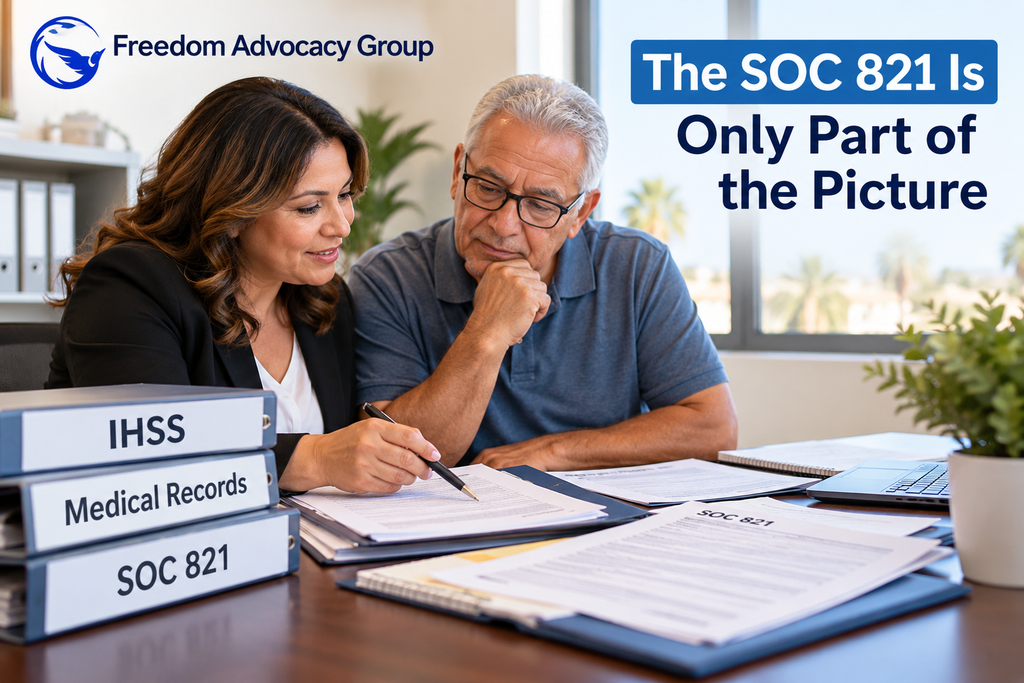
What Is the SOC 821?
The SOC 821 is California’s Assessment of Need for Protective Supervision for the In-Home Supportive Services Program.
It is an important form in many Protective Supervision cases.
The form asks an appropriate medical professional for information regarding areas including:
- Diagnosis or mental condition
- Prognosis
- Memory
- Orientation
- Judgment
- Relevant injury or accident history
- Physical capacity to place oneself in a potentially dangerous situation
CDSS currently lists the SOC 821 as the Protective Supervision assessment form, and the regulations provide that it is considered together with other pertinent information rather than being automatically determinative by itself. California Department of Social Services
This is an important point.
A signed form does not automatically mean:
“Protective Supervision approved.”
Likewise, families should not necessarily assume that one unfavorable piece of information determines the entire outcome.
The county evaluates the case under the applicable IHSS requirements.
The detailed relationship between the medical documentation, assessment, supporting information, and the recipient’s actual circumstances is exactly the kind of individualized analysis that is better handled through a case review rather than a generic blog article.
What Types of Safety Concerns Can Matter?
Families often want a simple list of behaviors that “qualify.”
Unfortunately, Protective Supervision does not work that way.
There is no single behavior that automatically guarantees approval.
Cognitive impairment can create safety concerns in many different ways. Depending on the circumstances, a family may be dealing with issues involving:
- Unsafe exiting or wandering
- Poor awareness of common hazards
- Unsafe interaction with household appliances
- Confusion about surroundings
- Difficulty remembering safety instructions
- Impaired judgment
- Repeated unsafe activities
- Inability to consistently apply previously given safety information
But merely checking one of those boxes does not establish eligibility.
The cause, circumstances, frequency, recipient’s mental functioning, potential hazard, caregiver response, and other case-specific facts can matter.
For that reason, this article intentionally does not provide a formula for turning individual incidents into a Protective Supervision case.
An individual review is a better way to evaluate whether a family’s actual circumstances may be relevant.
Does an Adult Need to Have Already Been Injured?
Not necessarily.
Families sometimes believe they cannot pursue Protective Supervision because their loved one has never experienced a catastrophic accident.
That assumption can overlook an important reality:
A serious accident may not have occurred because someone has been intervening.
The original material highlights this issue and explains that the absence of a prior serious injury does not necessarily establish that supervision is unnecessary. IHSS Protective Supervision for…
The relevant circumstances still need to be evaluated under the Protective Supervision requirements.
Families should therefore avoid deliberately allowing a dangerous situation to occur merely to “prove” that supervision is needed.
Safety comes first.
What Does Not Qualify for Protective Supervision?
Understanding the limits of Protective Supervision is important.
California regulations state that Protective Supervision is not authorized for several purposes, including:
- Friendly visiting or social activities
- Supervision where the need is medical and the supervision required is medical
- Anticipating a medical emergency
- Preventing or controlling antisocial or aggressive behavior
- Guarding against deliberate self-destructive behavior
The service is specifically tied to qualifying non-self-directed behavior associated with mental impairment. California Department of Social Services
This distinction is one reason families can become confused.
A loved one may unquestionably need substantial care, but that does not necessarily mean every type of supervision falls within Protective Supervision.
Other IHSS services may be relevant to other needs.
Families beginning IHSS can learn more through our IHSS application help services.
What Does the 24-Hour Supervision Requirement Mean?
California’s regulations provide that a need for 24-hours-a-day supervision must exist for the recipient to remain safely at home. California Department of Social Services
This requirement can be confusing.
It should not automatically be interpreted as meaning that one paid IHSS provider must physically stand beside the recipient every minute of every day.
California’s rules recognize that Protective Supervision can involve IHSS as well as certain alternative and voluntary resources. California Department of Social Services
CDSS also maintains the SOC 825, titled Protective Supervision 24-Hours-A-Day Coverage Plan. California Department of Social Services
Exactly how a particular family’s circumstances relate to the 24-hour requirement can be case-specific.
Rather than publishing a detailed template showing families exactly how to structure or present a coverage arrangement, Freedom Advocacy Group reviews those circumstances individually as part of its services.
Can Someone Attend an Adult Day Program and Still Receive Protective Supervision?
Potentially.
Attendance at an adult day program does not, by itself, necessarily answer the Protective Supervision question.
California regulations recognize alternative resources such as adult day care centers as possible components of Protective Supervision arrangements. California Department of Social Services
The county still evaluates the recipient’s overall circumstances and applicable supervision requirements.
A person may receive structured support during part of the day while having different supervision arrangements during other periods.
How those circumstances should be addressed depends on the individual case.
Why Documentation Matters—Without Turning Your Home Into a Case File
Families frequently know that something is wrong long before they understand how IHSS evaluates it.
You may know that your father cannot safely remain alone.
You may know that your mother repeatedly becomes confused.
You may know that your adult child’s judgment creates serious safety concerns.
But translating those experiences into information relevant to an IHSS determination can be difficult.
Documentation may play an important role.
However, the goal is not to manufacture a record or copy generic examples from the internet.
Documentation should accurately reflect what is actually happening.
Freedom Advocacy Group works with families to understand what information may be relevant to their individual circumstances and how existing records fit into the broader IHSS process.
For general information on this subject, you can also review our Protective Supervision behavior log resource.
The detailed review and development of an individual case, however, is something we reserve for clients rather than publishing as a complete DIY strategy online.
Why a Diagnosis Alone Usually Isn’t the Whole Case
Imagine two adults who both have Alzheimer’s disease.
The first person may still recognize familiar surroundings, understand common hazards, and consistently follow safety instructions.
The second may experience significant confusion, impaired judgment, and difficulty responding appropriately to ordinary hazards.
The diagnosis may be the same.
Their functional circumstances are not.
The same principle can apply to adults with:
- Autism
- Developmental disabilities
- Intellectual disabilities
- Traumatic brain injury
- Other cognitive disorders
This is why a medical diagnosis can be important without automatically determining Protective Supervision eligibility.
Families should focus on obtaining an accurate evaluation of the recipient’s actual circumstances rather than assuming that a diagnosis guarantees—or prevents—approval.
Preparing for an IHSS Assessment
The county assessment is an important part of the IHSS process.
For adults with cognitive disabilities, a short interaction may not always show everything a family experiences throughout an ordinary week.
A recipient may:
- Speak clearly
- Walk independently
- Answer simple questions
- Appear comfortable
- Describe themselves as independent
None of those facts alone necessarily answers whether the person meets Protective Supervision requirements.
At the same time, families should never exaggerate a recipient’s limitations merely because an assessment is taking place.
The goal should be accuracy.
If you have an upcoming assessment or reassessment, Freedom Advocacy Group provides IHSS assessment assistance.
We intentionally do not publish our complete assessment-preparation methodology because the appropriate approach depends on the recipient’s individual circumstances.
Common Misunderstandings About Protective Supervision
Several misunderstandings repeatedly create confusion.
“My parent has dementia, so they automatically qualify.”
A diagnosis alone does not automatically establish Protective Supervision.
“My loved one can walk and dress themselves, so they can’t qualify.”
Physical independence and cognitive self-direction are different issues.
“Nothing terrible has happened, so we can’t show a safety need.”
The absence of a serious accident does not necessarily resolve the issue, particularly where caregivers have been intervening.
“The doctor signed the SOC 821, so approval is guaranteed.”
The SOC 821 is important, but California regulations state that it is considered with other pertinent information and is not determinative by itself. California Department of Social Services
“Protective Supervision pays someone simply to stay with my parent.”
Protective Supervision has specific requirements and is not ordinary companionship.
These distinctions are exactly why an individualized review can be more useful than relying on generic online advice.
Case Example: Dementia and Safety Concerns
Consider a hypothetical adult with dementia.
She remains physically mobile and can communicate well enough that a brief conversation may make her appear relatively independent.
Her family, however, has become increasingly concerned about her safety because cognitive changes affect how she responds to ordinary situations.
The family wants to know whether these circumstances could be relevant to Protective Supervision.
At this point, the appropriate approach is not to simply copy a list of behaviors from a blog article.
The family’s circumstances need to be evaluated individually.
Relevant questions may involve the recipient’s cognitive functioning, the nature of the safety concerns, the supervision currently being provided, existing medical information, and the county’s assessment.
That analysis is part of the value Freedom Advocacy Group provides to clients.
Case Example: Adult With a Developmental Disability
Consider an adult with a developmental disability who can walk, communicate, dress, and eat independently.
His family is nevertheless concerned that cognitive limitations affect his ability to consistently recognize certain hazards.
Physical independence alone does not necessarily answer whether Protective Supervision may apply.
Conversely, having a developmental disability does not automatically establish eligibility.
The complete circumstances matter.
A professional review can help the family understand what issues may be relevant before an assessment, reassessment, or appeal.
What Happens If Protective Supervision Is Denied?
A denial does not necessarily mean that a family has no further options.
The first important document is generally the Notice of Action.
It explains the county’s decision and provides information regarding hearing rights.
California IHSS recipients can have state-hearing rights regarding adverse county actions, and deadlines can be important.
If Protective Supervision has already been denied, review Freedom Advocacy Group’s IHSS appeals information promptly.
Families needing more extensive assistance with the dispute can also learn about our IHSS due process representation services.
Do not assume that an informal conversation with the county automatically protects hearing rights.
How Freedom Advocacy Group Can Help With Protective Supervision
Protective Supervision can be one of the more complicated areas of IHSS.
Families often understand the practical problem immediately:
“I cannot safely leave my loved one alone.”
The difficult part is determining how the individual’s circumstances fit within California’s IHSS requirements and how the case should be approached.
That is where Freedom Advocacy Group can help.
Depending on the circumstances and the services selected, our assistance may involve:
- Reviewing the recipient’s current IHSS situation
- Evaluating Protective Supervision issues
- Reviewing existing documentation
- Identifying areas requiring additional attention
- Preparing families for an assessment or reassessment
- Reviewing relevant medical and IHSS documentation
- Assisting after a Protective Supervision denial
- Helping families understand the appeal process
- Providing individualized guidance based on the recipient’s circumstances
We deliberately do not publish every internal review method, documentation strategy, or case-preparation technique in our public articles.
Those details depend on the individual case and are part of the hands-on assistance Freedom Advocacy Group provides its clients.
Families beginning IHSS can learn more about IHSS application help.
You can also review all Freedom Advocacy Group services or contact Freedom Advocacy Group directly.
Frequently Asked Questions About IHSS Protective Supervision for Adults
Can an adult receive IHSS Protective Supervision?
Yes. Protective Supervision is not limited to children. Adults may qualify when applicable California IHSS requirements are satisfied.
Can an adult with dementia qualify?
Potentially. Dementia can affect memory, orientation, judgment, and safety awareness, but a diagnosis alone does not automatically establish eligibility.
Can someone with Alzheimer’s disease qualify?
Potentially. The county evaluates the individual’s circumstances and how the mental impairment affects the need for qualifying supervision.
Does autism automatically qualify an adult?
No. Autism by itself does not automatically establish Protective Supervision eligibility.
What does non-self-directing mean?
In general, the issue concerns whether mental impairment affects the person’s ability to appropriately direct their behavior and protect themselves from injury, hazard, or accident.
What is the SOC 821?
The SOC 821 is California’s Assessment of Need for Protective Supervision for In-Home Supportive Services Program. It asks an appropriate medical professional for information about the recipient’s mental condition and areas including memory, orientation, and judgment. California Department of Social Services
Does a completed SOC 821 guarantee Protective Supervision?
No. California regulations provide that the SOC 821 is considered with other pertinent information and is not determinative by itself. California Department of Social Services
Does someone have to be physically dependent to qualify?
Not necessarily. Physical ability and cognitive self-direction are different considerations.
Does the recipient have to already have been injured?
Not necessarily. The individual circumstances and applicable IHSS requirements matter.
Can someone attend adult day care and still potentially qualify?
Potentially. California’s regulations recognize adult day care and other alternative resources as possible components of supervision arrangements. California Department of Social Services
What should I do if Protective Supervision was denied?
Review the Notice of Action promptly and pay close attention to the hearing information and deadlines. You can also review Freedom Advocacy Group’s IHSS appeals services.
Protective Supervision Is About the Individual—Not Just the Diagnosis
An adult may have Alzheimer’s disease, dementia, autism, traumatic brain injury, or another cognitive disability.
That diagnosis is important.
But it does not tell the entire story.
Protective Supervision involves the relationship between the person’s mental impairment, their ability to safely direct their own behavior, their supervision needs, and California’s IHSS requirements.
That is why generic internet checklists have limits.
Your loved one’s case should be evaluated based on your loved one’s circumstances.
If you are concerned that an adult family member cannot safely remain without supervision, Freedom Advocacy Group can help you better understand the IHSS process and the options that may be available.
Get Help With IHSS Protective Supervision
You don’t have to try to build a Protective Supervision case from internet articles.
Freedom Advocacy Group works with California families dealing with cognitive disabilities, dementia, Alzheimer’s disease, developmental disabilities, autism, and other circumstances that can create complicated IHSS issues.
Whether you’re preparing for an initial assessment, dealing with changing needs, pursuing Protective Supervision, or responding to a denial, an individualized review can help you understand what deserves attention.
Call Freedom Advocacy Group today at 714-248-3871 or contact our team to discuss your situation.
Hablamos Español.
Advocating today for a brighter tomorrow.
Legal Disclaimer
This information is provided for general informational purposes only and does not constitute legal advice. No attorney-client relationship is created. Consult a qualified attorney regarding your specific circumstances.