

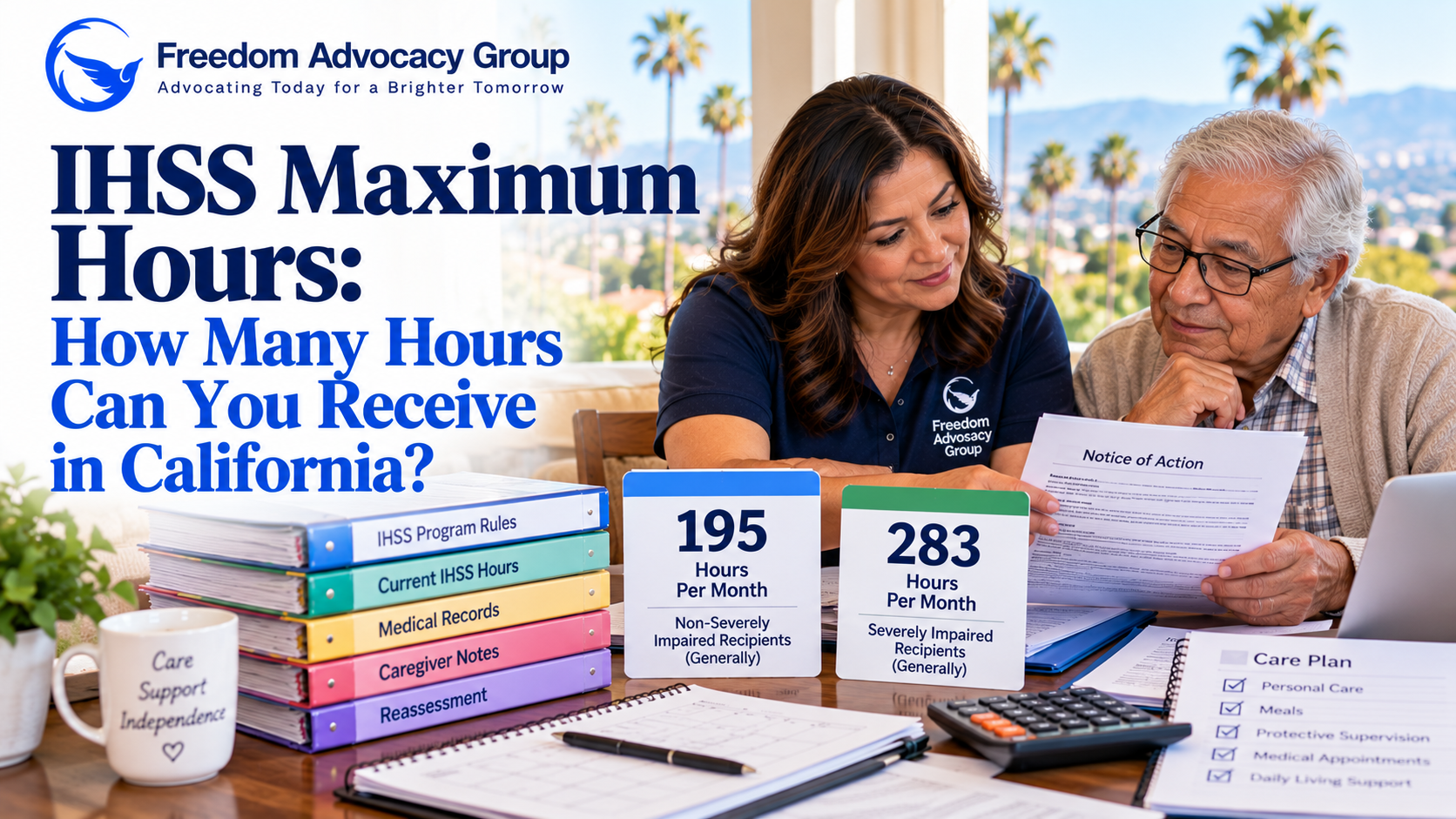
One of the first questions families ask when trying to understand In-Home Supportive Services is:
“What are the maximum IHSS hours in California?”
You may have heard that IHSS provides up to 195 hours per month.
Someone else may have told you the maximum is 283 hours per month.
And if you know another family receiving substantially more hours than your loved one, you may understandably wonder whether your own IHSS authorization is too low.
The important thing to understand is that 195 and 283 hours can both be relevant numbers—but they do not apply to every recipient in the same way.
California IHSS hours are based on the recipient’s individual assessed needs, authorized services, and applicable program rules. A recipient does not automatically receive the maximum simply because they have a serious medical condition or disability.
Generally, a recipient who meets IHSS’s severely impaired criteria may be subject to a maximum of 283 hours per month, while a recipient who does not meet those criteria is generally subject to a 195-hour monthly maximum. IHSS Maximum Hours
But understanding the maximum is only the beginning.
The more important question is:
Does your loved one’s current IHSS authorization accurately reflect their actual eligible care needs?
That is where many IHSS cases become much more complicated.
Freedom Advocacy Group helps California families understand their IHSS authorization, prepare for assessments and reassessments, address Protective Supervision issues, and evaluate situations where approved hours may not reflect the care being provided.
Call Freedom Advocacy Group at 714-248-3871 to discuss your situation.
Table of Contents – IHSS Maximum Hours
What Are the Maximum IHSS Hours in California?
California’s IHSS program generally distinguishes between two monthly maximums:
Non-severely impaired recipients: generally up to 195 hours per month
Severely impaired recipients: generally up to 283 hours per month
These numbers are maximum limits—not automatic awards. IHSS Maximum Hours
For example, being classified as severely impaired does not automatically mean a recipient will receive 283 hours.
Likewise, being subject to the 195-hour maximum does not mean the county automatically authorizes 195 hours.
The actual authorization depends on the services the county determines the recipient needs under applicable IHSS requirements.
This distinction is extremely important because families sometimes focus on obtaining a particular number rather than determining whether the county has accurately assessed the recipient’s needs.
Why Do Some IHSS Recipients Have a 283-Hour Maximum?
The higher 283-hour monthly maximum is generally associated with recipients who meet California IHSS’s definition of severely impaired.
But the term “severely impaired” has a particular meaning within the IHSS program.
It does not simply mean that:
- A person has a severe disability
- A physician describes the condition as severe
- Someone has advanced dementia
- Someone has autism
- A recipient requires substantial family assistance
IHSS applies program-specific criteria when determining whether someone falls within the severely impaired category. IHSS Maximum Hours
This is an area where an individual review can matter.
A family’s everyday understanding of “severe” and the way IHSS evaluates a recipient’s service needs are not necessarily the same thing.
If you are trying to determine whether your loved one’s current hours properly reflect their needs, Freedom Advocacy Group can review the circumstances with you rather than having you guess from a monthly maximum.
What Does “Severely Impaired” Mean for IHSS?
This is one of the areas where families can easily become confused.
IHSS uses specific criteria when determining severely impaired status. The determination involves assessed needs within specified IHSS service categories rather than simply the name or perceived severity of a medical diagnosis. IHSS Maximum Hours
That distinction can have a major effect on the recipient’s applicable monthly maximum.
However, determining whether a particular recipient meets those criteria requires looking at the person’s actual IHSS assessment and circumstances.
Rather than trying to reverse-engineer the classification from information online, families who believe their loved one’s needs are not accurately reflected can have the situation reviewed.
Call Freedom Advocacy Group at 714-248-3871 for help understanding your IHSS case.
Is 195 Hours the Maximum for Everyone Else?
Generally, a recipient who does not meet the program’s severely impaired criteria is subject to the lower 195-hour monthly maximum. IHSS Maximum Hours
But again, 195 is a ceiling—not an automatic authorization.
A recipient could receive substantially fewer than 195 hours depending on the services and time authorized by the county.
This is why comparing your loved one’s total hours with another person’s total can be misleading.
Two recipients with the same diagnosis can receive different IHSS hours because their actual functional needs may be different.
Is IHSS Protective Supervision 195 Hours?
Protective Supervision is another reason families frequently encounter the number 195.
For a qualifying recipient, Protective Supervision can generally be authorized for up to 195 hours per month. IHSS Maximum Hours
But there is an important distinction:
Protective Supervision is a service.
The overall IHSS monthly maximum is a separate issue.
A recipient who qualifies for Protective Supervision may also qualify for other authorized IHSS services.
Therefore, it is possible in appropriate circumstances for a recipient’s total IHSS authorization to exceed the Protective Supervision amount.
Families should not assume that:
Protective Supervision = 283 hours.
It does not.
If cognitive impairment or safety concerns are part of your loved one’s situation, learn more about IHSS Protective Supervision or contact Freedom Advocacy Group for an individual review.
Can Someone Receive 283 IHSS Hours With Protective Supervision?
Potentially.
A recipient who qualifies for Protective Supervision may also have legitimate needs for additional authorized IHSS services.
If the recipient meets the applicable requirements for the higher monthly maximum and the county’s assessment supports sufficient additional service needs, the total authorization can potentially exceed 195 hours and reach the broader maximum. IHSS Maximum Hours
But this should not be interpreted as a formula.
There is no universal:
“Protective Supervision + disability = 283 hours.”
Each recipient must be individually assessed.
Does Dementia Automatically Qualify Someone for Maximum IHSS Hours?
No.
A diagnosis of dementia or Alzheimer’s disease does not automatically result in either 195 or 283 hours.
Dementia can affect many areas of daily functioning and safety, but the county evaluates the recipient’s individual needs when determining authorized services and hours. IHSS Maximum Hours
As dementia progresses, those needs may change considerably.
Someone who required relatively limited assistance a year ago may now require substantially more help.
If that happens, the existing IHSS authorization may no longer reflect the person’s current circumstances.
Families dealing with cognitive decline can learn more about IHSS for Alzheimer’s and dementia caregivers and IHSS reassessments.
Does Autism Automatically Qualify Someone for 283 IHSS Hours?
No.
An autism diagnosis does not automatically establish eligibility for:
- Protective Supervision
- 195 hours
- Severely impaired status
- 283 hours
The recipient’s individual functional needs and applicable IHSS requirements still matter. IHSS Maximum Hours
For some individuals with autism, safety awareness, judgment, cognitive functioning, personal care, and supervision can become important considerations.
Families dealing specifically with these issues should review our information about IHSS Protective Supervision for Autism or contact Freedom Advocacy Group for help understanding how the recipient’s individual circumstances may fit within IHSS.
How Does IHSS Determine Your Actual Hours?
This is where the IHSS process becomes more individualized.
The county does not simply assign a monthly number based on a diagnosis.
Instead, the recipient is evaluated for applicable IHSS services, and the resulting authorization is based on the county’s assessment under program rules. IHSS Maximum Hours
Several factors can affect the final authorization.
That is also why calculating what someone “should” receive based solely on an online example can be misleading.
Every case needs to be evaluated on its own facts.
Freedom Advocacy Group works with families to examine the current IHSS authorization, understand what the county assessed, and identify issues that may deserve closer review.
This individualized review is especially important when:
- Care needs have increased
- A recipient’s condition has changed
- Hours were recently reduced
- Protective Supervision was denied
- The family believes important needs were not properly considered
- A reassessment produced an unexpected result
Rather than guessing at the appropriate number of hours, the goal is to understand whether the current assessment accurately reflects the recipient’s eligible needs.
Why Can Two People With the Same Diagnosis Receive Different IHSS Hours?
Because IHSS hours are not determined by diagnosis alone.
Two people can both have Alzheimer’s disease.
Two people can both have autism.
Two people can both have Parkinson’s disease.
Two people can have the same physical disability.
Yet their ability to safely perform everyday activities may be very different.
As a result, their authorized IHSS services and total monthly hours may also be different. IHSS Maximum Hours
This is another reason you should be cautious about comparing your loved one’s IHSS authorization to someone else’s.
The more useful question is:
Does my loved one’s assessment accurately reflect their individual needs?
What Are IHSS Functional Assessments?
IHSS uses assessment criteria to evaluate how much assistance a recipient requires with applicable activities.
The county’s assessment of functional ability can have an important effect on the services and hours ultimately authorized. IHSS Maximum Hours
This is an area where details can matter considerably.
Families sometimes unintentionally minimize the assistance they provide because caregiving has become routine.
Other times, the recipient may appear more independent during a relatively short assessment than they are during an ordinary week.
Rather than trying to memorize assessment terminology or prepare scripted responses from an online article, families should be prepared to accurately explain the recipient’s real circumstances.
Freedom Advocacy Group can help you prepare for an IHSS assessment or reassessment based on your family’s individual situation.
Why Might IHSS Hours Be Lower Than a Family Expected?
There isn’t one universal reason.
An authorization may not match a family’s expectations because of the way the recipient’s needs were assessed, changes in circumstances, information available to the county, applicable program rules, or other case-specific issues.
This is exactly why a careful review can be valuable.
If you believe the hours are too low, don’t automatically assume the solution is simply asking for “283 hours.”
Instead, determine whether there is a legitimate issue with the current assessment or authorization.
That requires reviewing the individual case.
Can You Request More IHSS Hours?
If a recipient’s needs have changed, a reassessment may be appropriate.
Families do not necessarily have to assume that an old authorization must remain unchanged until the next regularly scheduled review. The PDF notes that changed needs can be grounds to request reassessment. IHSS Maximum Hours
However, requesting additional hours and demonstrating why an existing authorization should change are not necessarily the same thing.
That is where preparation becomes important.
Freedom Advocacy Group helps families prepare for IHSS reassessments and evaluate situations where current hours may no longer reflect a recipient’s needs.
Call 714-248-3871 to discuss your situation before your reassessment.
Can More Than One IHSS Provider Share Authorized Hours?
Yes, multiple eligible providers may potentially provide services to one IHSS recipient.
This can be particularly relevant in cases involving substantial authorized hours.
However, the recipient’s total authorized hours and the rules governing how much an individual provider may work are separate issues.
Provider workweek requirements, overtime rules, exemptions, and other applicable requirements can affect how services are scheduled. IHSS Maximum Hours
Families with high-hour cases should therefore avoid assuming that one provider can automatically work every authorized hour.
Can a Family Member Be Paid for IHSS Hours?
In many circumstances, a family member can serve as an IHSS provider when applicable requirements are satisfied.
Depending on the situation, this can include an adult child, parent, spouse, or another relative. IHSS Maximum Hours
But there are two separate questions:
How many IHSS hours is the recipient authorized to receive?
and
Who can be paid to provide those authorized services?
Those should not be confused.
If you’re caring for a relative and want to understand the provider side of the program, read our guide to becoming a family member paid IHSS caregiver.
What If Your IHSS Hours Were Reduced?
If the county reduces existing services, carefully review the Notice of Action.
Do not ignore it.
An adverse IHSS determination can generally be challenged through California’s State Hearing process, and deadlines can apply. IHSS Maximum Hours
If your hours were recently reduced, review our IHSS appeals process information and contact Freedom Advocacy Group promptly.
A reduction case is different from simply asking for additional hours, so the appropriate next step depends on what the county actually did.
Should You Try to Calculate Your Own Maximum IHSS Hours?
Understanding the general rules is useful.
Trying to determine the correct authorization from a generic online formula is much less reliable.
Your loved one’s case may involve multiple services, functional limitations, cognitive issues, household circumstances, provider considerations, prior assessments, medical information, or Protective Supervision issues.
Those factors can interact differently from case to case.
That is why this article intentionally provides the general framework rather than a step-by-step formula for building or presenting an individual IHSS case.
The appropriate strategy depends on the recipient’s actual circumstances.
What Should You Do If You Believe Your IHSS Hours Are Too Low?
Start by recognizing that a monthly maximum and an individual authorization are two different things.
Someone else receiving 283 hours does not prove that your loved one should receive 283.
Likewise, receiving substantially fewer hours does not necessarily mean the county’s assessment is correct.
The question is whether the authorization accurately reflects the recipient’s eligible needs under the applicable IHSS rules.
A professional review can help identify what deserves further attention without relying on assumptions based on another person’s case.
How Freedom Advocacy Group Can Help With IHSS Hours
The numbers 195 and 283 create a tremendous amount of confusion.
Families often receive conflicting information from friends, social media, caregiver groups, and online discussions.
Freedom Advocacy Group helps California families look beyond those numbers and understand what is happening in their individual IHSS case.
Depending on your circumstances, we can assist with issues involving:
- Existing IHSS hours
- Assessments and reassessments
- Protective Supervision
- Changes in care needs
- Notices of Action
- Reductions or denials
- Family-provider issues
- State Hearing preparation
The specific approach depends on the recipient’s circumstances.
That individualized analysis is important because no blog post can determine the correct IHSS authorization for a particular recipient.
If you are applying for the first time, review our IHSS application help services.
If your loved one’s circumstances have changed, learn about IHSS reassessments.
If cognitive impairment creates serious safety concerns, learn about IHSS Protective Supervision.
If services have been denied or reduced, review the IHSS appeals process promptly.

Frequently Asked Questions About IHSS Maximum Hours
What are the maximum IHSS hours in California?
Depending on the applicable classification and program requirements, California IHSS monthly maximums are generally 195 hours for non-severely impaired recipients and 283 hours for severely impaired recipients. These are ceilings rather than automatic awards. IHSS Maximum Hours
Does everyone on IHSS receive 195 hours?
No. Actual authorized hours depend on the recipient’s assessed need for eligible IHSS services.
Can IHSS provide 283 hours per month?
Potentially. A recipient must meet the applicable requirements for the higher maximum, and their assessed service needs must support the authorization.
Does Protective Supervision automatically provide 195 hours?
No. Protective Supervision has specific eligibility and assessment requirements.
Can someone receive 283 hours if they have Protective Supervision?
Potentially. Protective Supervision may be combined with other authorized IHSS services, and total hours can potentially reach the higher maximum when applicable requirements and assessed needs support it. IHSS Maximum Hours
Does dementia automatically qualify someone for 283 hours?
No. Dementia does not automatically determine an IHSS authorization.
Does autism automatically qualify someone for 283 hours?
No. Autism does not automatically establish either Protective Supervision or maximum IHSS hours. IHSS Maximum Hours
Can I request more IHSS hours?
When a recipient’s circumstances or care needs change, a reassessment may be appropriate.
Can IHSS hours decrease after reassessment?
Potentially. A reassessment evaluates current circumstances, and authorized services may change based on the county’s findings. IHSS Maximum Hours
Can I appeal if my IHSS hours are reduced?
An adverse IHSS determination can generally be challenged through the State Hearing process. Review the Notice of Action and applicable deadlines carefully. IHSS Maximum Hours
Maximum IHSS Hours Are Only Part of the Question
The numbers 195 and 283 are useful to understand.
But they do not tell you what your loved one should actually receive.
The more important issue is whether the current IHSS authorization properly reflects the recipient’s individual eligible needs.
If something doesn’t seem right—whether hours appear too low, needs have increased, Protective Supervision was denied, or a reassessment resulted in a reduction—the next step should be based on the facts of the individual case.
Don’t build your loved one’s IHSS case around somebody else’s number.
Build it around your loved one’s needs.
Get Help Understanding Your IHSS Hours
If you believe your loved one’s current IHSS hours do not accurately reflect their care needs, Freedom Advocacy Group can help you understand your options.
We work with California families dealing with IHSS applications, assessments, reassessments, Protective Supervision, reductions, denials, and appeals.
Rather than trying to piece together an individual strategy from general information online, you can have your specific circumstances reviewed.
Call Freedom Advocacy Group today at 714-248-3871 or book an appointment online.
Hablamos Español.
Advocating today for a brighter tomorrow.
Legal Disclaimer
This information is provided for general informational purposes only and does not constitute legal advice. No attorney-client relationship is created. Consult a qualified attorney regarding your specific circumstances.