

IHSS Due Process Representation for California Families
When an IHSS decision threatens the care, supervision, or assistance that you or a loved one depends on, you do not necessarily have to accept the county’s decision as final.
California’s In-Home Supportive Services program provides a process for applicants and recipients to challenge certain county decisions. This can include disputes involving denied IHSS applications, reductions in authorized hours, termination of services, Protective Supervision denials, and other decisions affecting IHSS benefits.
But having the right to challenge a decision and knowing how to effectively present your case are two very different things.
Families often know exactly how much care their loved one requires because they provide that care every day. They see the assistance with bathing, dressing, meal preparation, mobility, toileting, medication-related tasks, supervision, redirection, and other daily needs.
The challenge is turning those everyday experiences into an organized case that clearly explains why the county’s determination does not accurately reflect the recipient’s needs.
That is where IHSS Due Process Representation can help.
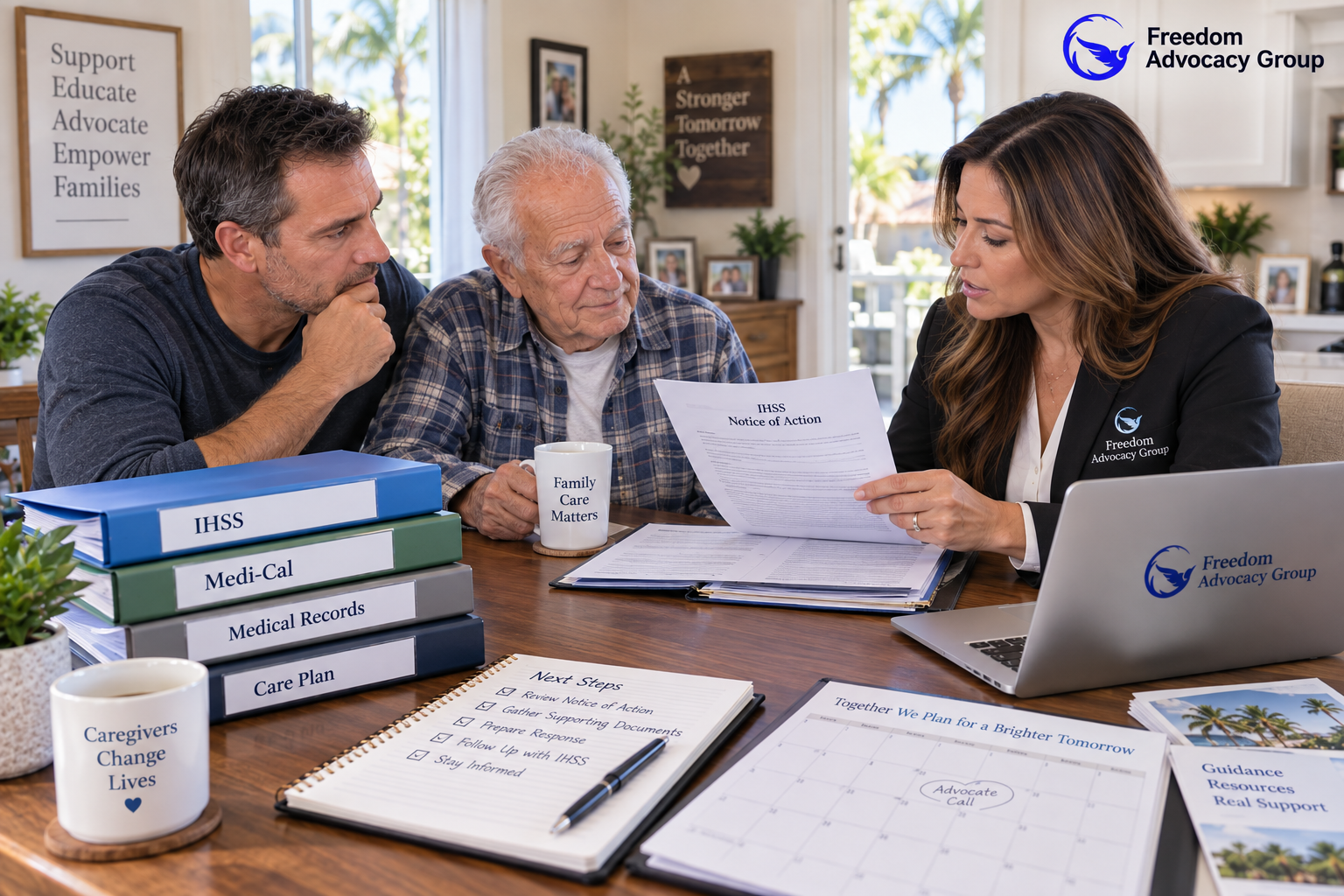
Freedom Advocacy Group helps California IHSS recipients and their families understand disputed county decisions, organize supporting documentation, prepare for State Hearings, and clearly communicate the facts supporting the services and hours they believe are necessary.
If you have recently received a Notice of Action, learning about the IHSS appeals process should be one of your first steps.
Freedom Advocacy Group is here to help. You can schedule an appointment with Freedom Advocacy Group online or call 714-248-3871 today.
What Is IHSS Due Process?
Due process provides IHSS applicants and recipients with an opportunity to challenge certain government decisions affecting their services and benefits.
When the county makes an IHSS determination, the applicant or recipient generally receives a Notice of Action, commonly referred to as an NOA.
The Notice of Action can contain critical information about what the county has decided, when the action will take effect, and what options may be available if the recipient disagrees.
Depending on the circumstances, a disputed decision may involve:
- A denied IHSS application
- Fewer authorized hours than the recipient believes are necessary
- A reduction in existing IHSS hours
- Termination of IHSS services
- A Protective Supervision denial
- Changes following an IHSS reassessment
- Disagreement over the amount of assistance required for specific services
- Other disputed eligibility or service determinations
California’s State Hearing process gives qualifying applicants and recipients an opportunity to challenge disputed county actions.
The county has an opportunity to explain its determination, and the claimant has an opportunity to present evidence and explain why the decision should be changed.
An Administrative Law Judge evaluates the dispute and issues a decision.
That makes preparation extremely important.
Your Notice of Action May Not Be the Final Word
Receiving a Notice of Action saying denied, reduced, or terminated can be intimidating.
Some families assume that because the decision came from the county, there is nothing more they can do.
That may not be the case.
A Notice of Action can also provide important information concerning hearing rights and deadlines.
This is why families should carefully review the entire notice rather than focusing only on the number of hours or the word “denied.”
If you disagree with an IHSS determination, begin investigating your options as soon as possible.
Waiting until immediately before a deadline or hearing can make gathering records, documenting care needs, and preparing your case substantially more difficult.
Families dealing with an initial application problem can also review our IHSS application help resources to better understand how application and assessment issues can affect an IHSS determination.
Why IHSS State Hearings Can Be Difficult
The recipient’s needs may seem obvious to the caregiver.
You live with the situation every day.
You may know that your mother cannot safely remain home alone.
You may know that your father requires repeated reminders, redirection, or hands-on assistance.
You may know that your child has little awareness of danger and requires supervision throughout the day.
But a hearing requires more than simply saying:
“My mother needs more hours.”
“My father can’t be left alone.”
“My child needs constant supervision.”
Those statements may be completely accurate, but a strong case generally requires more detail.
What actually happens?
How frequently does it happen?
What does the caregiver have to do?
What assistance is required?
How long does that assistance take?
Why is the assistance necessary?
What happens when the caregiver does not intervene?
These are the kinds of details that can help transform a general statement about someone’s needs into meaningful evidence.
What Types of IHSS Decisions Can Be Challenged?
IHSS Due Process Representation can become important in several different types of disputes.
IHSS Application Denials
When an IHSS application is denied, one of the first questions should be:
Why did the county deny the application?
Understanding the county’s stated reason helps determine what information may be needed to challenge the decision.
Medical documentation, functional limitations, assessment information, caregiver observations, and other records may become relevant depending on the reason for the denial.
An application denial does not necessarily mean the recipient has no legitimate care needs.
It means the county reached a determination based on the information it considered.
The appeals process provides an opportunity to challenge qualifying determinations.
IHSS Hours That Are Too Low
Another common problem occurs when someone qualifies for IHSS but receives fewer hours than the family believes are necessary.
This can be extremely frustrating.
A caregiver may spend substantial time assisting the recipient every day, yet the authorized hours may not appear to reflect the amount of assistance actually being provided.
This can happen when important care needs are overlooked, the frequency of assistance is underestimated, the recipient minimizes their limitations, or the caregiver does not fully explain everything they do during the assessment.
Understanding how to properly describe functional limitations can therefore be extremely important.
Reduction of Existing IHSS Hours
A reduction can be particularly disruptive when a family has already structured the recipient’s care around previously authorized services.
When hours are reduced following a reassessment, it is important to determine exactly what changed.
Questions may include:
Did the county determine that the recipient’s condition improved?
Was a previously authorized service removed?
Was less time assigned to a particular task?
Was the recipient’s level of assistance changed?
Did the assessor receive incomplete information?
Did something said during the assessment create an inaccurate picture of the recipient’s functioning?
Comparing the previous determination with the new Notice of Action can help identify the specific areas that need to be addressed.
Protective Supervision Denials
Protective Supervision disputes can be especially complex because these cases can depend heavily on the recipient’s actual behavior and cognitive functioning.
A diagnosis by itself may not tell the entire story.
The issue can involve whether the recipient is non-self-directing and whether supervision is necessary to prevent injury, hazard, or accident.
Specific examples can therefore become extremely important.
A family may need to document behaviors involving wandering, unsafe interaction with appliances, leaving the home unexpectedly, attempting unsafe activities, inability to recognize hazards, or other behavior demonstrating impaired judgment or danger awareness.
If Protective Supervision is the central issue in your case, read our detailed information about IHSS Protective Supervision and how documentation can affect these claims.
Evidence Can Make a Major Difference in an IHSS Appeal
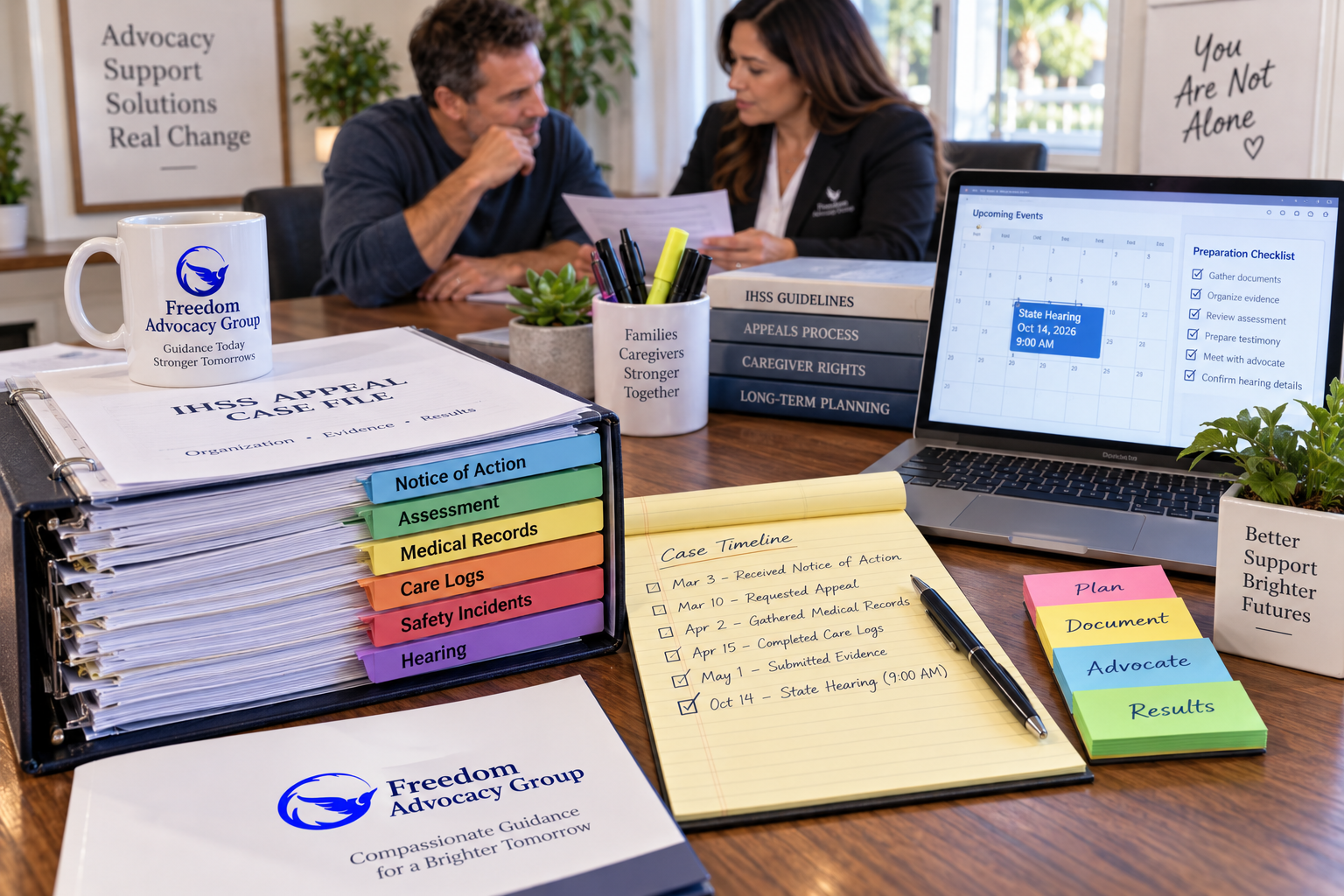
One of the most important parts of preparing for an IHSS State Hearing is gathering relevant evidence.
Families frequently have substantial evidence without realizing it.
The problem is often that the information is scattered among medical records, calendars, text messages, physician reports, caregiver notes, assessments, and memories.
The objective is not simply to gather the largest possible stack of paperwork.
The objective is to identify documentation that helps establish the recipient’s actual needs and addresses the county’s disputed determination.
Depending on the case, potentially useful documentation may include:
- The current Notice of Action
- Previous Notices of Action
- IHSS assessment information
- Medical records
- Physician statements
- Functional assessments
- Hospital records
- Therapy documentation
- Caregiver declarations
- Daily care logs
- Safety and incident logs
- Regional Center records when applicable
- School or program documentation when relevant
- Records showing changes in physical or cognitive functioning
- Other evidence directly related to the disputed IHSS service
Not every document concerning the recipient will necessarily help prove the disputed issue.
Relevant evidence is more important than simply having more evidence.
Start With the IHSS Notice of Action
A strong review often begins with the Notice of Action.
Why?
Because you first need to understand what you are challenging.
A family may understandably want to explain everything that has happened over the previous several years.
But if the disputed issue is a reduction in time for a particular IHSS service, the strongest evidence may be documentation showing why the recipient continues to require the previous level of assistance.
Similarly, if the dispute involves Protective Supervision, the evidence should focus heavily on the recipient’s mental functioning, safety-related behaviors, and need for supervision.
Starting with the Notice of Action helps keep the case focused.
Document What Really Happens Every Day
Caregivers often underestimate their own workload because providing assistance has become routine.
You may no longer think about helping someone get out of bed.
You simply do it.
You may not think about redirecting someone away from the front door for the fourth time that afternoon.
You simply redirect them.
You may automatically prepare food in a particular way because the recipient cannot safely prepare it independently.
These actions become part of everyday life.
But those details can be important when trying to explain the recipient’s actual functional needs.
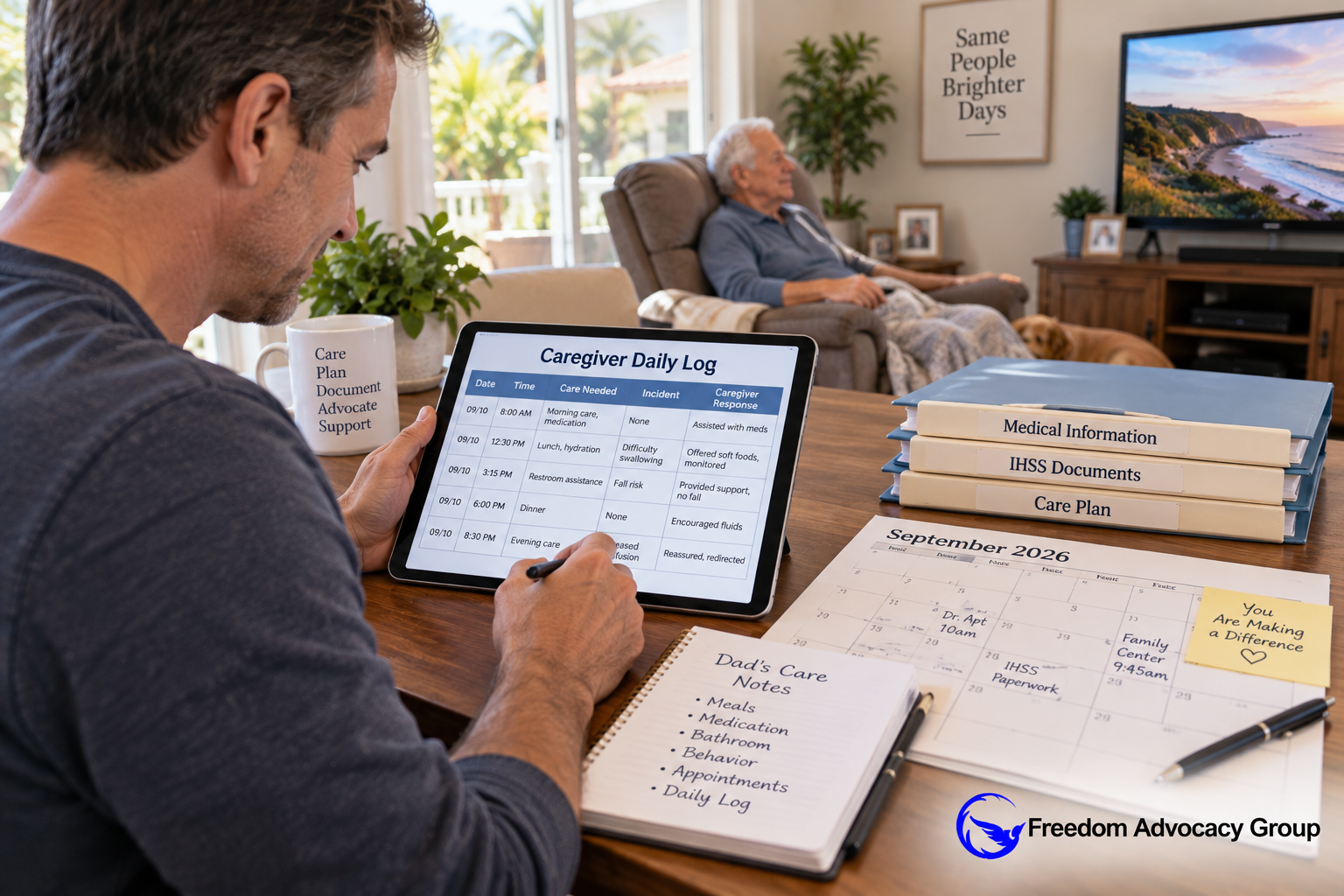
A daily care log can help preserve this information.
When appropriate, consider documenting:
What happened: Describe the care task, behavior, or incident.
When it happened: Record the date and approximate time.
What assistance was necessary: Explain exactly what the caregiver did.
How long it took: Record realistic time when relevant.
Why assistance was required: Connect the assistance to the recipient’s limitation.
What happened or could have happened without intervention: This can be particularly relevant when documenting safety-related behavior.
Specific examples are generally much more informative than broad statements.
Instead of writing:
“Dad gets confused.”
A useful entry may explain:
“Dad opened the front door at approximately 10:15 p.m. and said he needed to walk to work even though he retired years ago. I redirected him inside, locked the door, and remained with him until he became calm.”
The second example provides context.
Don’t Minimize the Recipient’s Limitations
This is one of the most important lessons families can learn when dealing with IHSS.
Caregivers become extremely good at compensating for another person’s limitations.
Eventually, you may stop recognizing how much assistance you actually provide.
Suppose someone asks:
“Can your father dress himself?”
You might automatically answer:
“Yes.”
But the complete answer might be:
“He can physically put on his clothes, but I have to select appropriate clothing, place everything in front of him, remind him repeatedly to get dressed, help orient his clothing correctly, and remain nearby because he becomes confused and forgets what he is doing.”
Those are two very different descriptions.
The same issue can arise with walking, eating, bathing, toileting, medication-related activities, transfers, and many other daily tasks.
Someone may technically be capable of performing part of an activity while still requiring substantial assistance to complete it safely.
IHSS assessments and appeals can depend heavily on functional ability.
Describe what actually happens on an ordinary day.
What Happens at an IHSS State Hearing?
A California State Hearing is an administrative proceeding used to resolve disputes involving qualifying public-benefit decisions.
The county generally has an opportunity to explain its position and provide information supporting the determination.
The claimant has an opportunity to explain why they disagree and present relevant supporting evidence.
An Administrative Law Judge considers the dispute and issues a decision.
This is why preparation matters.
A hearing should not be viewed simply as an opportunity to tell an emotional story.
The family’s story matters tremendously, but the strongest presentation connects that story to organized facts and evidence.
Why IHSS Due Process Representation Can Help
Families are generally very knowledgeable about their loved one’s needs.
But they may be completely unfamiliar with IHSS procedures.
At the same time, they are frequently dealing with enormous caregiving responsibilities.
Preparing records, reviewing Notices of Action, documenting incidents, understanding the disputed issue, and preparing for a hearing can become overwhelming.
IHSS Due Process Representation provides families with assistance in organizing and presenting their position.
Depending on the circumstances, preparation may involve reviewing the disputed decision, identifying relevant documentation, organizing evidence, helping the family understand the central issues, and preparing for the hearing.
The objective is straightforward:
Make sure the recipient’s actual needs are clearly explained and supported.
How Freedom Advocacy Group Helps Prepare IHSS Cases
Every IHSS case is different.
That means the strategy should begin with the facts of the individual case rather than a generic appeal template.
Review the Notice of Action
The first step is understanding what the county decided and why.
Identify the Disputed Issue
A Protective Supervision denial requires different evidence than a disagreement involving bathing, dressing, meal preparation, mobility, or another IHSS service.
Review Existing Documentation
Medical records, assessments, previous Notices of Action, caregiver logs, physician information, and other documents may contain important evidence.
Identify Missing Evidence
Sometimes the most important document is the one that has not yet been obtained.
Organize the Case
Hundreds of pages of unorganized records can make important information difficult to find.
Relevant evidence should be organized around the issues being disputed.
Prepare the Family
The caregiver or recipient should understand what is being disputed and be prepared to explain the recipient’s needs clearly and accurately.
Prepare for the Hearing
The final objective is to connect the facts and supporting documentation to the county decision being challenged.
Families can also stay informed by reviewing the latest IHSS news and advocacy resources from Freedom Advocacy Group.
What If You Lose an IHSS State Hearing?
An unfavorable State Hearing decision does not necessarily mean there are no additional options.
Depending on the circumstances, further administrative or judicial review may be available.
These steps can involve different procedures and important deadlines.
If you have already completed your State Hearing and received an unfavorable decision, learn more about IHSS Writ Petitions and potential next steps after the administrative hearing process.
Because deadlines can matter, families should review their options promptly after receiving a hearing decision.
Don’t Wait Until Your Hearing Is Around the Corner
One of the biggest advantages you can give yourself is time.
Strong documentation often cannot be created overnight.
Medical records may take time to obtain.
Physicians may need time to complete requested documentation.
Care logs become more useful when they demonstrate patterns over time.
Previous IHSS documents may need to be located.
The Notice of Action must be reviewed.
The disputed issues must be identified.
Waiting until the last minute can make all of this more difficult.
If you have received an IHSS denial, reduction, termination, or Protective Supervision denial, start reviewing your options as soon as possible.

Get IHSS Due Process Representation Today
An IHSS denial or reduction affects much more than numbers printed on a Notice of Action.
Those hours can represent bathing.
Dressing.
Meal preparation.
Mobility.
Toileting.
Personal care.
Supervision.
Safety.
Independence.
And ultimately, the ability of a person with disabilities, cognitive impairments, or other qualifying limitations to remain safely in their home.
That is why disputed IHSS decisions deserve careful attention.
If you believe the county’s decision does not accurately reflect your loved one’s actual needs, you have options.
Freedom Advocacy Group helps California families understand IHSS decisions, organize documentation, prepare for appeals, and approach the State Hearing process with greater clarity.
Learn more about our IHSS advocacy services or contact Freedom Advocacy Group to discuss your situation.
Freedom Advocacy Group is here to help.
You can easily book an appointment online or call 714-248-3871 today.
Frequently Asked Questions About IHSS Due Process Representation
What is IHSS Due Process Representation?
IHSS Due Process Representation involves helping an IHSS applicant or recipient challenge a disputed county decision through the applicable administrative process. Assistance can include reviewing the Notice of Action, identifying disputed issues, organizing evidence, preparing documentation, and helping the family prepare for a State Hearing.
Can I appeal an IHSS denial?
Qualifying IHSS county actions can generally be challenged through California’s State Hearing process. Carefully review the Notice of Action because it should contain important information concerning the county’s decision and your hearing rights.
Can I challenge a reduction in my existing IHSS hours?
A reduction in existing services may be appealable. Review the Notice of Action promptly to determine what the county changed and what deadlines may apply.
Can I appeal an IHSS Protective Supervision denial?
Protective Supervision determinations can be disputed. These cases can depend heavily on evidence concerning mental functioning, non-self-direction, safety-related behaviors, and the need for supervision to prevent injury, hazard, or accident. Our IHSS Protective Supervision resource provides additional information about this benefit.
What evidence can help with an IHSS appeal?
The most useful evidence depends on what is being disputed. Documentation may include the Notice of Action, medical records, physician information, previous IHSS determinations, assessments, caregiver logs, safety incident records, Regional Center documentation when applicable, and other records demonstrating the recipient’s functional needs.
Is a medical diagnosis enough to win an IHSS appeal?
A diagnosis can be important evidence, but IHSS determinations often involve the recipient’s actual functional needs. Documentation should clearly explain how the person’s condition affects daily activities and why particular assistance or supervision is necessary.
Why are caregiver logs important?
Caregiver logs can help establish patterns over time. They can document what assistance was required, how frequently incidents occurred, how the caregiver responded, and why intervention was necessary.
Should I wait until my hearing date to start gathering evidence?
No. Starting early gives you more time to obtain records, document care needs, review the county’s decision, identify missing evidence, and organize your case.
What happens if I receive an unfavorable State Hearing decision?
Depending on the circumstances, additional administrative or judicial options may exist. Different procedures and deadlines can apply after a hearing decision. You can learn more about IHSS Writ Petitions if your case has progressed beyond the State Hearing stage.
When should I contact Freedom Advocacy Group?
Consider contacting Freedom Advocacy Group as soon as you receive an IHSS Notice of Action that you believe does not accurately reflect the recipient’s needs. Early preparation can provide additional time to understand the disputed issue and gather relevant documentation.
Take the Next Step With Freedom Advocacy Group
You know what happens inside your home every day.
You know the assistance your loved one requires.
You know the supervision you provide.
And you know when an IHSS determination does not appear to reflect the reality of those needs.
The next step is making sure those facts are properly documented and clearly presented.
Whether you are dealing with a denial, reduced hours, Protective Supervision, or another disputed determination, Freedom Advocacy Group can help you prepare for what comes next.
Explore our IHSS appeals assistance, read the latest California IHSS news, or schedule your consultation with Freedom Advocacy Group today.
Call 714-248-3871 today to discuss your IHSS case.