

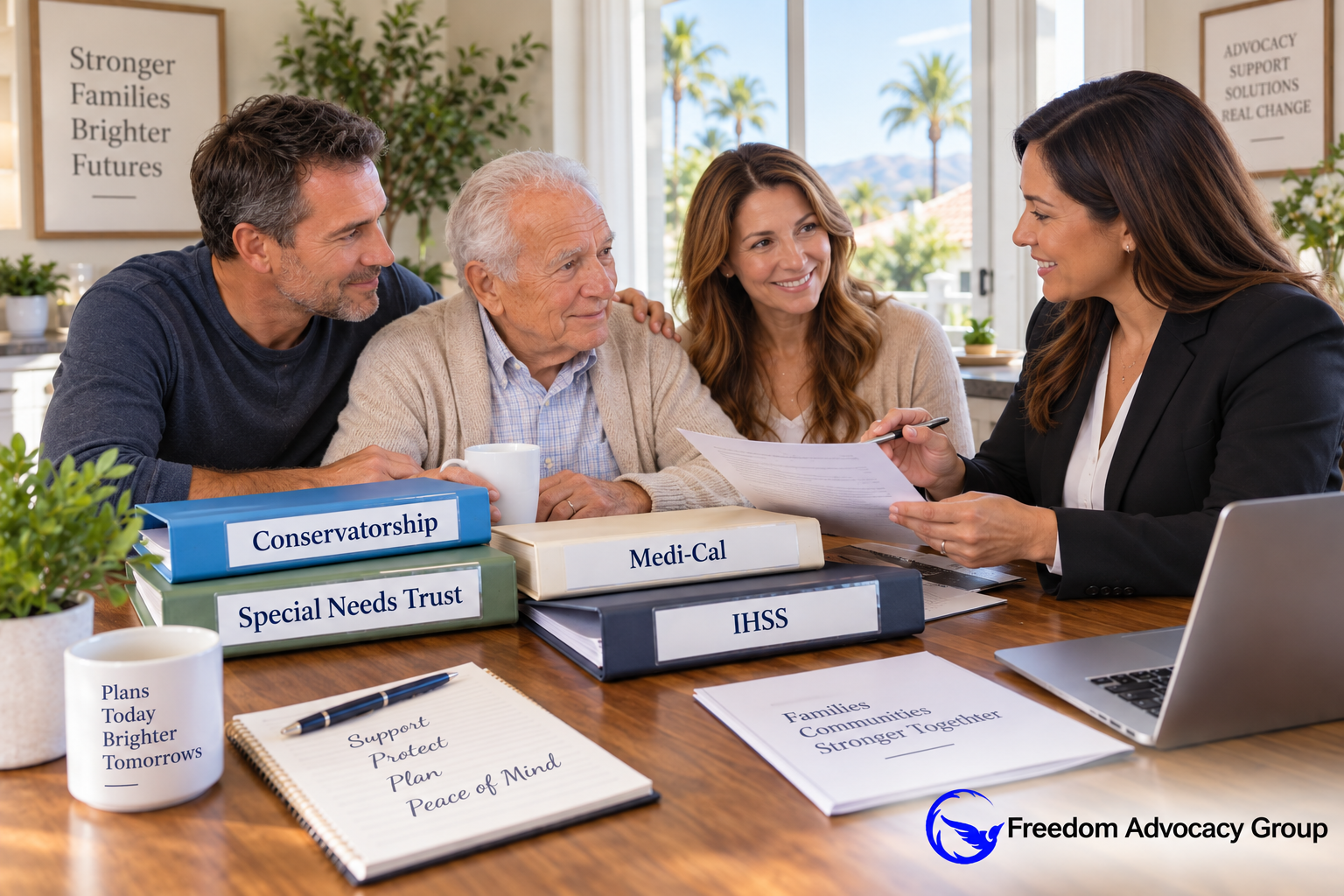
Conservatorship and Special Needs Trust: Protecting a Loved One in California
When a loved one has a developmental disability, cognitive impairment, dementia, or another condition that affects their ability to make important decisions independently, families can suddenly find themselves navigating several complicated systems at the same time.
Who can make medical decisions?
Who can manage money and property?
What happens when a child with a disability becomes an adult?
How can an inheritance or settlement be protected?
Could receiving money jeopardize Medi-Cal, Supplemental Security Income (SSI), or other means-tested government benefits?
Who will advocate for a loved one if their parents or primary caregivers are no longer able to do so?
A Conservatorship and Special Needs Trust can address different parts of these concerns. Although the two are frequently discussed together, they serve very different purposes.
A conservatorship primarily addresses legal authority and decision-making for an adult who cannot adequately manage certain personal or financial matters.
A Special Needs Trust, often abbreviated as SNT, primarily addresses how assets are held and managed for a person with a disability, including situations where maintaining eligibility for means-tested public benefits is important.
For some California families, one of these planning tools may be appropriate. For others, both may become part of a larger care and financial plan.
The first step is understanding exactly what each one does—and what it does not do.
Families can also explore Freedom Advocacy Group’s California IHSS advocacy and family resources when a loved one’s long-term plan includes In-Home Supportive Services.
Freedom Advocacy Group is here to help. You can easily book an appointment online or call 714-248-3871 today.
What Is a Conservatorship in California?
A conservatorship is a California court proceeding in which a judge appoints a responsible person or organization, called the conservator, to make certain decisions for another adult, called the conservatee.
Conservatorship can become an issue when an adult cannot adequately care for personal needs, manage finances, or make certain important decisions independently.
California treats conservatorship as a serious legal intervention because it can affect fundamental rights. Courts may consider whether less restrictive alternatives can adequately meet the person’s needs before granting a conservatorship.
Families considering this process should review the official California Courts Conservatorship Guide and obtain appropriate legal advice regarding their individual circumstances.
Probate Conservatorship
A probate conservatorship is commonly considered when an adult cannot properly provide for personal needs or manage financial resources.
This may occur because of:
- Dementia or significant cognitive decline
- Serious illness
- Traumatic injury
- Significant impairment in decision-making
- Inability to manage personal care
- Inability to manage finances
- Vulnerability to financial exploitation or undue influence
A probate conservatorship can involve two primary areas.
Conservatorship of the Person
A Conservatorship of the Person generally concerns decisions involving the conservatee’s personal care and well-being.
Depending on the authority granted by the court, this can involve matters related to living arrangements, health care, food, clothing, personal care, and other daily needs.
Conservatorship of the Estate
A Conservatorship of the Estate concerns financial affairs.
The conservator may be responsible for managing income, property, bills, financial accounts, and other assets subject to the court’s orders and California conservatorship requirements.
In some situations, a person may need both a conservatorship of the person and a conservatorship of the estate.
Families caring for an older adult with significant cognitive decline should also understand that conservatorship and IHSS are separate systems.
If remaining safely at home requires substantial assistance with activities of daily living, families can learn more about how to prepare for an IHSS assessment.
Limited Conservatorship for Adults With Developmental Disabilities
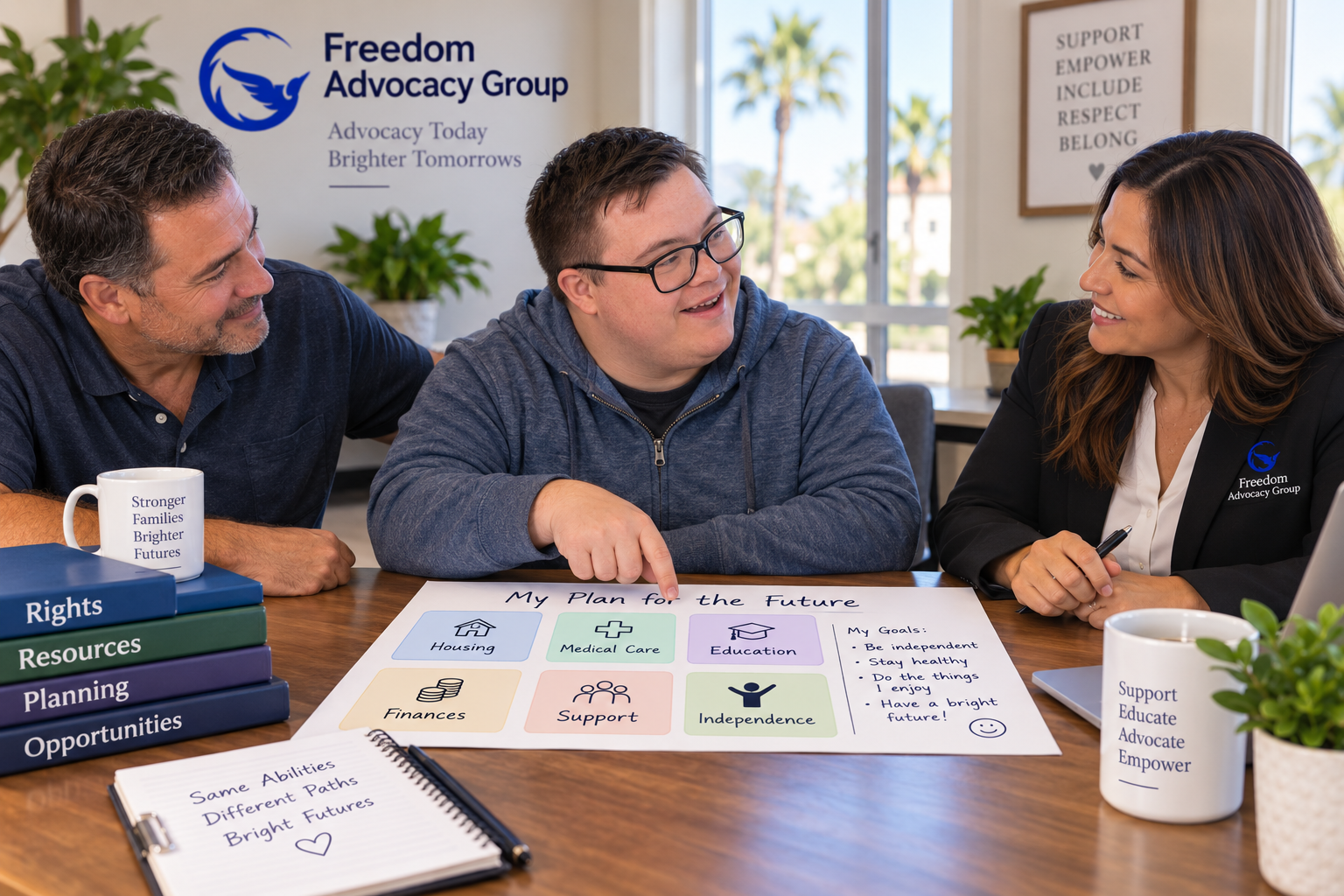
A limited conservatorship is specifically designed for certain adults with developmental disabilities.
The word limited is important.
The objective is not to automatically transfer complete control over the individual’s life to someone else. Instead, the conservatee should retain as much independence and decision-making authority as possible while the conservator receives only the powers the court determines are necessary.
Depending on the circumstances and the court’s order, a limited conservatorship may address specific decisions involving areas such as residence, medical care, education, contracts, access to records, marriage, and social relationships.
California families considering this option should review the California Courts information on Limited Conservatorships.
Less restrictive alternatives should also be considered when they can adequately protect the adult.
Depending upon the individual’s abilities and circumstances, alternatives can include supported decision-making, powers of attorney, advance health care directives, representative payee arrangements, trusts, or other forms of assistance.
The appropriate solution depends on the individual—not simply the diagnosis.
What Is an LPS Conservatorship?
An LPS Conservatorship is different from an ordinary probate conservatorship.
LPS refers to California’s Lanterman-Petris-Short Act.
This form of conservatorship is associated with individuals who meet specific California requirements involving grave disability resulting from qualifying mental health conditions.
LPS conservatorships operate through California’s mental health system rather than following the same process as ordinary probate conservatorships.
A family member cannot simply file an ordinary probate petition and convert it into an LPS conservatorship. Different procedures and legal standards apply.
Families should therefore avoid assuming that an LPS conservatorship, limited conservatorship, and probate conservatorship are interchangeable.
What Is a Special Needs Trust in California?
A Special Needs Trust is a legal arrangement used to hold and manage assets for a person with a disability.
When properly established and administered, certain Special Needs Trusts can allow assets to be available for the beneficiary while helping preserve eligibility for means-tested public benefits.
This can be particularly important for someone receiving Medi-Cal or Supplemental Security Income (SSI).
Families should review the official California Department of Health Care Services Special Needs Trust information when considering how an SNT may interact with Medi-Cal.
The Social Security Administration’s information about trusts and SSI is also an important resource for families concerned about Supplemental Security Income.
Special-needs planning may become especially important when a person with a disability receives:
- An inheritance
- A personal injury settlement
- Lawsuit proceeds
- Family gifts
- Life insurance proceeds
- Other substantial assets
Simply transferring a large inheritance or settlement directly to someone receiving means-tested benefits can create eligibility issues.
That is why planning should ideally occur before the assets are distributed.
First-Party Special Needs Trust
A First-Party Special Needs Trust is funded with assets that belong to the person with a disability or assets to which that individual is legally entitled.
For example, an individual may receive a substantial personal injury settlement.
Another situation may involve an inheritance that was left directly to the person rather than being placed into an appropriate third-party trust beforehand.
First-party Special Needs Trusts are governed by detailed legal and public-benefit rules.
One of the most important considerations is the potential requirement to reimburse the state for certain Medi-Cal benefits from remaining trust assets after the beneficiary’s death.
Because mistakes can have serious financial and benefit consequences, families should speak with a qualified California special-needs or estate-planning attorney before transferring significant assets.
Third-Party Special Needs Trust
A Third-Party Special Needs Trust is funded with assets belonging to someone other than the beneficiary.
Parents and grandparents frequently consider these trusts as part of long-term planning for a family member with a disability.
For example, parents may want their adult child to benefit from an inheritance without leaving assets directly to the child in a way that could interfere with means-tested public benefits.
A properly structured third-party SNT can allow assets to be managed for the beneficiary while also allowing the person creating the trust to specify what happens to remaining assets after the beneficiary’s death.
Third-party trusts are particularly important to consider before parents, grandparents, or other relatives make large gifts or prepare estate plans.
Pooled Special Needs Trust
A Pooled Special Needs Trust is administered by a nonprofit organization.
Rather than every beneficiary having an entirely separate investment structure, the nonprofit pools funds for investment and administrative purposes while maintaining separate subaccounts for individual beneficiaries.
Depending on the person’s circumstances, a pooled trust may offer another option for special-needs planning.
However, families should carefully review the specific trust’s terms, administrative fees, distribution policies, retained-fund provisions, and any applicable Medi-Cal recovery requirements before proceeding.

Conservatorship vs. Special Needs Trust: What’s the Difference?
This is one of the most important distinctions for families to understand.
A conservatorship primarily concerns legal decision-making authority.
A Special Needs Trust primarily concerns assets and financial management.
An easy way to remember the difference is:
Conservatorship = decision-making and protection.
Special Needs Trust = asset management and benefits planning.
A Special Needs Trust does not automatically authorize a trustee to make every medical, residential, educational, or personal decision for the beneficiary.
Likewise, being appointed conservator does not automatically establish a Special Needs Trust or guarantee that an inheritance will not affect public benefits.
Depending on the person’s needs, both systems can sometimes be part of a larger plan.
Example: An Adult With a Developmental Disability
Consider an adult with a developmental disability who receives Medi-Cal, SSI, and IHSS.
The person can make some decisions independently but requires substantial assistance with others.
A limited conservatorship or less restrictive alternative may be considered for particular decisions.
Now suppose the same individual receives a substantial inheritance.
The inheritance creates a different issue.
A Special Needs Trust or another appropriate benefits-planning strategy may need to be considered to determine how those assets can be managed.
The conservatorship addresses decision-making.
The trust addresses assets.
Meanwhile, IHSS addresses qualifying in-home care needs.
Understanding those differences helps families avoid treating one program or legal arrangement as though it automatically solves every problem.
How Conservatorship and a Special Needs Trust Can Work Together
These issues frequently arise during major family transitions.
Parents may spend decades helping a child with a disability with nearly every aspect of daily life.
When that child reaches adulthood, however, the legal relationship changes.
Parents may begin asking:
Who will make important decisions if my child cannot?
Who will manage the money I leave behind?
Will an inheritance interfere with Medi-Cal or SSI?
Who will advocate for my loved one when I am gone?
How will they receive the care necessary to remain safely at home?
A comprehensive plan can involve several different systems.
A conservatorship or less restrictive alternative may address decision-making.
A Special Needs Trust may address financial assets.
SSI may provide qualifying income assistance.
Medi-Cal may provide health coverage and access to other programs.
Regional Center services may assist qualifying Californians with developmental disabilities.
And IHSS may provide qualifying in-home services that help an individual remain safely in their own home.
Families can learn more about California’s program through the California Department of Social Services IHSS information.
How Does Conservatorship Affect IHSS?
Having a conservatorship does not automatically qualify someone for IHSS.
It also does not automatically determine how many IHSS hours the person receives.
IHSS eligibility and authorized services are evaluated separately according to the individual’s circumstances and qualifying functional needs.
Depending on eligibility, IHSS can potentially authorize assistance with areas such as:
- Bathing and grooming
- Dressing
- Toileting
- Meal preparation
- Feeding
- Mobility
- Domestic services
- Accompaniment to qualifying appointments
- Other authorized personal-care needs
The important issue is not simply the person’s diagnosis.
The county needs to understand what the person can and cannot safely do and how much assistance is actually required.
That makes the county assessment extremely important.
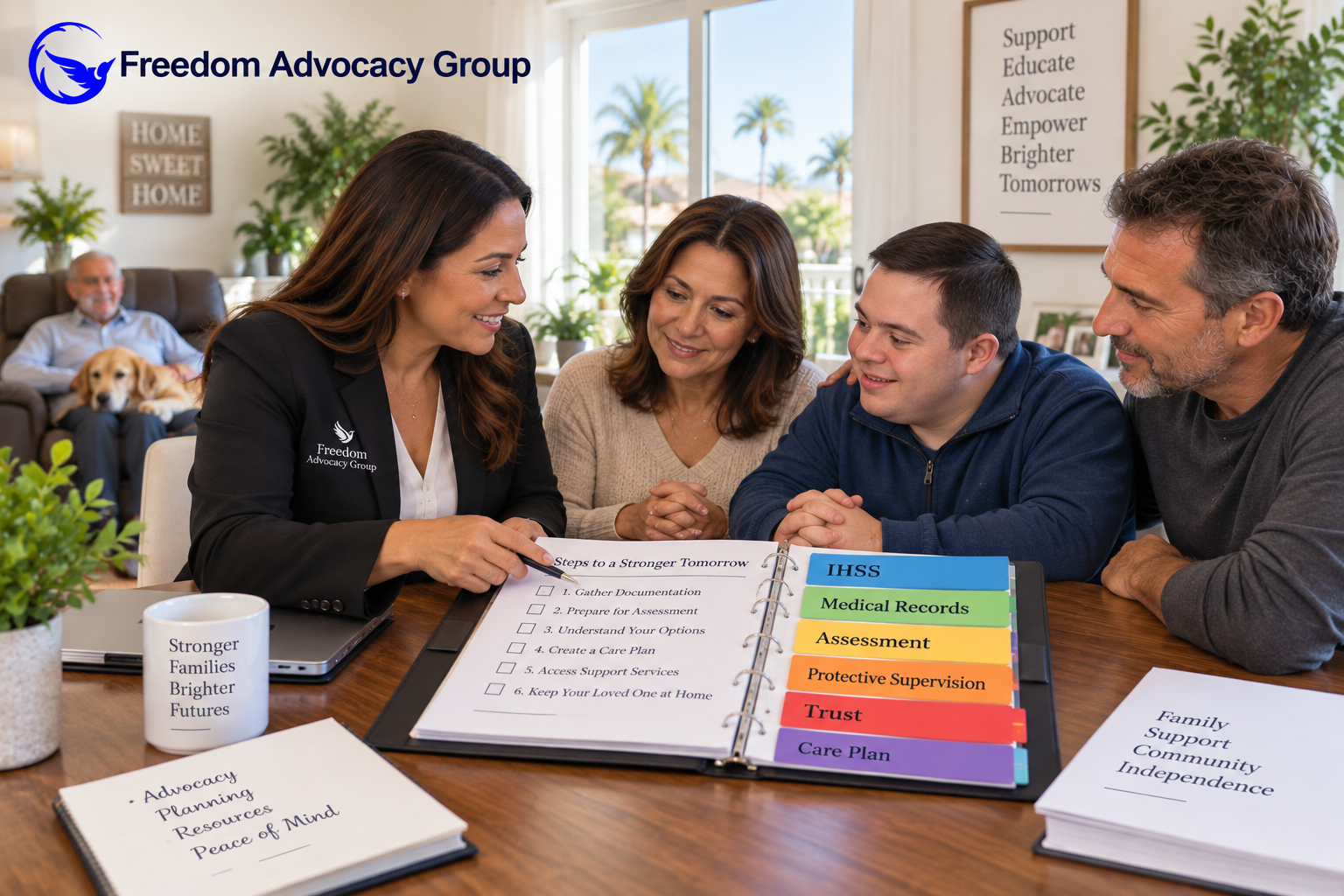
Freedom Advocacy Group helps families prepare for an IHSS assessment so that important functional limitations are clearly documented and explained.
Conservatorship, Cognitive Impairment and Protective Supervision
Some individuals with developmental disabilities, dementia, brain injuries, or other cognitive impairments may also engage in dangerous behavior because they are unable to recognize or evaluate hazards appropriately.
In qualifying situations, IHSS Protective Supervision may become an important part of the person’s care plan.
Protective Supervision is not simply ordinary companionship, general monitoring, or supervision because someone has a diagnosis.
Eligibility involves specific IHSS requirements, including issues involving mental impairment, non-self-direction, and the need for supervision to prevent injury.
Families dealing with these behaviors should learn more about IHSS Protective Supervision.
Documentation can become especially important in these cases.
Documentation Matters
Whether a family is dealing with conservatorship, a Special Needs Trust, IHSS, Protective Supervision, or another disability-related program, documentation matters.
Depending on the issue, important records can include:
- Medical records
- Physician statements
- Psychological evaluations
- Developmental assessments
- Regional Center records
- School and IEP records
- Therapy records
- Medication records
- Hospital records
- IHSS Notices of Action
- County assessment information
- Safety and behavior logs
- Caregiver statements
- Financial records
- Trust documents
- Records describing functional limitations
Families should not wait for a denial, emergency, or legal dispute before beginning to organize important documentation.
For IHSS purposes, records should help explain the recipient’s actual day-to-day needs.
What assistance is necessary?
How often is it necessary?
Why can’t the recipient safely perform the activity independently?
What happens when appropriate assistance or supervision is unavailable?
Those details can often be more informative than a diagnosis by itself.
When IHSS and Conservatorship Documentation Overlap
IHSS and conservatorship have different legal standards, but some of the evidence used to describe the person’s condition may overlap.
Consider an adult with significant dementia.
Medical records may show cognitive decline.
Caregiver records may document that the person forgets medications, leaves appliances on, wanders from home, attempts unsafe activities, becomes disoriented, or cannot reliably recognize hazards.
Those facts may be relevant in different ways to different systems.
For IHSS, the focus should remain on the recipient’s actual qualifying functional and supervision needs.
Freedom Advocacy Group helps families understand how to document those needs and prepare for the IHSS assessment process.
What if IHSS Denies Services or Approves Too Few Hours?
Even families with substantial medical documentation can receive an IHSS decision they believe does not accurately reflect their loved one’s needs.
The county might:
- Deny an application
- Deny Protective Supervision
- Approve fewer hours than expected
- Reduce previously authorized services
- Disagree about the amount of assistance required
When this occurs, families may have appeal rights.
Freedom Advocacy Group helps Southern California families understand and prepare for the IHSS appeals process.
A strong IHSS case generally requires more than showing that the recipient has a serious diagnosis.
The evidence should connect the person’s condition to their actual functional limitations and qualifying care needs.
Families can also visit the Freedom Advocacy Group IHSS News Center for additional California IHSS articles, updates, and practical guidance.
How Freedom Advocacy Group Can Help
Families caring for a person with a disability or significant cognitive impairment rarely deal with just one system.
There may be:
IHSS.
Medi-Cal.
SSI.
Regional Center services.
Medical providers.
School services.
Estate planning.
Special Needs Trusts.
Conservatorship.
And each system can have different eligibility requirements, forms, evidence, deadlines, and appeal procedures.
Freedom Advocacy Group focuses on helping families understand and navigate IHSS.
We can help families with issues involving:
- IHSS applications
- IHSS assessments
- Preparing for county home visits
- Documenting functional limitations
- Protective Supervision
- Safety and behavioral documentation
- IHSS Notices of Action
- IHSS denials
- IHSS appeals
- Changes in care needs
- Ongoing IHSS advocacy and preparation
If a conservatorship or Special Needs Trust is needed, families should work with an appropriately qualified California attorney regarding those legal matters.
Freedom Advocacy Group can help you address the IHSS side of the care plan and better document the daily needs that affect your loved one’s ability to remain safely at home.
Explore Freedom Advocacy Group’s IHSS advocacy services or contact Freedom Advocacy Group to discuss your situation.
Special Education Due Process Representation
Families of children and young adults with disabilities can also encounter disputes involving special education.
A special education due process hearing is a formal administrative proceeding used to resolve certain disputes between parents and school districts.
These cases arise under the federal Individuals with Disabilities Education Act (IDEA).
Families can review the federal government’s official IDEA information for more information about special education rights and requirements.
Disputes can involve:
- Special education eligibility
- Assessments and evaluations
- Educational placement
- Related services
- Specialized instruction
- Accommodations
- Whether the student is receiving a Free Appropriate Public Education (FAPE)
California special education due process matters are administered through the state’s Office of Administrative Hearings Special Education Division.
A due process case can involve formal filings, deadlines, evidence, witnesses, mediation, resolution procedures, and ultimately a hearing before an Administrative Law Judge if the dispute is not resolved.
Special education due process is separate from conservatorship, Special Needs Trust planning, and IHSS.
Families navigating several systems simultaneously should be careful to identify which laws, deadlines, agencies, and evidentiary requirements apply to each issue.
Frequently Asked Questions
What is the difference between a conservatorship and a Special Needs Trust?
A conservatorship gives a court-appointed conservator specified authority to make decisions for an adult who cannot adequately make certain decisions independently. A Special Needs Trust holds and manages assets for a beneficiary with a disability and can help preserve eligibility for certain means-tested government benefits when properly established and administered.
Can someone have both a conservatorship and a Special Needs Trust?
Yes. The two serve different purposes and can exist together. A conservatorship can address decision-making authority, while a Special Needs Trust addresses how particular assets are held and managed.
Does having a Special Needs Trust mean a conservatorship is unnecessary?
Not necessarily. A trust primarily deals with assets. It does not automatically give a trustee authority over medical, residential, educational, or other personal decisions.
Does a conservatorship automatically protect Medi-Cal and SSI?
No. Conservatorship and public-benefit eligibility are separate issues. Families concerned about assets and benefits should obtain appropriate legal and benefits-planning advice.
What is a First-Party Special Needs Trust?
A first-party SNT is funded with assets belonging to or legally owed to the beneficiary with a disability. These trusts are subject to specific requirements and can include Medi-Cal repayment obligations.
What is a Third-Party Special Needs Trust?
A third-party SNT is funded with assets belonging to someone other than the beneficiary, commonly a parent or grandparent. These trusts are often used as part of long-term estate planning for a family member with a disability.
What is a Pooled Special Needs Trust?
A pooled trust is administered by a nonprofit organization. Individual beneficiary accounts are maintained while funds are pooled for investment and management purposes.
Is a limited conservatorship the same as a probate conservatorship?
A limited conservatorship is specifically designed for certain adults with developmental disabilities and is intended to preserve as much independence as possible while granting only necessary powers to the conservator.
Families can review official California Courts information about Limited Conservatorships.
Can a parent automatically continue making decisions for a child after the child turns 18?
Not automatically in the same way as when the child was a minor. Depending on the adult’s capacity and needs, families may consider supported decision-making, powers of attorney, advance health care directives, representative-payee arrangements, limited conservatorship, or other appropriate options.
Does conservatorship automatically qualify someone for IHSS?
No. IHSS has its own eligibility requirements and assessment process. Conservatorship status alone does not establish IHSS eligibility or determine the number of authorized hours.
Can someone with dementia qualify for IHSS Protective Supervision?
Potentially. Eligibility depends on whether the person meets the specific IHSS requirements, including requirements involving mental impairment, non-self-direction, and the need for supervision to prevent injury.
A dementia diagnosis alone does not automatically establish eligibility.
Learn more about IHSS Protective Supervision.
What should a family do before a person with a disability receives an inheritance or settlement?
Whenever possible, obtain advice from a qualified California Special Needs Trust or estate-planning attorney before the assets are distributed. The way assets are received and held can affect eligibility for means-tested government programs.
Families should also review the California DHCS Special Needs Trust information and, when SSI is involved, the Social Security Administration’s trust guidance.
Can Freedom Advocacy Group help with IHSS?
Yes. Freedom Advocacy Group helps Southern California families navigate IHSS applications, assessments, documentation, Protective Supervision, denials, appeals, and related IHSS challenges.
Protect Your Loved One’s Care, Benefits and Future
When a loved one has a developmental disability, dementia, cognitive impairment, or another significant disability, families often have to plan for both today and the future.
You want your loved one protected.
You want them to maintain as much independence and dignity as possible.
You want necessary care to remain available.
You want financial resources managed responsibly.
And you do not want a paperwork mistake or misunderstanding to jeopardize important services or benefits.
Understanding the difference between Conservatorship and Special Needs Trust planning is an important part of that process.
Just as important is making sure your loved one’s day-to-day care needs are accurately documented when applying for or maintaining IHSS.
Freedom Advocacy Group is here to help families navigate the IHSS process with greater clarity, organization, and confidence.
Visit the Freedom Advocacy Group IHSS News Center for additional California IHSS information, learn more about IHSS assessments, explore help with IHSS appeals, or contact Freedom Advocacy Group to discuss your family’s situation.
Freedom Advocacy Group is here to help. You can easily book an appointment online or call 714-248-3871 today.